
Instead of manually reconciling flight quotes, passenger details and confirmation emails, use a business class booking workflow that moves each approved itinerary from request to e-ticket through clear checks. With Global Business Flights, you work with a dedicated travel consultant rather than a self-service booking engine; this guide explains what to prepare, approve and verify for your 2026 journey.
- Global Business Flights suits travelers who want a consultant-led business class booking workflow, from personal quote to e-ticket.
- Approve the itinerary, passenger details and fare conditions before authorizing ticketing.
- A booking reference identifies a reservation; verify that each traveler also receives an e-ticket number.
- For corporate travel, separate internal approval from authorization to issue tickets.
Why this matters
A comfortable flight starts with an accurate booking. The right cabin matters, but so do the travel dates, connection points, passenger names and conditions attached to the fare.
Global Business Flights is best for leisure and corporate travelers who want consultant-led business class booking. The agency arranges business and first class tickets, including flexible fares and multi-passenger bookings, with support from quote to e-ticket.
Personal service does not remove your approval responsibilities. You still need to confirm that the proposed itinerary fits your plans and that the fare conditions match the flexibility you need.
For 2026 travel, keep the current itinerary, written conditions and final ticket documents together. That makes your decisions easier to trace when several versions of a quote arrive.
Before you start
- Prepare your trip brief. Include departure and destination airports, travel dates, passenger count, preferred cabin and any flexibility. Add connection preferences, accessibility needs and corporate approval requirements where relevant.
- Have accurate passenger information ready. Use names as shown on the travel documents required for the journey. Provide personal information through the method your consultant specifies, and keep payment information out of general email threads.
- Understand the ticketing distinction. A quote is not an issued ticket, and a booking reference alone does not establish that ticketing is complete. Ask what must happen before issuance and whether the proposal has a stated ticketing deadline.
You do not need an automation account or software integration for this workflow. You need a clear trip brief, access to your consultant and someone authorized to approve the booking.
Your trip brief
Start the business class booking workflow with one written request. Separate requirements from preferences so your consultant knows what cannot change and where an alternative routing would work.
- Define the journey. State the origin, destination and travel dates. Write out month names to avoid confusion between date formats. Specify whether each date refers to departure or arrival, particularly for overnight flights.
- Define the comfort requirements. Identify the cabin you want on each flight, acceptable connection points and any seating requirements. If a lie-flat seat matters, ask for confirmation for the proposed segment rather than assuming every business class flight has one.
- Define the decision process. Name the person who will approve the itinerary and the person authorized to arrange payment. For a leisure booking, these can be the same person; for a company booking, keep their responsibilities explicit.
A practical request includes 3 decision inputs: route, dates and flexibility. Add your preferences beneath those essentials rather than burying the route inside a long message.
Expected result: Your consultant can distinguish an acceptable itinerary from one that fails a requirement, without asking you to repeat the basic brief.
A request you can adapt
Use short headings in your message: Trip, Travelers, Cabin, Flexibility and Approval. These are suggested message headings, not website fields.
Under Flexibility, explain whether you can change departure days, airports or connection points. Under Approval, state who needs to review the proposal before you authorize ticketing. Leave out details that do not affect the journey.
Your fare review
Review the proposed itinerary as a complete journey, not simply as a cabin name. A suitable long-haul flight can still come with a connection or short-haul segment that does not meet your needs.
- Check every flight segment. Confirm airports, local departure and arrival dates, connection points and the cabin shown for each segment. Pay attention to airport changes and arrivals on a different calendar day.
- Request the applicable conditions. Ask for the change, cancellation, refund and baggage conditions attached to the actual proposal. Request clarification when a description such as flexible does not explain what you can change or what restrictions apply.
- Record your decision against one version. Identify the itinerary you are approving by its route, dates and the consultant's reference, if supplied. State any unresolved questions before giving authorization.
For a 2026 itinerary, make sure the year appears in the written travel dates. This is especially helpful when planning a seasonal trip well ahead of departure.
Expected result: You have one selected proposal with understood conditions, not several partly approved alternatives.
Keep the accepted version intact. If you request a different departure day afterward, treat the revised itinerary as a new proposal requiring review rather than carrying your earlier approval across automatically.
Passenger details and authorization
Before ticketing, bring the traveler information and the selected itinerary together. This is the point to catch a mismatch, not to assume it will be easy to correct later.
- Verify passenger details. Check spelling against the required travel documents. Confirm any additional information requested for the journey through your consultant's specified channel; do not send a passport copy unless it is requested and the transfer method is appropriate.
- Complete the approval check. Confirm the selected itinerary, the applicable conditions and the approved passenger details. For companies, record the internal approver before asking the consultant to proceed.
- Authorize the agreed booking. Follow the payment and authorization instructions provided for your booking. If anything in the itinerary changes before issuance, review that change before confirming again.
Use 2 distinct approvals: itinerary approval and ticketing authorization. They can happen in the same conversation, but their meaning should remain separate. Liking a proposed flight is not the same as instructing someone to issue the ticket.
Expected result: Your consultant has a clear instruction tied to the correct travelers and the accepted itinerary.
E-ticket verification
The workflow ends with verified travel documents, not with the message saying your request has been received. Read the issued itinerary and e-ticket receipt while the details are fresh.
- Locate the ticket details. Find the e-ticket number for each traveler. Keep the booking reference too; the reservation reference and ticket number serve different purposes.
- Match the issued journey. Compare passenger names, airports, dates, flight segments and cabins with the version you approved. Ask the consultant to explain any discrepancy rather than assuming a different display means the same booking.
- Save the final documents. Keep the issued itinerary and e-ticket receipt together, and share the relevant documents with each traveler through an appropriate channel. Retain your consultant's contact details for follow-up questions.
Expected result: Every traveler has the correct issued ticket details and understands the journey they are taking.
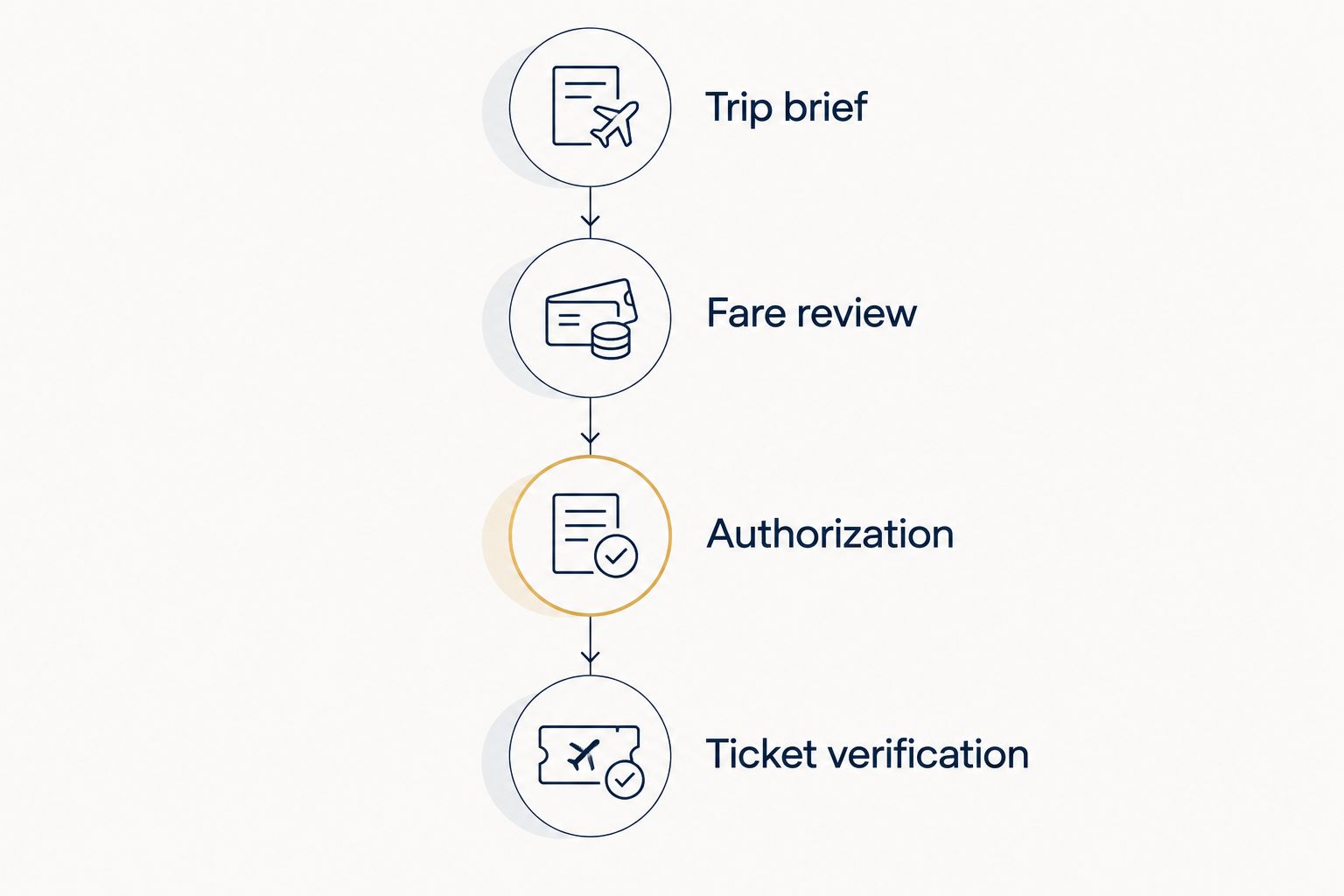
For this 2026 workflow, use the same sequence each time: Trip brief, Fare review, Authorization, Ticket verification. The sequence keeps a preliminary quote from being mistaken for completed travel arrangements.
When plans change or several travelers need approval
The same workflow works for a revised itinerary. Start again at the point affected by the change instead of assuming earlier checks still cover the new journey.
For example, changing the departure day requires another itinerary review. Adding a passenger requires a separate passenger-information check. Changing a connection calls for another review of the complete routing and the conditions of the revised proposal.
Corporate and multi-passenger bookings
For a company trip, keep traveler preferences separate from company authorization. A traveler can confirm a suitable schedule while a manager or travel coordinator handles approval.
Maintain a passenger list with a clear approval status for each person. Do not treat one traveler's confirmation as approval for the whole group. If travelers need different return dates, identify those differences in the initial brief.
Global Business Flights supports multi-passenger bookings and managed corporate travel accounts. Best for corporate coordinators: use one clearly identified coordinator to consolidate instructions, while asking each traveler to verify their own personal details.
Connected journeys and separate tickets
For a connecting trip, deciding between one ticket or separate bookings affects how you assess disruption handling, baggage arrangements and onward connections. Confirm the ticket structure before approving the itinerary; a single email containing several flights does not establish that all flights are on one ticket.
| Ticket structure | Best for | Advantage | Limitation to check |
|---|---|---|---|
| One through-ticket | Travelers prioritizing a connected itinerary | Connections form part of the same ticketed journey | Baggage arrangements and disruption handling still require confirmation |
| Separate tickets | Travelers whose chosen journey requires independently booked portions | Each portion can be arranged independently | A delay on one ticket does not automatically protect the onward booking |
Neither structure replaces a connection review. Ask who handles a disrupted journey, whether baggage must be collected and rechecked, and what happens if you miss the onward flight. Get answers for the actual proposal rather than relying on a general rule.
Troubleshooting
You have a booking reference but no e-ticket number
Ask your consultant whether ticketing is complete and request the e-ticket receipt. Do not treat the reservation reference as proof of issuance. If a ticketing deadline was provided, clarify the status against that deadline.
The cabin differs between flight segments
Ask for the cabin on each segment to be identified clearly. Decide whether the complete itinerary meets your needs before authorizing issuance. Business class on one segment does not establish the cabin on the rest of the journey.
A passenger name does not match the travel document
Contact your consultant promptly and identify the discrepancy. Ask for the correction procedure before making another booking. Name corrections and passenger substitutions are different requests, and the applicable airline rules matter.
A revised proposal arrives after approval
Compare the revised itinerary with the approved version. Recheck dates, routing, cabins and conditions, then give a fresh instruction. Do not let approval of an earlier version stand in for approval of a changed journey.
Customize your workflow
Use a shorter process for a straightforward solo trip and a more explicit approval record for company or group travel. Keep the same final checks in both cases: passenger details, accepted itinerary and issued ticket information.
For recurring travel in 2026, retain a reusable trip-brief template, but verify the details for every journey. A previous preference is a starting point, not permission to repeat an old itinerary.
When you are ready, request your personal quote with your route, dates and cabin preferences. Include the flexibility and approval requirements that will shape the booking.
FAQ
What is a business class booking workflow?
A business class booking workflow is the sequence from trip request and fare review to passenger verification, authorization and e-ticket checks. It keeps a proposed itinerary separate from an approved and issued booking.
Is Global Business Flights a self-service booking website?
Global Business Flights is a travel agency that works through phone and online quote requests with a dedicated travel consultant. Its service covers business and first class arrangements from quote to e-ticket.
Does a booking reference mean my flight is ticketed?
A booking reference alone does not establish that your flight is ticketed. Ask for the e-ticket receipt and verify the ticket number for each traveler.
What should I send when requesting a business class quote?
Send your route, travel dates, passenger count, preferred cabin and flexibility. Add connection preferences and any company approval requirements so the proposal reflects the actual journey you need.
Can I change the itinerary after approving a quote?
You can request a revised itinerary, but the revised proposal needs another review before authorization. If tickets have already been issued, ask your consultant to explain the conditions that apply to the requested change.
How do I check a business class booking for several passengers?
Verify passenger details and ticket information for each traveler separately. Keep a shared itinerary review, but do not assume one person's confirmation approves everyone else's details.
Should connecting flights be on one ticket?
Choose the ticket structure after reviewing connection handling and the conditions of the proposed journey. Separate tickets require particular attention because disruption to one booking does not automatically protect an onward booking.
One last thing
Finish your review by reading the journey backward. Start with the arrival airport and date, then check the connection and departure. This gives the arrival you actually need its own check, rather than letting a familiar departure time dominate the decision.