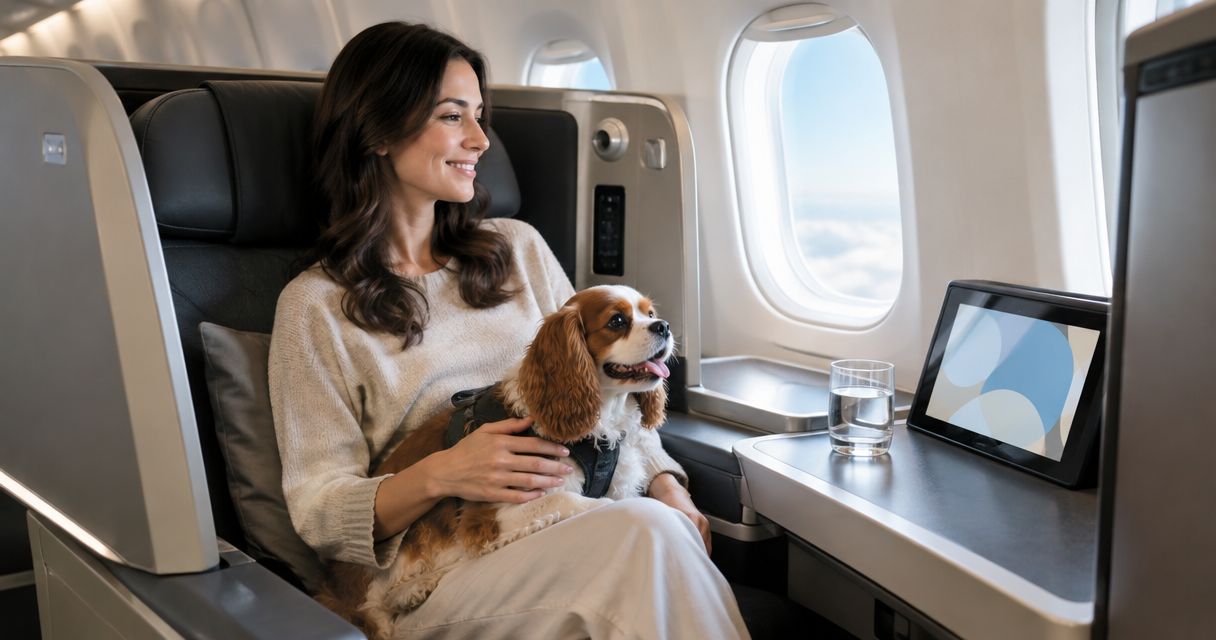
Yes, pets can travel in the cabin on some business class flights, but permission depends on the operating airline, aircraft, route, and pet policy—not simply the cabin you book. Your pet generally must remain in an approved carrier in the designated space, and some business class seats cannot accommodate one.
- Can pets travel in cabin business class? Yes, where the airline permits pets in that specific cabin and aircraft.
- A business class ticket does not, by itself, authorize a pet in the cabin.
- Confirm carrier requirements and pet acceptance on every flight before committing to your itinerary.
- U.S. Department of Transportation service-animal rules distinguish trained service dogs from pets.
Can pets travel in the cabin on business class flights?
Yes, but you need approval for the exact flight and cabin. An airline that accepts pets elsewhere on its network does not necessarily accept them in every business class seat. Check the operating carrier’s current 2026 policy and request confirmation for your itinerary before ticketing.
If you want help arranging the premium ticket itself, you can discuss your itinerary. Keep the airline’s pet-acceptance process separate from the passenger booking.
| Flight arrangement | Best for | Advantage | Limitation to check |
|---|---|---|---|
| Business class with an approved carrier space | Travelers whose pet meets the airline’s cabin requirements | You and your accepted pet travel in the passenger cabin | The carrier must fit the approved space, not just the published baggage allowance |
| Lie-flat business class | Travelers prioritizing a bed-style seat | The seat supports rest on a longer journey | Its layout does not establish whether pets are permitted |
| Connecting business class itinerary | Travelers who need an onward connection | You can reach destinations without a nonstop service | Every operating airline and flight needs its own policy check |
These arrangements describe what to verify, not permission to bring a pet. Only the airline can confirm acceptance under its rules.
Why this matters
A business class seat gives you the passenger amenities attached to that booking. It does not automatically give your pet a place in the cabin, permission to leave a carrier, or entry into another country.
Treat your 2026 journey as 2 separate approval checks: airline acceptance and destination entry. Satisfying one does not satisfy the other. A suitable carrier cannot replace required health documents, and complete documents cannot override a cabin restriction.
The practical order is straightforward: establish whether your pet can travel on the proposed flights, then compare the passenger fare conditions. This keeps the pet’s requirements part of the original booking decision rather than an issue to resolve afterward.
Why pet acceptance varies
The useful question is not just whether an airline accepts pets. Ask whether it accepts your pet on your particular booking.
- Operating airline: A flight sold by one airline can be operated by another. Check the rules of the airline actually flying each segment.
- Aircraft and seat: The approved carrier space depends on the cabin layout. A seat map alone does not establish pet acceptance.
- Pet and carrier: Species, size, carrier construction, and the animal’s ability to fit comfortably matter under the airline’s policy.
- Route and border rules: Departure, transit, and arrival requirements can introduce separate restrictions and documentation.
- Flight-specific approval: A general pet policy is not confirmation that the airline has accepted your pet on a particular departure.
- Travel classification: Ordinary pets and qualifying trained service dogs follow different rules. Emotional support alone does not make an animal a trained service dog under U.S. air travel rules.
For a 2026 booking, use current official guidance rather than an older trip report. Another traveler’s experience can explain what to ask, but it cannot authorize your booking.
Does a lie-flat seat mean my pet has more room?
No. A larger passenger seat does not automatically create an approved place for a pet carrier. Storage, seat mechanisms, and the required carrier position remain subject to the airline’s cabin rules.
Choose an approved carrier location before choosing a preferred seat. Ask whether the exact business class seat accepts a carrier during taxi, takeoff, landing, and cruise. Do not assume that an empty footwell or a wide seat is suitable.
Lie-flat seating is best for travelers who value the bed-style passenger experience, but its benefit does not establish pet compatibility. Business class with an approved carrier space is best for travelers whose priority is keeping an eligible pet in the cabin; the limitation is that the pet still needs to meet every applicable requirement.
Ask what happens if the aircraft changes before departure. A reservation on the original aircraft does not explain how the airline will handle a replacement cabin with different seating.
How do I confirm my pet can travel?
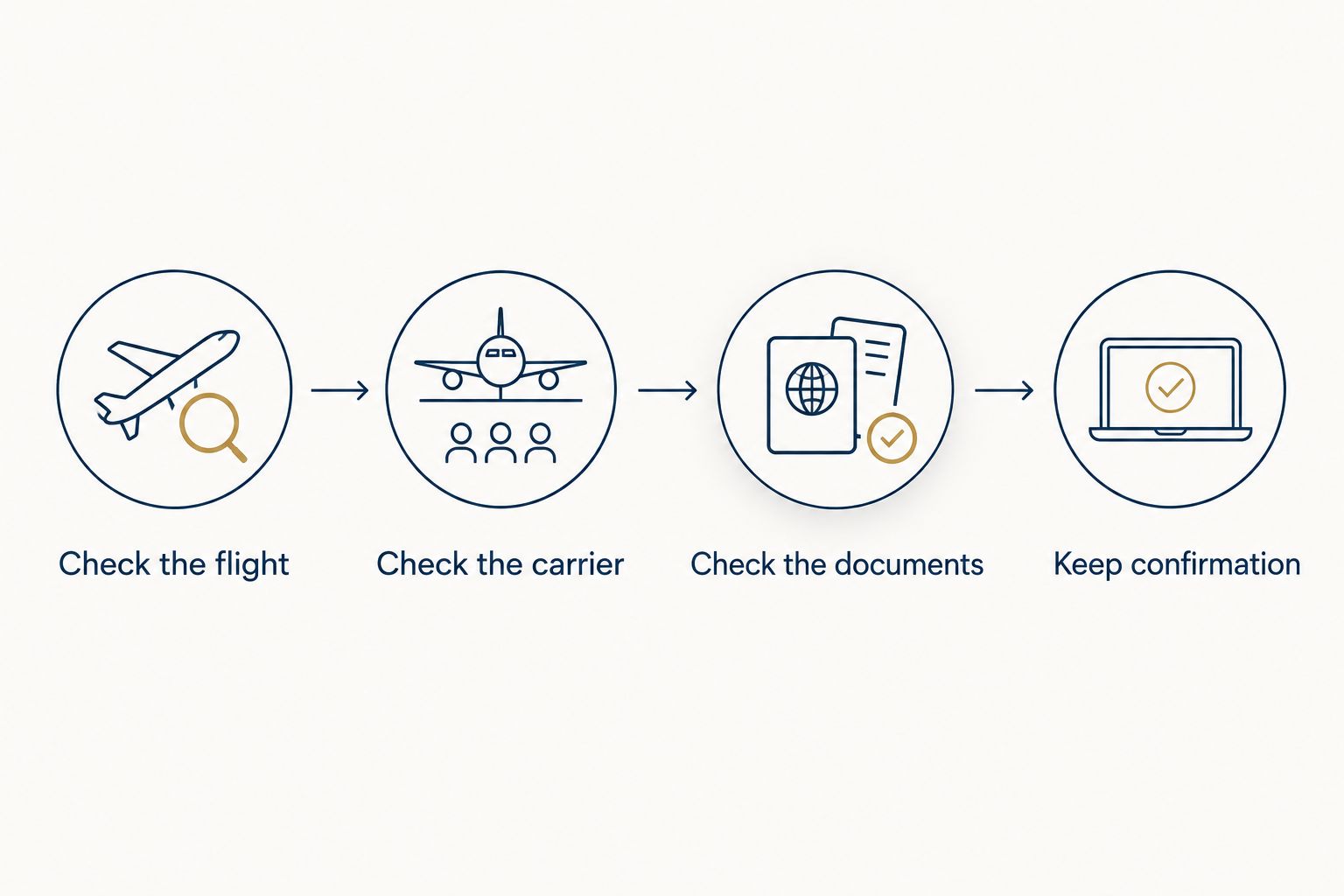
Use these 4 booking checks before committing to a premium itinerary. Keep the answers with your travel documents so you can refer to the actual terms rather than a general understanding.
- Check the flight. Identify the operating airline, route, aircraft, cabin, and connections. Ask whether an ordinary pet is permitted in that exact business class cabin.
- Check the carrier. Give the airline your pet’s species and size, together with the carrier’s external dimensions. Confirm the required carrier type and where it must remain.
- Check the documents. Review the official requirements for departure, transit, and arrival. Ask your veterinarian about health requirements and the timing of any necessary appointments.
- Keep confirmation. Obtain the airline’s confirmation of pet acceptance and its instructions for check-in. Review the passenger fare conditions before authorizing the ticket.
A booking confirmation for you is not necessarily a pet confirmation. Ask the airline to explain how the pet request is recorded and what evidence you should bring to the airport.
For a connecting itinerary, repeat the flight and carrier checks for each segment. Do not treat a successful answer for the longest flight as approval for the entire journey.
What should I ask about the carrier?
Start with the airline’s requirements, not a retailer’s description. A carrier advertised as airline-approved still needs to meet your operating airline’s rules for your particular cabin.
Ask about external dimensions, permitted construction, ventilation, closure requirements, and the designated position. Confirm whether measurements include wheels, handles, or other protruding parts. Give precise information rather than describing the carrier as small.
Your pet’s comfort also matters. Check that your pet can use the carrier in the way the airline requires, and discuss suitability for air travel with your veterinarian. Do not assume that a carrier fitting under a seat makes it appropriate for the animal inside.
During your 2026 planning, keep a copy of the policy used to assess the carrier. Recheck the requirements if the airline changes the aircraft or moves you to a different seat.
What changes on an international journey?
International travel adds border requirements to the airline’s cabin rules. The documents depend on the animal, origin, destination, transit points, and travel history.
Check official government guidance for every country involved. For travel into the United States with a dog, consult the Centers for Disease Control and Prevention’s current dog-import requirements; do not assume that rules for cats or another destination are the same.
A connection deserves its own review. Ask whether the transfer involves collecting the pet, clearing immigration, changing airports, or checking in again. Those details help determine which requirements apply.
Airline acceptance is not permission to enter a country. For a 2026 departure, confirm the applicable paperwork early enough to complete any required veterinary process, then check again before travel for changes.
Are service dogs treated the same as pets?
No. Under U.S. Department of Transportation air travel rules, a qualifying service animal is a dog individually trained to perform work or tasks for a person with a disability. Ordinary pets and animals whose role is emotional support do not receive that classification merely because they provide comfort.
For U.S.-covered travel, consult the Department of Transportation’s service-animal guidance and the operating airline’s submission requirements. International journeys also require a review of the rules applying elsewhere on the itinerary.
Do not use a pet request as a substitute for the service-animal process, or the reverse. Describe the animal accurately so the airline can apply the correct requirements.
Where does personal booking support help?
Globalbusinessflights is best for premium travelers who want a dedicated consultant rather than a self-service booking engine. The agency arranges business and first class tickets for leisure and corporate travelers, with support from quote to e-ticket.
Tell your consultant at the outset that you intend to travel with a pet. Share the proposed route, your date flexibility, and any airline-confirmed restrictions before comparing passenger fare options.
Globalbusinessflights offers personal booking support; the airline remains responsible for accepting the pet, and government authorities set entry requirements. That distinction matters: a consultant-assisted passenger booking is not a substitute for either approval.
When requesting a quote, explain whether your priority is a nonstop journey, a particular cabin, or flexible passenger fare conditions. Ask for the relevant ticket terms in writing, especially if your plans depend on a pet request that has not yet been confirmed.
Explore your fare options
Discuss your business or first class itinerary with a dedicated travel consultant.
FAQ
Can my dog sit on my lap in business class?
Do not assume your pet dog can sit on your lap in business class. Ordinary in-cabin pets generally must remain in the carrier and location specified by the airline; qualifying service dogs follow a separate process.
Can I buy a business class seat for my pet?
Buying a passenger seat does not by itself authorize a pet to occupy it. Ask the operating airline whether it offers any applicable arrangement and what restrictions apply before purchasing an additional seat.
Can cats travel in business class cabins?
Cats can travel in business class where the operating airline permits them on the specific flight and they meet its carrier and route requirements. Confirm acceptance for every segment rather than relying on the airline’s general pet policy.
Is business class better than economy for traveling with a pet?
Business class is not automatically better for traveling with a pet. The deciding factor is whether the cabin provides an airline-approved carrier location that works for your animal, not the passenger seat’s size or amenities.
What if my flight has a connection?
A connecting journey requires a pet-policy check for every operating airline and flight. Confirm carrier compatibility, transit requirements, and whether you must collect and recheck your pet during the connection.
Does an emotional support animal count as a service dog?
Emotional support alone does not qualify an animal as a service dog under U.S. Department of Transportation air travel rules. A qualifying service dog must be individually trained to perform work or tasks for a person with a disability.
Can Globalbusinessflights help me book a premium ticket?
Globalbusinessflights arranges business and first class tickets through a dedicated travel consultant. Explain your pet-related requirements when requesting a quote, and obtain the operating airline’s separate confirmation that your pet is accepted.
One last thing
Ask a final question before ticketing: What happens to the pet arrangement if the flight or aircraft changes? It is easy to focus on initial acceptance and overlook the conditions attached to a later change.
Keep your passenger ticket, pet confirmation, carrier requirements, and entry documents together. For your 2026 journey, that is a more useful preparation than relying on the words business class alone.