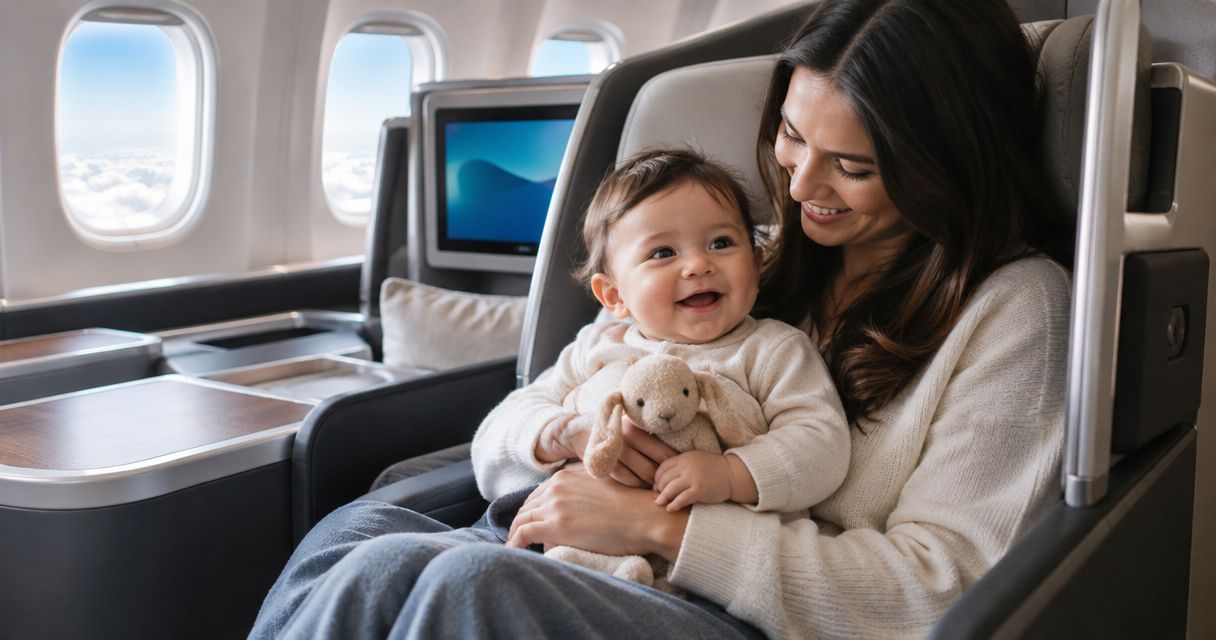
Yes, infants can sometimes fly in business class without a separate airfare when traveling on an adult’s lap on a domestic itinerary, but this is not a universal airline benefit. International lap-infant travel can require a paid ticket and taxes, while a separate business class seat generally requires its own ticket; confirm the rules for your exact itinerary before paying for the adults.
- Can infants fly business class free? Sometimes as domestic lap infants; international travel and separate seats require different checks.
- The FAA recommends an approved child restraint rather than holding your baby on your lap.
- Globalbusinessflights arranges business class travel through a dedicated consultant, not a self-service booking engine.
- Confirm infant ticketing, operating-airline rules, and restraint compatibility before purchasing adult tickets.
Why this matters
A business class ticket for you does not automatically include a seat for your baby. Lap-infant permission, infant ticketing, and an assigned seat are different things. Separating them makes your booking conversation much clearer.
For travel in 2026, ask about the infant at the same time as the adult itinerary. Globalbusinessflights arranges business and first class tickets through a dedicated travel consultant, so you can discuss the family’s requirements before choosing a fare.
The most useful question is not simply whether your baby travels free. Ask whether the proposed booking includes everything your baby needs on every flight, including the return journey.
Can infants fly in business class for free?
Sometimes, when an eligible infant travels on your lap on a domestic flight. There is no single business class infant policy across airlines, and an international itinerary needs a separate check even when the baby will not occupy a seat.
In U.S. aviation rules, the lap-child exception applies to children under 2 years old. That age threshold does not mean every airline must transport every infant without a charge, nor does it guarantee permission to use every premium seat with a baby.
| Travel arrangement | Is travel without a separate airfare possible? | Best for | Main limitation |
|---|---|---|---|
| Domestic lap infant | Yes, under the airline’s applicable policy | Families choosing a permitted lap-infant booking | Your baby has no assigned seat or separate restraint |
| International lap infant | Do not assume it; confirm infant ticketing and charges | Families considering international travel without a separate infant seat | An infant ticket and taxes can still apply |
| Infant with a separate seat | Do not assume the seat is included with your ticket | Families planning to use an approved child restraint | The restraint must be permitted in that exact aircraft seat |
A permitted lap-infant booking is not the same as the safest seating arrangement. The FAA recommends securing children in an approved child restraint system rather than holding them on an adult’s lap.
Domestic lap infants: confirm the airline’s rules
A domestic flight is the clearest place to ask about travel without a separate infant airfare. Still, the booking must identify your child correctly and comply with the airline’s documentation and age requirements.
Ask whether the infant needs to be added during booking and what proof of age the airline accepts. Do not treat an adult reservation confirmation as proof that your infant has been added.
Business class also needs a seat-specific check. Aircraft configurations differ, and permission to carry a lap infant does not establish that every seat in the cabin is suitable.
For a domestic trip in 2026, keep the practical questions together:
- Is a lap infant permitted on each flight?
- Has the infant been added to the reservation?
- What age documentation should you carry?
- Are there restrictions affecting your selected seats?
- What infant baggage rules apply to this booking?
The advantage of lap-infant travel is that it avoids purchasing a separate seat when the airline permits that arrangement. The limitation is equally clear: your child does not have a dedicated place to sit or an approved restraint attached to an aircraft seat.
International lap infants: confirm ticketing before purchase
International travel changes the booking conversation. An infant can need a ticket even when traveling on your lap, and infant charges can depend on the carrier and itinerary.
Ask for the infant’s ticketing requirements before accepting the adult fare. A quote that covers only the adults does not answer what the whole family’s journey requires.
Keep travel documents separate from ticketing questions. U.S. citizen infants need their own passports for international air travel; destination and transit requirements also need checking for the child’s nationality and route.
A connection adds another layer. If different airlines operate different flights, confirm the infant arrangement with each operating carrier rather than relying only on the airline name shown most prominently on the booking.
For international travel in 2026, request a written explanation of the proposed infant arrangement. It should distinguish a lap-infant ticket from a ticket that provides a separate seat, without leaving you to infer the difference from an adult fare description.
A separate business class seat: check restraint compatibility
A separate seat gives your baby a place to use an approved child restraint when the restraint and aircraft seat are compatible. It is a different booking from adding a lap infant, even if both arrangements appear under the same family reservation.
The FAA recommends an approved child restraint system for children weighing less than 40 pounds. Follow the restraint manufacturer’s size limits and installation instructions as well as the airline’s seating requirements.
Premium seating deserves particular attention because business class seats do not all use the same layout or restraint arrangement. A child restraint approved for aircraft use is not automatically compatible with every business class seat.
Before purchasing, give the airline the restraint’s make and model and ask about the exact aircraft and seat. If the airline cannot confirm compatibility, do not treat a cabin description or seat photograph as confirmation.
Best for: families who want their child secured in an approved restraint during the flight. The trade-off is the need to purchase a separate ticket and verify that the chosen seat supports the intended arrangement.
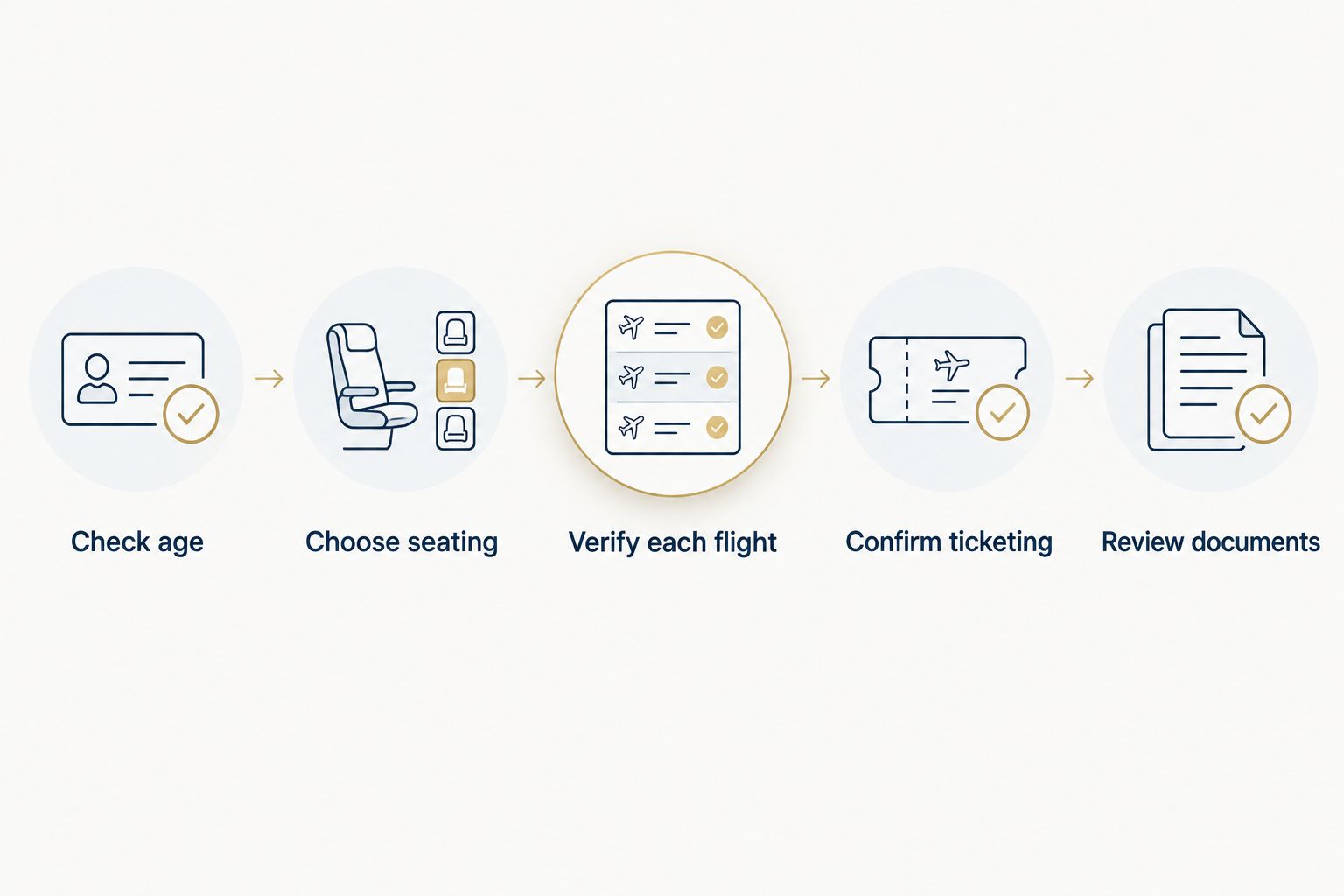
How to confirm your infant’s booking
Use the same sequence whether you are planning a holiday or combining family travel with a business trip. Establish the child’s eligibility and seating needs before comparing adult fare options.
- Check age. Give the child’s date of birth and check their age on every departure date, including the return.
- Choose seating. Decide whether you want to explore a permitted lap-infant arrangement or a separate seat with an approved restraint.
- Verify each flight. Identify the operating airline, cabin, and aircraft for every segment, then confirm the relevant infant rules.
- Confirm ticketing. Ask what must be issued for the infant and obtain confirmation that the child is included correctly.
- Review documents. Check passports, proof of age, and any destination or transit documentation before travel.
For a 2026 departure, save the written answers with your booking documents. Recheck seat and restraint suitability if the operating airline changes the aircraft or moves your assigned seats.
Why infant booking requirements vary
The word infant describes an age group, not a standard package of airline benefits. These factors determine what you need to confirm:
- Domestic or international travel. Crossing a border changes the ticketing and document questions, even when your baby stays on your lap.
- Lap travel or a separate seat. These are different arrangements, with different ticketing and restraint requirements.
- The operating airline. The carrier flying the aircraft controls the onboard seating arrangement; check every carrier involved.
- Aircraft and seat design. Premium seat layouts affect whether and how an approved child restraint can be installed.
- Age on each travel date. A child who turns 2 years old during the trip needs a separate seat for flights after that birthday.
Do not use an airline’s general infant page as a substitute for checking a specific business class itinerary. The general policy establishes the starting point; the operating flights determine the practical details.
How should you plan seats and connections with a baby?
Start with the flights you will actually board, not just the route printed at the top of the itinerary. A single journey can involve different operating airlines, aircraft, and seating arrangements.
On a connecting itinerary such as Calgary to Amritsar, booking seats for your baby means checking each segment separately, including infant ticketing and baggage rules. Confirmation for one flight does not establish the arrangement on the next.
Ask which seats are suitable for your chosen infant arrangement and whether a request is confirmed or simply recorded. If you plan to use a child restraint, keep the compatibility question attached to each flight rather than asking only whether the airline accepts car seats generally.
Connection planning should also reflect how you will move through the airport. Consider carrying your baby, handling hand baggage, and reaching the next gate when comparing itineraries; a shorter overall journey is not the only practical consideration.
Is a bassinet the same as a separate seat?
No. A bassinet is not an assigned passenger seat, and it does not replace an approved child restraint for use during taxi, takeoff, or landing.
Ask whether the aircraft has bassinets, which seats provide access, and what size and usage restrictions apply. Treat a bassinet request as a separate item from the infant’s ticket and your seat assignment.
If a bassinet is important to your plans, ask what happens if the aircraft changes. Your booking decision should still work without assuming that a requested bassinet will provide uninterrupted use throughout the flight.
What if my baby turns 2 during the trip?
At 2 years old, a child no longer qualifies for the U.S. lap-child exception and needs a separate seat. Tell the airline about a birthday between the outbound and return flights before any tickets are issued.
Ask how the itinerary should be ticketed across that birthday. Do not assume an outbound lap-infant arrangement automatically extends to the return journey.
For a family trip in 2026, checking the date of birth against each flight is a small step that prevents a fundamental mismatch between the reservation and the child’s seating requirement.
When does a travel consultant help?
Globalbusinessflights is best for travelers who want a dedicated consultant to arrange business or first class tickets. The service includes support from quote to e-ticket, with leisure and corporate travelers among its clients.
The consultant-led approach lets you explain the family’s seating needs alongside the adult fare request. The trade-off is that this is not a self-service booking engine: you discuss and confirm the itinerary rather than completing every step independently online.
Prepare your travel dates, route, passenger details, and preferred infant arrangement before requesting a quote. Ask for the infant requirements to be addressed alongside the adult tickets, not as an afterthought.
FAQ
Can infants fly business class free on domestic flights?
Sometimes, when an eligible infant travels on an adult’s lap under the airline’s domestic policy. Confirm the rule for the exact itinerary and make sure the child is added to the reservation.
Can my baby fly business class free internationally?
Do not assume international lap-infant travel is free. An infant ticket and taxes can apply even when your baby does not occupy a separate seat.
Does a business class ticket include a seat for my baby?
No, your adult business class ticket does not automatically provide a separate seat for your baby. A lap-infant arrangement and an infant traveling in a purchased seat must be booked differently.
Is holding my baby as safe as using a car seat on a plane?
The FAA recommends an approved child restraint rather than holding your baby on your lap. Confirm that the restraint is approved for aircraft use and compatible with the specific business class seat.
Can I use any aircraft-approved car seat in business class?
No, aircraft approval alone does not establish compatibility with every business class seat. Ask the operating airline about your restraint model and the exact aircraft seating arrangement before purchase.
Does my infant need a passport for an international flight?
U.S. citizen infants need their own passports for international air travel. Check destination and transit document requirements for the child’s nationality and itinerary.
What happens if my child turns 2 before we fly home?
A child aged 2 years or older needs a separate seat under U.S. rules. Tell the airline about the birthday before ticketing so the return journey has the correct arrangement.
One last thing
Ask for the infant’s arrangement to be stated in plain language: lap infant or separate seat, which flights it covers, and what documentation is required. That short confirmation is more useful than a general assurance that the booking is family-friendly.
Choose the itinerary that fits your baby’s seating needs before choosing between adult fares. Comfort begins with knowing how everyone will travel.