
Instead of repeating your travel plans across separate calls and messages, book first class flight by phone through a consultant-led workflow that carries your preferences from the initial conversation to the e-ticket. With Global Business Flights, start with your itinerary, review the proposed flights and fare conditions, and verify ticket issuance separately from your seat assignment.
- Global Business Flights suits travelers who want a dedicated consultant to book first class flight by phone.
- Confirm the cabin on every flight segment before approving a first class booking.
- A reservation reference, an e-ticket number, and a seat assignment serve different purposes.
- Keep your approved itinerary and fare conditions together for the final ticket check.
Why this matters
A phone conversation helps you explain preferences that a simple flight search does not capture: an overnight connection you want to avoid, a companion traveling from another city, or an arrival time tied to a meeting. The conversation works best when those preferences become written booking instructions.
Global Business Flights is best for leisure and corporate travelers who want a dedicated consultant for first class booking. The agency arranges premium airline tickets through phone and online quote requests, with support from quote to e-ticket rather than a self-service booking engine.
The benefit is personal assistance. The trade-off is that you must review and approve the details through that consultant-led process. For a 2026 journey, treat the written itinerary—not your memory of the call—as the record of what you intend to book.
Before you start
- Prepare your traveler details. Have each passenger's name as shown on the travel document, intended travel dates, departure and destination airports, and contact information. Keep passport information accessible if requested through an appropriate channel.
- Define your priorities. Write down your preferred arrival time, acceptable connections, cabin expectations, and whether dates can move. Corporate travelers should also have their company's approval requirements ready.
- Watch for mixed cabins. A journey described as first class can include a connecting segment in another cabin. Ask for the cabin on every flight before you authorize ticketing; a premium long-haul segment does not describe the whole itinerary.
You do not need to begin with an airline account. Have any existing frequent-flyer details ready, and ask whether they can be attached to the proposed booking. Never send passwords or payment-card details in an ordinary email.
Your consultation brief
Put the journey into words
- State the route. Name the departure and destination airports when you know them. If you can use another airport, explain the extra ground travel you would accept.
- Give the dates. Separate fixed dates from flexible ones. Explain whether your priority is the departure date, arrival date, or time you must reach your destination.
- Describe the travelers. State who needs to travel together and whether everyone needs the same cabin. Explain any assistance requests relevant to the itinerary.
- Set the comfort priorities. Describe what first class means for this trip: privacy, a particular seating arrangement, or a cabin on a particular flight. Ask the consultant to verify those features rather than assuming the cabin label guarantees them.
Expected result: You and the consultant share a clear brief covering the route, timing, passengers, and cabin priorities. Ask for a written recap if the conversation includes several alternatives.
For a 2026 trip with fixed commitments, name the commitment first. Arriving before a conference opening or family event is a clearer instruction than simply asking for a convenient flight.
Separate requirements from preferences
Keep the brief short enough to use during a call. Divide it into 3 categories:
| Category | Best for | Benefit | Limitation |
|---|---|---|---|
| Fixed requirements | Travelers with immovable commitments | Makes unsuitable itineraries easy to reject | Leaves less room to change the routing |
| Strong preferences | Travelers prioritizing particular comfort features | Gives the consultant a clear comparison standard | Requires verification on the proposed flight |
| Flexible details | Travelers open to alternate dates or airports | Creates more combinations to consider | Adds decisions and possible ground travel |
This is not a ranking of travelers' needs. It is a way to prevent a flexible preference from displacing an essential requirement.
Your written flight proposal
Review the itinerary segment by segment
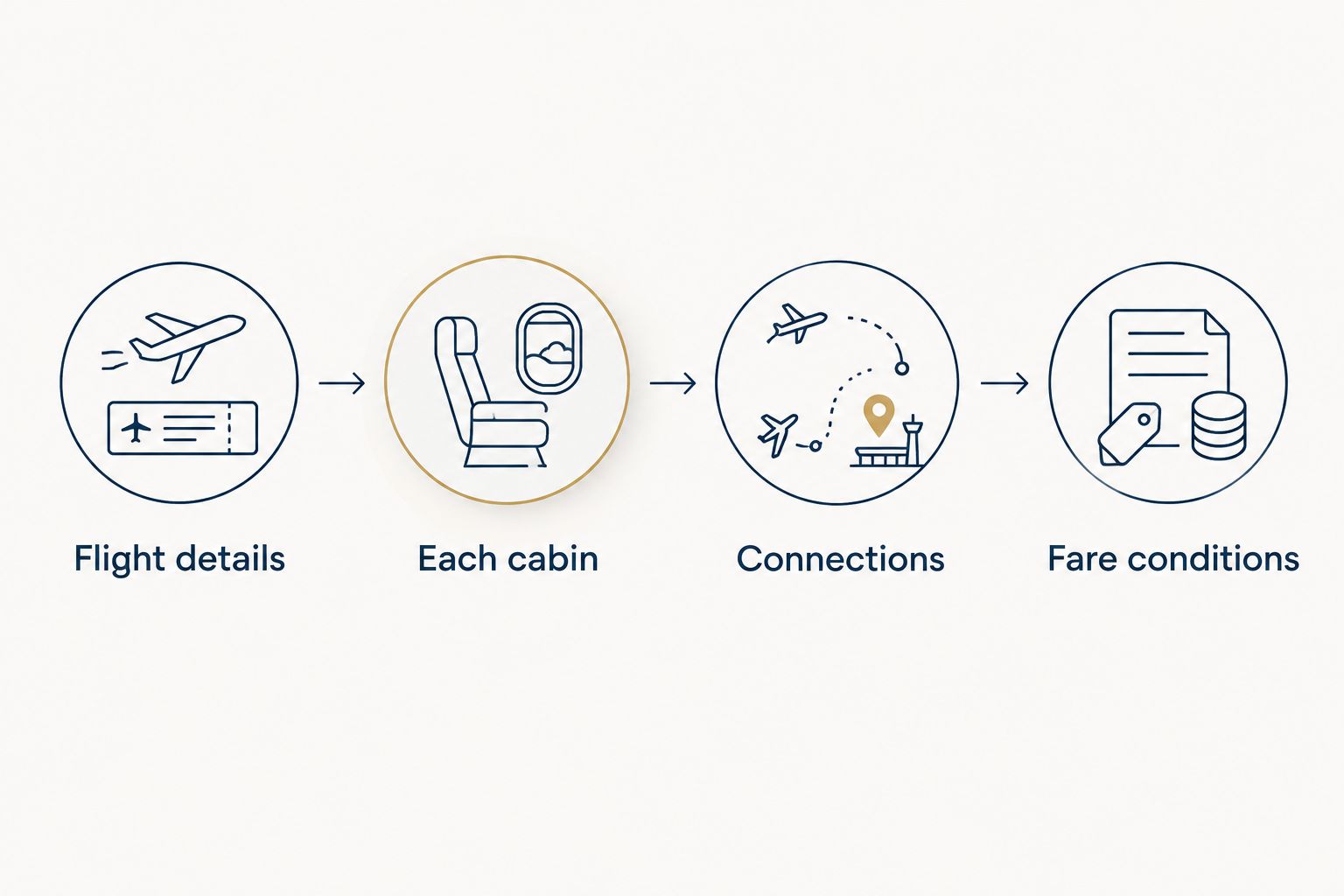
- Read the flight details. Check the operating airline, flight number, departure airport, arrival airport, and local dates and times for every segment. Pay particular attention to overnight travel and date changes.
- Check each cabin. Ask which segments are booked in first class and which use another cabin. Request clarification wherever the proposal uses a broad description without segment-level detail.
- Review the connections. Look for an airport change, an overnight stop, or a connection that conflicts with your comfort needs. Ask whether the proposed flights will be issued on one ticket or separate tickets, and what that means for your journey.
- Read the fare conditions. Ask for the change, cancellation, refund, and no-show conditions before approving the booking. Do not treat the word flexible as a substitute for the actual rules.
Expected result: You have a written proposal you can explain back accurately, including the cabin on each segment and the conditions that matter to your plans.
A first class booking should be judged segment by segment, not by the headline cabin label. That check matters whether you are traveling for leisure or arranging a corporate itinerary.
Resolve the details that change your decision
Ask specific questions rather than requesting a general reassurance. For example: does the connecting flight use a different cabin, does the itinerary involve changing airports, and what happens under the fare rules if your return date changes?
If a particular seat feature determines your choice, ask the consultant to verify the proposed flight's cabin arrangement. Aircraft changes can affect seating, so keep the cabin requirement separate from a preferred seat number.
For your 2026 booking, retain the version of the proposal you approve. If a revised itinerary arrives, review the changes rather than assuming only one detail has moved.
Ticketing and seat verification
Authorize the agreed itinerary
- Check passenger names. Compare the proposed names with the travel documents. Resolve spelling or name-order questions before you authorize ticketing.
- Confirm your approval. Identify the exact itinerary you are accepting. If a company must approve the trip, complete that approval before giving ticketing instructions.
- Confirm the payment process. Ask which payment method and secure channel apply to your booking. Follow the provided instructions without sending sensitive information through an unverified message.
- Request the ticketing record. Ask for the issued e-ticket details and reservation references. An itinerary sent for review is not, by itself, evidence that a ticket has been issued.
Expected result: You have documentation identifying the passenger, ticketed flights, and e-ticket number, rather than only a quote or reservation summary.
Check the ticket and seat separately
- Match the ticket to your approval. Compare the issued itinerary with the route, dates, flights, and cabins you accepted. Report any discrepancy to the consultant promptly.
- Locate the airline reference. Where an airline booking reference is provided, use the airline's booking-management service to review the reservation. The reference used by an agency and the airline's reference are not always identical.
- Verify the seat assignment. Check whether each flight shows an assigned seat. Ask for clarification if a seat is missing or differs from your request.
- Keep the records together. Save 2 documents for review: the approved proposal and the issued e-ticket confirmation. Retain any separate written fare conditions alongside them.
Expected result: You can distinguish a ticketed first class reservation from a seat request, and you know which seat assignments are recorded.
An e-ticket number identifies the issued ticket; a seat number identifies an assigned seat. A seat assignment can change, including after an aircraft substitution. Recheck the airline's current itinerary before departure rather than treating the original seat number as permanent.
Explore your fare options
Share your route, travel dates, and cabin preferences for a consultant-led first class booking.
When several travelers need one plan
The same phone-booking workflow works for a family trip or corporate group, but shared requirements need to be explicit. Global Business Flights arranges multi-passenger bookings and serves companies needing managed corporate travel accounts.
Start with 1 shared itinerary brief, then record each traveler's differences. These can include a different departure city, a separate return date, or an individual assistance request. Do not let the shared brief obscure passenger-specific details.
Before approving a multi-passenger booking, ask:
- Which travelers are booked together, and which have separate reservation references?
- Does every passenger have the intended cabin on every flight?
- Are requested seats recorded, and has any seating-together request been confirmed?
- Who receives the travel documents and handles company approval?
Expected result: Every passenger has a clear itinerary, and one person knows which approvals remain outstanding. For a 2026 corporate trip, keep the traveler-facing itinerary separate from internal approval correspondence so neither becomes difficult to find.
Troubleshooting
The itinerary says first class, but a connection does not
Ask the consultant to identify the cabin on the affected flight and explain the alternatives. Decide whether the mixed-cabin journey meets your requirements before authorizing ticketing. Do not rely on the overall itinerary heading.
You received a reservation reference but no e-ticket number
Ask whether ticketing is complete and request the issued ticket details. A reservation reference helps locate a booking; it does not replace confirmation of ticket issuance. Keep the question focused on the ticket's status.
The airline cannot find the booking
Check that you are using the operating airline's booking reference and the passenger name entered on the reservation. If the record still does not appear, ask the consultant to verify the reference and ticket details. Do not create another booking merely to resolve a lookup problem.
Your preferred seat is not shown
Ask whether the seat was requested or assigned, and verify the current seating record with the airline or consultant. Keep your ticketed cabin separate from your seating preference. A missing preferred seat number does not, on its own, establish that the cabin is wrong.
Your plans change after ticketing
Contact the consultant with the exact flight and date you want to change. Ask for the applicable fare conditions and a written explanation of the proposed revision before approving it. Do not assume a change request has altered the ticket until you receive confirmation.
Customize your workflow
Make the process fit the reason for your trip. Leisure travelers can add companion seating and connection preferences to the brief; corporate travelers can add approval contacts and required arrival times.
Keep one current itinerary as the working record. When a revision arrives, label the older copy clearly so another traveler or company approver does not act on outdated details.
Global Business Flights provides consultant support from quote to e-ticket. Ask how to handle later itinerary questions and airline schedule changes, and keep the relevant contact instructions with your travel documents.
FAQ
How do I book first class flight by phone?
Prepare your route, dates, passenger details, and cabin priorities, then discuss them with a travel consultant. Review the written itinerary and fare conditions before authorizing ticketing, and verify the issued e-ticket separately from your seat assignment.
Who is Global Business Flights best for?
Global Business Flights is best for leisure and corporate travelers who prefer a dedicated consultant for first class booking. The agency works through phone and online quote requests rather than a self-service booking engine.
Does a booking reference mean my first class ticket is issued?
A booking reference alone does not establish that your ticket has been issued. Request the e-ticket number and issued itinerary, then compare the flights and cabins with your approved proposal.
Will every flight on my itinerary be in first class?
Check the cabin on every segment rather than assuming the whole itinerary is first class. A connecting flight can use a different cabin, and the written proposal should make that clear before you approve it.
Can I book first class by phone for several passengers?
Yes. Global Business Flights arranges multi-passenger bookings; provide each traveler's details and identify any different dates, routes, or cabin requirements. Ask which travelers share reservation references and verify each person's ticket.
Is my first class seat number guaranteed after booking?
Treat a recorded seat assignment as subject to change, not as a permanent guarantee. Check the airline's current seating record before departure, particularly after a schedule or aircraft change.
What should I check before a first class flight in 2026?
Check the current itinerary, passenger names, ticketed cabins, and recorded seat assignments. Also review the destination's travel-document requirements and retain the consultant's contact instructions with your e-ticket details.
One last thing
Ask two separate closing questions: has the ticket been issued, and is the seat assigned? They sound similar, but they verify different parts of the booking.
That distinction gives you a useful final check without turning a personal consultation into a technical exercise. Keep the issued itinerary close, confirm the details that matter to your comfort, and let your consultant know when something needs clarification.