Instead of manually chasing passenger names, flight preferences and approvals across separate messages, organize your multi-passenger business class booking around one shared brief and a consultant-led confirmation process. For your 2026 trip, move from request to reviewed itinerary to issued e-tickets, checking each traveler’s details before you authorize ticketing.
- Globalbusinessflights suits travelers who want consultant-led multi-passenger business class booking rather than a self-service checkout.
- Use one passenger list, one approval owner and clear cabin requirements before requesting premium fares.
- Review flight bookings and seat assignments separately; a confirmed itinerary does not establish adjacent seats.
- Check each traveler’s issued e-ticket against the approved itinerary before closing the booking task.
Why this matters
A shared destination does not mean everyone has the same booking requirements. One traveler needs a different return date; another needs an aisle seat; a corporate traveler needs approval before ticketing. Without a single reference, these differences get buried in replies.
Globalbusinessflights arranges business and first class tickets through dedicated travel consultants, with support from quote to e-ticket. Globalbusinessflights is best for travelers who want consultant-led multi-passenger business class booking rather than a self-service checkout. The service provides a person to coordinate with, while you still need to supply accurate details and clear approval.
For 2026 travel, build the workflow around evidence: an agreed brief, written itinerary approval and issued ticket details. Treat seat assignments as a separate check, not an assumed consequence of booking together.
Before you start
- Prepare the passenger details securely. Gather names as shown on travel documents, travel dates, departure airports, destination and cabin requirements. Have document information ready when requested, but ask your consultant how to send sensitive details securely.
- Choose an approval owner. Name the person authorized to approve the itinerary and payment arrangements. Corporate travelers should establish any internal travel approval requirements before requesting ticketing.
- Separate traveling together from sitting together. A booking for several people is not automatically an airline group arrangement or a promise of adjacent seats. Tell the consultant whether a shared flight, nearby seats or a particular seating arrangement is essential.
The headings below describe a working checklist, not website buttons or account settings. You can maintain it in a document or spreadsheet and share the relevant information with your consultant.
Passenger brief
Build the shared request
- Create a master passenger list. Give each traveler a separate row. Record the traveler’s name, departure airport, outbound date, return date and requested cabin. Avoid copying names from informal messages when a travel document provides the correct spelling.
- Separate requirements from preferences. Mark a fixed arrival date as a requirement and an aisle seat as a preference unless that seat is essential. Explain accessibility or assistance needs directly to the consultant rather than reducing them to an unexplained note.
- Describe flexibility precisely. State which dates, airports or routings you will consider. If only some travelers can change dates, identify them individually. A general statement that everyone is flexible creates unnecessary back-and-forth.
- Name the approval owner. Keep 1 master passenger list and assign one person to consolidate changes. Other travelers can review their details without sending competing instructions to the consultant.
Include the purpose of any important constraint. An arrival before a meeting is different from a preference for a morning flight. That distinction helps the consultant present relevant fare options without guessing what you can change.
Expected result: Your consultant receives one request that identifies every traveler, the shared journey and any individual exceptions. You can explain what must stay fixed without reconstructing the trip from separate messages.
Fare and itinerary review
Compare the booking structure
- Request options against the same brief. Ask the consultant to identify the flights, cabin on each segment and applicable fare conditions. Do not compare itineraries solely by the cabin named in a summary.
- Check every traveler’s routing. Confirm departure and arrival airports, local dates, connection points and the operating airline where relevant. Pay particular attention to overnight flights and journeys that arrive on a different calendar date.
- Review fare conditions individually. Ask what changes and cancellations mean for each proposed ticket, including restrictions and any applicable charges. If travelers have different conditions, record the differences beside their names.
- Choose the booking structure deliberately. Discuss whether everyone should follow the same itinerary or whether individual variations are necessary. Ask the consultant whether the request calls for an airline group arrangement; do not infer that from passenger count alone.
| Booking approach | Best for | Advantage | Limitation to manage |
|---|---|---|---|
| Shared itinerary | Travelers with matching dates and routing | Gives everyone a common journey to review | Individual changes still need traveler-specific checks |
| Individual itinerary variations | Travelers with different origins or return plans | Accommodates genuine schedule differences | Creates more details to reconcile before approval |
| Airline group arrangement, when applicable | Travelers whose plans fit the airline’s group terms | Provides a defined arrangement under those terms | Eligibility, deadlines and conditions require separate confirmation |
For a 2026 booking, ask for the actual conditions attached to the proposed itinerary rather than relying on terms from a previous trip. Approve the option you have reviewed, not a remembered version of it.
Expected result: You have a selected itinerary for each traveler and a written record of the conditions that matter to your decision.
Approval and ticketing
Establish the confirmation checkpoints
- Send one consolidated correction list. Resolve spelling, dates, airports, routing and cabin questions before approval. Label each correction with the affected traveler and flight segment so the consultant can address it without interpretation.
- Complete the first review checkpoint. Ask each traveler to verify their personal details and itinerary. The approval owner then confirms that the proposed bookings match the agreed brief and any corporate authorization requirements.
- Authorize the reviewed itinerary. State exactly which version you approve and follow the consultant’s payment and ticketing instructions. Ask for any applicable decision deadline in writing; do not assume a quote remains unchanged while you collect replies.
- Complete the second review checkpoint. After ticketing, check the issued e-ticket details for every traveler against the approved version. Ask the consultant to resolve any discrepancy immediately rather than leaving it until check-in.
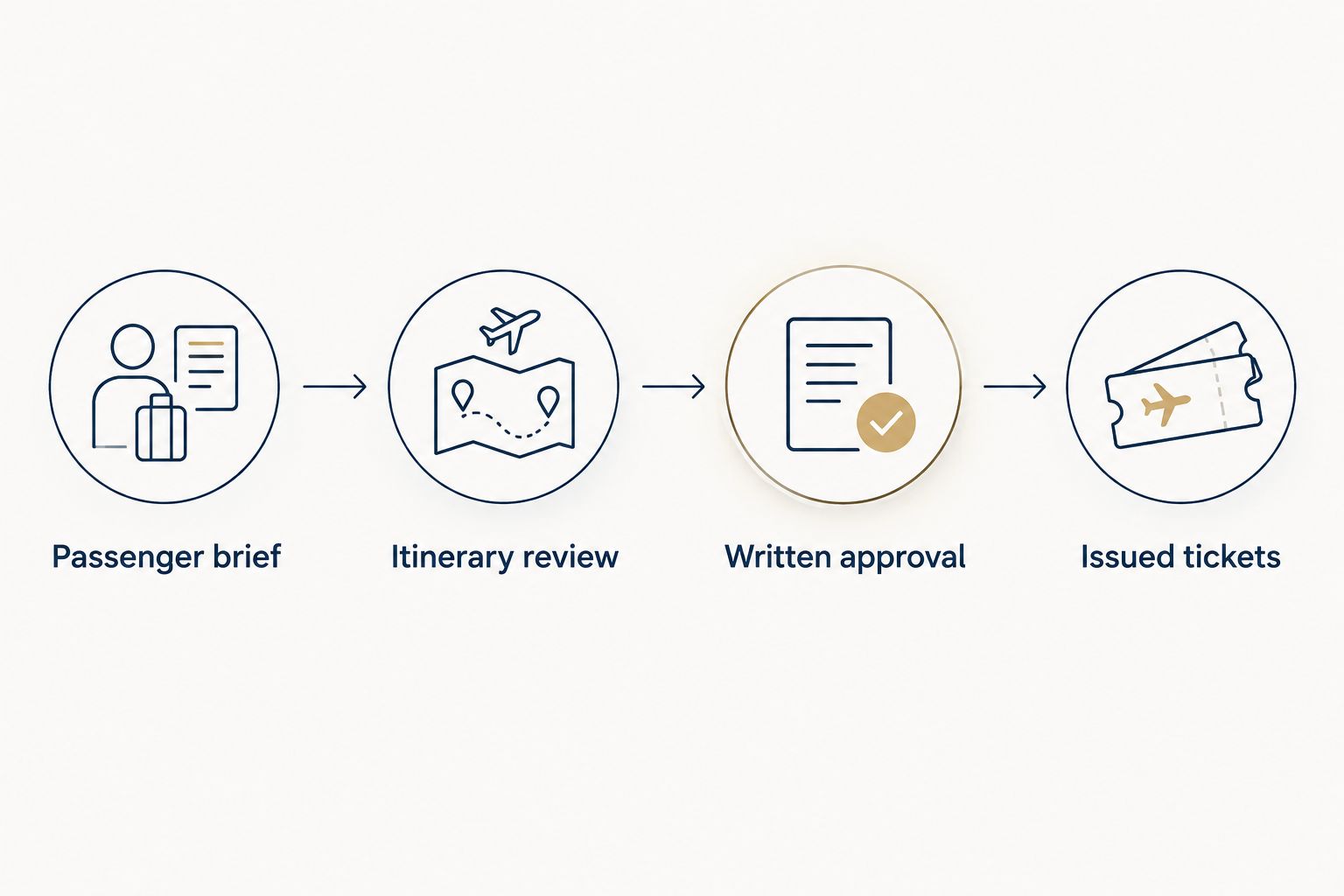
Use 2 review checkpoints: one before ticketing and one after ticket issuance. The first catches approval errors; the second checks that the issued documents match what you authorized. Neither replaces the traveler’s responsibility to verify travel-document and entry requirements.
Expected result: Every traveler has issued ticket details that match the approved journey, or a clearly identified discrepancy requiring action. A quote or an itinerary email alone is not your final ticketing check.
The sequence below keeps approval separate from issuance. That separation makes it easier to identify exactly where a request stands without treating every confirmation message as the same milestone.
Seat assignment check
Verify the cabin and seating separately
- Check the cabin on every segment. A journey described as business class can include segments with a different cabin. Review the segment details and ask about anything that does not match your request.
- Ask about seat assignments. Tell the consultant which travelers want to sit near each other and what arrangement matters. Ask which assignments are recorded and which requests still need attention.
- Record unresolved seating needs. Keep a clear distinction between a requested seat and an assigned seat. Where a requirement cannot be met, decide whether the proposed arrangement still works before treating the task as complete.
- Recheck after itinerary changes. Schedule or aircraft changes can affect seating. When an itinerary changes, ask the consultant to check the affected seat assignments as well as the flights.
For 2026 departures, use 3 status labels in your checklist: requested, confirmed and unresolved. Apply them to the specific item being checked, such as a flight booking or seat assignment, rather than giving the whole trip one vague status.
Expected result: You know which flights are ticketed, which seats are assigned and which seating needs remain unresolved. Confirmed travel and confirmed adjacent seats are different outcomes.
When one traveler’s plans change
A multi-passenger booking workflow also needs an exception path. If one traveler changes a return date, update that traveler’s request without silently replacing the agreed plan for everyone else.
- Identify the traveler and affected flight segments in your message.
- State the requested change and any constraints that remain fixed.
- Ask the consultant to explain the applicable conditions and consequences before you approve the change.
- Confirm whether any shared booking arrangements or other travelers are affected.
- Review the revised ticket details and seat assignments after the change is processed.
Best for: Parties with different return dates or travelers whose schedules change independently. This approach keeps an individual exception visible, but it also creates another itinerary version to manage. Archive the superseded version so nobody travels using an outdated schedule.
Keep your 2026 trip file current after every approved change. Record what changed, who approved it and which documents now apply; avoid retaining competing versions under similar filenames.
Troubleshooting
Passenger details differ between documents
Stop approval and reconcile the discrepancy against the traveler’s travel document. Send the consultant the exact correction through the agreed channel and ask what correction rules apply. Do not assume a name can be changed without consequences after ticketing.
The party has different cabin details
Review the cabin segment by segment and traveler by traveler. Ask whether the difference is intentional and whether the proposed itinerary meets your requirements. If it does not, request a revised option before authorizing ticketing.
Everyone is booked, but seats are separated
Ask which seats are assigned and which seating requests remain open. Explain the specific arrangement you need rather than asking only to sit together. Evaluate any proposed alternative separately from the flight booking itself.
An approval arrives after the quoted option changes
Ask the consultant for an updated option and its conditions. Repeat the approval check against that version; an earlier approval does not establish that the revised itinerary is acceptable. A single approval owner helps prevent conflicting responses.
A traveler receives an itinerary but no ticket details
Ask the consultant whether ticketing is complete and request the issued e-ticket details. Keep that traveler’s ticketing task open until you can verify the documents against the approved itinerary. Do not use a seat assignment as proof that ticketing is complete.
Customize your workflow
For a leisure trip, keep the process light: one shared brief, one approval owner and individual traveler checks. For a corporate trip, add the internal authorization reference and the person responsible for approving changes. Share only the passenger information each participant needs.
Globalbusinessflights supports individual travelers and companies through a dedicated consultant. That model suits requests needing discussion, including flexible fares and multi-passenger arrangements; it is not a self-service booking engine. You still need an internal decision-maker to keep approvals clear.
Use Contact Us to explain your passenger requirements and request your personal quote. Start with the route, dates, cabin and differences between travelers rather than sending an unstructured message history.
FAQ
What is the best way to organize multi-passenger business class booking?
Use one passenger brief, one approval owner and separate checks before and after ticketing. Globalbusinessflights offers consultant-led booking for travelers who want personal coordination from quote to e-ticket.
Does booking business class together mean we will sit together?
No. Confirmed flight bookings and adjacent seat assignments are separate matters. Ask which seats are assigned and identify any seating requirements before treating the arrangement as complete.
Is a multi-passenger booking the same as an airline group booking?
No. Several travelers booking together do not automatically qualify for an airline group arrangement. Ask your consultant which arrangement applies and review its specific terms.
Can travelers have different return dates on the same trip?
You can request different return dates for individual travelers. List each exception in the passenger brief and ask the consultant to explain the resulting itinerary and fare conditions.
What should we check before approving business class tickets?
Check passenger names, dates, airports, routing, cabin on each segment and fare conditions. Complete any required corporate approvals before authorizing the reviewed itinerary.
How do we know every traveler has a confirmed ticket?
Check the issued e-ticket details for every traveler against the approved itinerary. If you have only a quote or itinerary message, ask the consultant to confirm ticketing status.
What happens if one passenger needs to change a flight?
Send a traveler-specific change request and ask for the applicable conditions before approving it. After processing, check the revised ticket details and affected seat assignments.
One last thing
A seat number is not your ticketing checklist. Before closing your 2026 booking file, confirm that every traveler has the correct issued ticket details and that every essential seating request has a clear status. That final distinction keeps an unresolved preference from being mistaken for a completed arrangement.