
Instead of repeating traveler details and chasing approvals for every trip, connect your corporate travel account to a dedicated consultant through a clear booking brief and an agreed approval process. Global Business Flights arranges business and first class tickets through personal consultation rather than a self-service booking engine.
- Global Business Flights suits corporate travelers seeking consultant-led business and first class flight booking.
- Connect your corporate travel account consultant through a shared brief, named approver, and confirmed communication process.
- Agree on fare flexibility and approval requirements before requesting a corporate travel quote.
- Confirm e-ticket details separately from the initial itinerary proposal.
Why this matters
A consultant needs more than your destination and travel dates. Meeting times, cabin requirements, approval responsibilities, and change preferences all affect which itinerary fits your company.
The connection is a working relationship, not a software integration. Establish who requests travel, who approves it, and what the consultant needs before arranging a ticket. Do not assume an existing company account automatically shares traveler profiles or approval permissions with an outside agency.
For your 2026 travel setup, treat the initial handoff as a booking process you can reuse. The benefit is consistency; the responsibility is keeping the brief current whenever your company's requirements change.
Before you start
- Gather your company brief. Include the legal company name, a work contact, existing account references if applicable, and the person authorized to approve travel. Have your travel policy ready, or write down the rules you want followed.
- Prepare a sample trip. Use 1 sample itinerary with departure and arrival airports, dates, passenger count, preferred cabin, and required arrival time. Keep sensitive identity and payment information out of the opening message.
- Resolve the approval gap. A travel request is not permission to issue a ticket. Identify the authorized approver and ask the consultant how approval, traveler details, and payment instructions should be supplied before you begin.
You do not need to design a technical connection for this workflow. You do need access to the people who can confirm company requirements and authorize a booking.
Your company handoff
Establish the account relationship
- Open the Contact Us page to start the conversation. Explain that you want consultant-led corporate travel support for business or first class flights.
- State whether you already have a company travel arrangement or are establishing a new working relationship. If you have an account reference, ask whether it applies before sending additional information.
- Nominate 1 company contact to coordinate the initial setup. Identify a backup by role, especially if an assistant or office manager handles bookings for several executives.
- Ask who will handle your requests and which communication method to use. Confirm how to reach the appropriate person when your usual contact is away.
- Ask what company information is required for the next step. Provide documents only after you understand their purpose and the appropriate submission method.
Expected result: You know who handles your requests, where to send them, and who represents your company. You have not mistaken an introductory conversation for a completed account setup or an issued ticket.
Keep the handoff practical. A short, accurate brief is more useful than a lengthy policy document with no named decision-maker.
Your booking brief
Define the travel requirements
- Write a reusable company brief for 2026. Separate company-wide requirements from preferences that apply only to a particular traveler.
- Record the permitted cabin, preferred departure airports, acceptable connections, and any timing restrictions. Describe the journey's purpose when it affects the itinerary, such as attending a meeting immediately after arrival.
- Explain how your company evaluates flexibility. Ask for the change and cancellation conditions attached to each proposed fare rather than relying on a general description such as flexible.
- Identify any traveler preferences, including seating or loyalty-program details, that the consultant should consider. Ask how to submit personal information securely before sharing it.
- Mark which requirements are mandatory and which are preferences. An arrival deadline is different from a preferred departure time; the consultant needs to know the distinction.
Expected result: The consultant can distinguish an acceptable itinerary from one that merely reaches the right destination.
Use the following structure to keep company rules separate from trip details:
| Brief component | What you supply | What to confirm |
|---|---|---|
| Company requirements | Cabin policy, authorized requester, approval owner | Which rules apply to every booking |
| Trip requirements | Airports, dates, passenger count, arrival deadline | Which details are fixed |
| Traveler preferences | Seating preferences and relevant loyalty details | How preferences will be recorded |
| Fare requirements | Your priorities for changes and cancellations | Conditions attached to the proposed fare |
| Final approval | Named decision-maker and written authorization | What is required before ticket issuance |
For a 2026 booking, include the year alongside the travel dates. Avoid shorthand that leaves the month or departure day open to interpretation, especially when colleagues work across countries.
Your approval process
Agree on the decision path
- Name the person authorized to approve the itinerary. If the traveler and approver are different people, make that distinction explicit.
- Explain whether an assistant can request proposals without approving them. Define what happens when the usual approver is unavailable.
- Ask the consultant to explain the proposed itinerary and relevant fare conditions before you authorize the booking. Review the operating flights and cabin for each segment, not just the overall trip description.
- Set 2 approval checkpoints: itinerary acceptance and authorization to proceed with ticket issuance. Ask the consultant how these checkpoints fit the booking process and what information is required at each stage.
- Confirm how payment information should be provided and who is authorized to supply it. Do not place card details in a shared travel brief.
Expected result: Everyone understands the difference between requesting a proposal, accepting an itinerary, and authorizing a ticket.
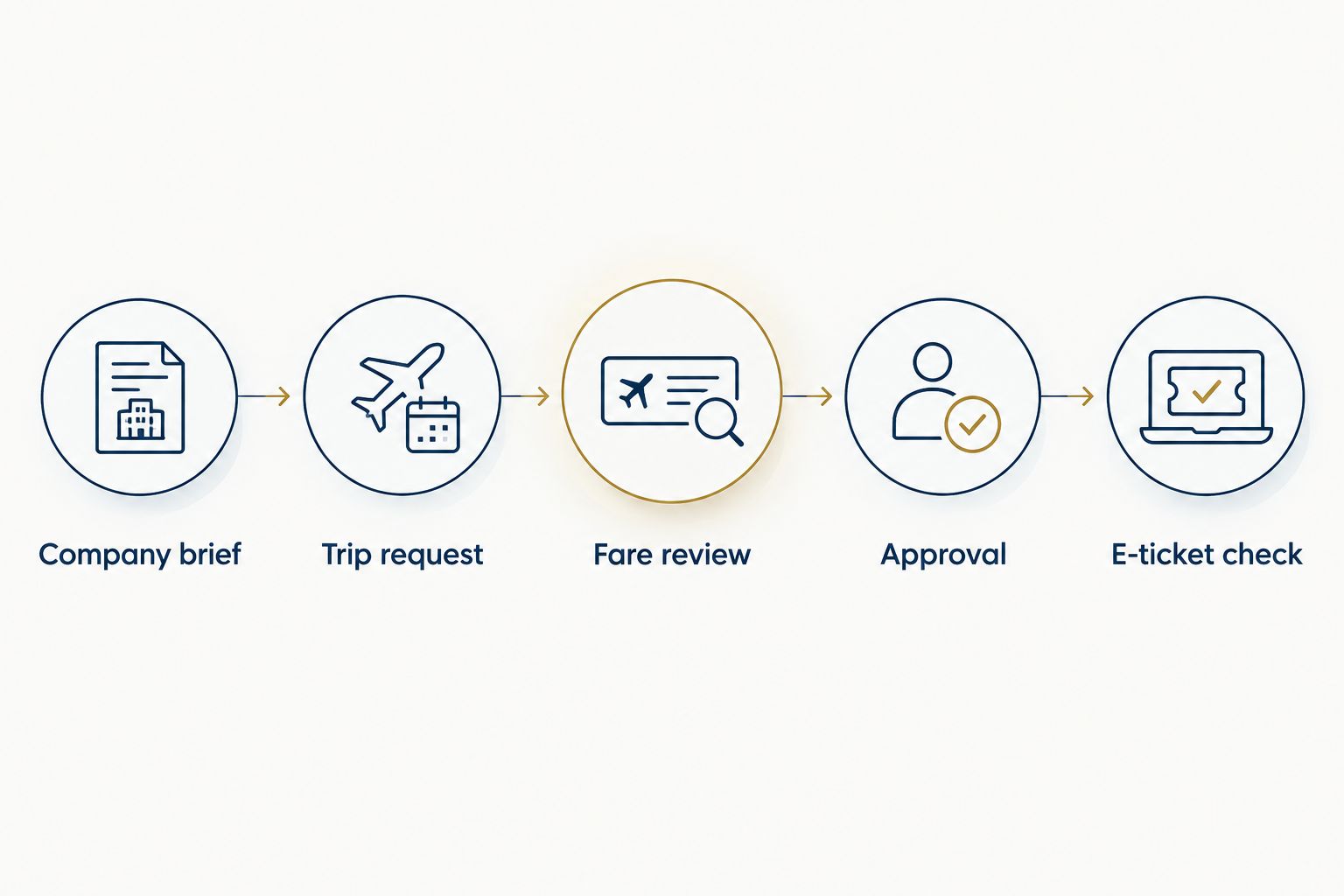
A simple sequence keeps those decisions visible: Company brief, Trip request, Fare review, Approval, E-ticket check. Each handoff should have an owner rather than relying on everyone in a message thread to act.
Your first booking
Test the process with a real request
- Send your sample trip using the agreed communication method. State the departure and destination airports, travel dates, passenger count, cabin request, and required arrival time together.
- Review the proposed journey against your brief. Check local departure and arrival dates, connections, and cabin details for every flight.
- Ask questions about the fare conditions before approving. Confirm what a change or cancellation would involve under that specific fare.
- Submit approval through the process you agreed upon. If anything changes after approval, state exactly what changed and request confirmation before proceeding.
- After issuance, check the e-ticket against the approved itinerary and traveler identity details. Keep the final travel documents separate from earlier proposals so colleagues do not use an outdated version.
Expected result: Your first request reaches the e-ticket stage with a clear record of the itinerary and its approval. Note any missing information and update the brief before the next request.
For travel spanning 2026 and a later calendar year, write the full departure and return dates. An overnight journey can also arrive on a different local date, so check the arrival date against the meeting schedule.
When a traveler or itinerary changes
An established relationship still needs updates. A new executive, a changed cabin policy, or a revised meeting time should trigger a specific message rather than an assumption that the consultant already knows.
Use this second workflow whenever a traveler profile or trip requirement changes:
- Identify the affected traveler or booking using the reference already agreed with your consultant.
- State the old requirement and the replacement requirement clearly. Separate a permanent profile update from a change that applies only to the current trip.
- Ask whether the change affects the itinerary, fare conditions, or approval requirements.
- Obtain any required authorization before proceeding, then check the revised documents.
An update request is not confirmation that a change has been completed. Wait for explicit confirmation and review the resulting itinerary or ticket.
Keep your 2026 company brief dated so colleagues can identify the current version. Remove superseded copies from the normal request process rather than leaving conflicting instructions in circulation.
Choose the right request structure
Global Business Flights arranges individual and multi-passenger bookings. Choose your request structure according to how closely the travelers' plans align, then ask the consultant how to organize the booking.
| Request structure | Best for | Advantage | Limitation |
|---|---|---|---|
| Individual request | A traveler with a distinct itinerary | Keeps personal timing and preferences clear | Requires separate coordination when colleagues travel together |
| Multi-passenger request | Colleagues sharing core travel requirements | Brings shared requirements into one brief | Individual dates, cabins, or approval rules still need explicit detail |
Do not assume everyone attending the same event needs the same flights. List exceptions by traveler, including different return dates or departure airports, before asking for proposals.
Consultant-led booking is best for travelers who want personal help reviewing premium-cabin fare options. It also requires clear communication and an approval handoff; it is not a substitute for your company's internal travel decisions.
Troubleshooting
Nobody knows who can approve
Name the authorized approver and a backup before progressing the request. If the company's policy is unclear, resolve that internally rather than asking the consultant to infer permission from a copied email.
The proposal misses a meeting requirement
Restate the required arrival date and local time, not just the meeting date. Ask for a revised itinerary and make the deadline a mandatory field in future briefs.
Travelers receive conflicting versions
Identify which proposal or e-ticket is current and tell everyone which earlier document it replaces. Keep the approved itinerary and final ticket together in your company's chosen record location.
A requested change is still unresolved
Ask whether the change is being reviewed, awaiting approval, or completed. Do not treat a sent message as proof that the booking has changed; verify the revised travel documents.
Sensitive information enters a group thread
Stop adding identity or payment details to the thread and ask for the appropriate submission method. Follow your company's information-handling procedure for any details already shared.
Customize your workflow
Once the first booking is complete, refine the brief around the questions that actually arose. Add a required arrival time if it was missing, clarify approval authority, or separate permanent traveler preferences from trip-specific requests.
For recurring travel, reuse the structure rather than copying an old itinerary unchanged. Dates, airports, meeting times, passenger details, and fare requirements still need a fresh check.
For a wider corporate arrangement, ask Global Business Flights how its managed corporate travel account service would fit your company's needs. Discuss the responsibilities and support you require without assuming reporting tools, automated approvals, or a connection to existing company software.
Explore your fare options
Discuss your corporate travel requirements and the steps from quote to e-ticket.
FAQ
How do I connect a corporate travel account consultant to my company?
Start by contacting the agency, naming your company contact, and sharing a clear travel brief. Agree on the request, approval, and ticketing process before your first booking.
Do I need software to work with Global Business Flights?
Global Business Flights operates through phone and online quote requests with a dedicated travel consultant rather than a self-service booking engine. Establish the communication process directly instead of assuming a software integration is required.
What should I send a corporate travel consultant first?
Send your company contact details and a trip brief covering airports, dates, passenger count, cabin preference, and arrival requirements. Ask how to submit sensitive traveler and payment information before sharing it.
Can an executive assistant request flights without approving them?
Your company should define whether an executive assistant can request proposals without authorizing ticket issuance. Tell the consultant who can request travel and who has final approval authority.
Can I arrange business class flights for several colleagues?
Global Business Flights arranges multi-passenger bookings. Provide shared requirements together and identify each traveler's different dates, airports, cabin requirements, or approval needs.
Does a flexible fare mean I can change anything?
A flexible fare still has specific conditions that need review. Ask the consultant to explain the change and cancellation rules for the proposed fare before you authorize the ticket.
How do I know my corporate flight booking is complete?
Check the issued e-ticket against the approved itinerary and traveler identity details. A quote or proposed itinerary alone does not establish that a ticket has been issued.
One last thing
Before sending your first request, write the sentence: Please treat this as a proposal request, not authorization to issue a ticket. Replace it with explicit booking authorization only when your company is ready to proceed.
That small distinction gives your consultant a clear instruction and preserves your approval process. Personal service works best when the next action is unambiguous.