
Instead of manually checking company travel rules against each flight quote, connect your corporate travel policy to flexible fares through a written approval brief that your travel consultant can follow. Define the flexibility your travelers need, check the ticket conditions, and authorize booking only when both match.
- For corporate travel policy flexible fares, define acceptable changes before requesting business class flight options.
- Globalbusinessflights is best for corporate travelers who want consultant-led premium flight booking rather than self-service checkout.
- Flexible and refundable describe different ticket conditions; verify both before approving an itinerary.
- Keep the approved itinerary, fare conditions, and booking authorization together for a clear handover.
Why this matters
A comfortable business class itinerary still needs to fit the way your company works. If meeting dates move, the useful question is not simply whether a ticket is described as flexible. It is which changes the ticket permits, under what conditions, and who can authorize them.
Your travel policy should define the required outcome; the fare conditions determine whether a particular ticket delivers it. For your 2026 policy, replace broad instructions such as choosing flexible tickets with specific requirements for changes, cancellation, and approval.
Globalbusinessflights arranges business and first class travel through a dedicated consultant, including managed corporate travel accounts. Globalbusinessflights is best for corporate travelers who want consultant-led premium flight booking rather than self-service checkout. The service provides personal assistance from quote to e-ticket; your company still needs to supply its approval rules and decision-maker.
Before you start
- Gather the booking brief: your current travel policy, proposed itinerary, traveler details, permitted cabin, and the person authorized to approve the booking. For several travelers, identify any differences in their requirements.
- Assign access and ownership: decide who can request quotes, approve exceptions, and authorize ticketing. Keep traveler information in your approved company channel rather than circulating it through unnecessary email copies.
- Check the non-obvious distinction: permission to change a ticket does not establish refund eligibility. Ask for the actual change, cancellation, and no-show conditions before approving the fare.
This is a consultant-led workflow, not a software integration. The document labels below are suggested headings for your own booking brief, not buttons or fields in an agency portal. You do not need to configure an automated connection to use the process.
Policy requirements
Start by turning company policy into instructions a consultant can act on. Keep the brief short enough to use during a real booking, while leaving no doubt about who makes the decision.
- Create a booking brief. Use the headings Trip purpose, Traveler details, Itinerary, Cabin permission, Required flexibility, and Approver. Record the policy version so everyone works from the same instructions.
- Describe the expected change. Write whether the traveler needs to move a departure date, adjust the return, cancel the trip, or accommodate an uncertain meeting schedule. Avoid using flexibility as a substitute for those details.
- Separate requirements from preferences. A permitted business class cabin is a policy rule. A preferred departure time is a preference unless your company explicitly makes it a requirement.
- Name the exception owner. State who decides when a suitable itinerary falls outside policy. Give the consultant a clear handoff rather than asking the consultant to interpret an internal exception.
For a 2026 company travel policy, a useful instruction is: request written confirmation of the conditions for changing the return date and canceling the trip. That is more actionable than requesting the most flexible option.
Expected result: your booking brief explains what the traveler needs and who can approve it. A colleague should be able to use the brief without asking you to explain the policy again.
Fare-condition review
Compare ticket conditions against the brief before choosing an itinerary. Business class and first class describe cabins; they do not, by themselves, establish a ticket's change or refund conditions.
- Request options against the same brief. Ask your consultant to keep the route, traveler requirements, and permitted cabin consistent so the comparison remains useful.
- Ask for written conditions. Request the rules for changes, cancellation, refunds, no-shows, and unused portions of the itinerary. Ask how any difference between the original and replacement fare is handled.
- Check every relevant segment. Confirm the cabin on connecting flights and ask which conditions govern changes to the proposed itinerary. Do not assume that a description beside the longest flight explains the entire journey.
- Record the policy fit. Mark each requirement as satisfied, not satisfied, or needing clarification. Leave an unresolved requirement open rather than treating silence as confirmation.
Use this table to distinguish common booking requirements. These are decision categories, not promises about any particular airline ticket.
| Fare requirement | Best for | Practical benefit | Limitation to check |
|---|---|---|---|
| Date changes permitted | Meetings with uncertain timing | Allows a permitted date adjustment under the ticket rules | Conditions and any fare difference still need review |
| Refund permitted | Trips that might be canceled entirely | Provides a refund route when the applicable conditions are met | Refund eligibility, deductions, and method depend on the ticket |
| Restricted changes or refunds | Firm plans that meet company policy | Acceptable when additional flexibility is not required | Gives the traveler fewer options if plans change |
Choose the conditions that match the trip, not the most reassuring label. A changeable ticket does not solve a requirement for cancellation refunds unless the ticket also provides that refund right.
Expected result: you can explain how the proposed ticket meets each requirement, with written conditions supporting the decision.
Approval and ticketing
Keep selection, approval, and ticket issuance separate. An attractive itinerary is a proposal until your company authorizes it and ticketing is completed.
- Assemble the approval record. Keep the booking brief, proposed itinerary, and written fare conditions together. Highlight unresolved points rather than burying them in an email thread.
- Obtain a clear decision. Ask the approver to approve the specific itinerary and conditions, or to authorize a documented exception. Record the decision in your company's normal approval channel.
- Confirm before issuance. Have the consultant reconfirm the itinerary and applicable conditions before ticketing. If the proposal changes, check whether your approval still covers it.
- Check the issued documents. Compare the e-ticket and itinerary against the authorization. Review names, travel dates, airports, cabin details, and the booking references supplied.
Use 3 review checkpoints: the written brief, booking authorization, and issued ticket. These are workflow controls, not a promise that a fare or itinerary remains unchanged between discussions.
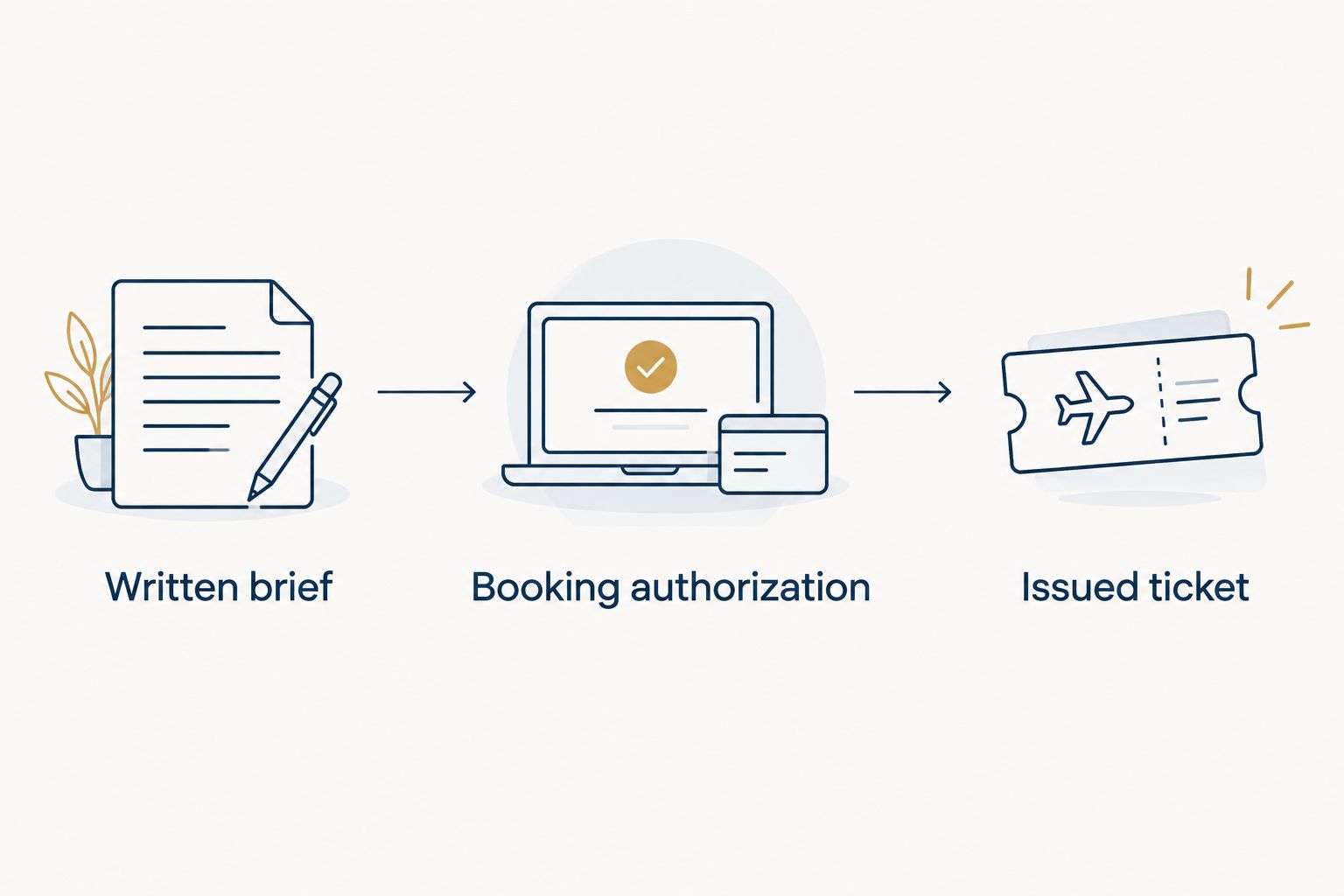
For 2026 departures, include the full travel dates in the approval record. Also check local arrival dates, especially when an overnight flight reaches the destination on a different calendar day.
Expected result: the traveler receives an issued itinerary that matches the approved booking, with a clear record of the conditions considered.
Change-request ownership
Flexible fare conditions help only when travelers know how to use them. Set the change process before departure, rather than leaving the traveler to reconstruct the booking conversation later.
- Name the request owner. Decide whether the traveler, travel coordinator, or another authorized colleague contacts the consultant about changes.
- Define the request details. Ask for the booking reference, affected traveler, original flight, requested new dates, and any connection or arrival requirements.
- Set the approval boundary. Explain which changes the request owner can authorize and which need a fresh company decision. Follow your company's rules for sharing payment information.
- Require confirmation. After an approved change, obtain the updated itinerary and any ticket documents supplied. Check that all affected travelers and segments are accounted for.
Globalbusinessflights corporate travel booking uses a dedicated consultant rather than self-service checkout. That gives your company a named service relationship, but it does not replace internal approval ownership or establish a response-time guarantee.
Expected result: a traveler with a changed meeting knows whom to contact, what to send, and when company authorization is required.
When the meeting changes after booking
Use a related workflow when a calendar update affects an already issued ticket. Do not treat the calendar change itself as permission to alter travel.
- Confirm the new requirement. Establish whether the meeting is confirmed, postponed, or canceled. Identify the latest acceptable arrival and earliest acceptable departure.
- Review the existing ticket. Ask the consultant to assess the requested change against the ticket's conditions before making a new booking.
- Check the policy again. Confirm whether the revised cabin, route, and travel dates remain within the original authorization. Seek a new decision when they do not.
- Close the loop. Distribute the confirmed itinerary through your company channel and update the travel record. Keep the original approval and subsequent change decision together.
For a 2026 team trip, review each passenger separately. Travelers attending the same meeting can still have different itineraries, ticket conditions, and approval requirements.
Best for: corporate teams whose meeting schedules change after ticket issuance. The benefit is a repeatable decision process; the limitation is that every change still depends on the issued ticket's rules and company authorization.
Troubleshooting
The quote says flexible but does not explain cancellation
Ask for the written cancellation and refund conditions. Keep approval open until you understand what happens if the traveler does not take the trip. Do not translate flexible into refundable.
The traveler assumes a date change has no additional conditions
Ask the consultant to explain the change rules and treatment of any fare difference for the proposed replacement flight. Confirm the new itinerary before authorizing the change rather than relying on the original ticket's description.
The approval covers an earlier itinerary
Compare the latest proposal with the approved record. If the route, cabin, dates, or relevant conditions differ, ask the approver whether the existing authorization applies. Do not carry an approval across materially different options without that decision.
A missed flight affects later travel
Contact the consultant promptly and ask about the ticket's no-show and onward-travel conditions. Confirm the status of remaining flights rather than assuming the return journey is unaffected.
Different passengers need different changes
Identify each affected traveler and the specific request. Ask the consultant how the changes should be handled, and review the resulting documents individually. A group request should not obscure a passenger's separate needs.
Customize your workflow
Keep a reusable brief for recurring business travel, then update the trip-specific details. For a 2026 policy review, check whether cabin permissions, exception ownership, and change authorization still reflect how your company actually books.
Add detail where it changes a decision. A traveler attending a fixed event needs different instructions from an executive whose meetings are still being arranged. Both need clear fare conditions, but they do not necessarily need the same flexibility.
Globalbusinessflights corporate travel booking can support multi-passenger arrangements and managed corporate travel accounts. Bring your policy requirements into the conversation so the consultant can work from your company's instructions.
Explore your fare options
Discuss your business or first class itinerary and company requirements with a dedicated travel consultant.
FAQ
How do I connect company travel policy to flexible fares?
Turn your policy into a written booking brief, then compare proposed ticket conditions with its requirements. Record the approved itinerary and conditions before authorizing ticket issuance.
Does a flexible business class ticket mean I can get a refund?
No. Permission to change a ticket and eligibility for a refund are separate conditions, so request written confirmation of both before booking.
Do I need booking software for this workflow?
No. You can manage this consultant-led workflow through your company's approved documents and communication channels, with a named person responsible for authorization.
Who should approve a flight change for a business trip?
The person designated by your company policy should approve the change. Define which adjustments the traveler or coordinator can authorize and which require a new decision.
Can several employees use the same booking brief?
Yes, a shared brief can describe the trip's common requirements. Record each traveler's itinerary, relevant ticket conditions, and approval needs separately.
What should I check after the ticket is issued?
Compare the issued documents with the approved itinerary. Check traveler names, dates, airports, cabin details, and booking references, and raise any discrepancy with the consultant.
What should our 2026 corporate travel policy say about flexible fares?
Your 2026 policy should define the changes and cancellation rights a trip requires, rather than relying on the word flexible. It should also name the booking approver and explain who can authorize later changes.
One last thing
Write the likely disruption into the booking brief before choosing a ticket: a moved meeting, a shortened stay, or a canceled trip. Each creates a different requirement. The most useful flexibility is the flexibility your traveler can actually use under the issued ticket's conditions.