
Instead of manually coordinating separate bookings, request a multi-city business class flexible fare as one proposed itinerary and ask a travel consultant to check whether the flights can be issued together. The goal is coordinated travel with clear change conditions—not an assumption that every flight shares one unrestricted fare.
- Request a multi-city business class flexible fare with written change conditions for every flight.
- Global Business Flights suits travelers who prefer a dedicated consultant for premium flight bookings.
- One reservation does not prove every flight shares one ticket or one fare rule.
- Compare through-ticket and separate-ticket arrangements before approving your itinerary.
Why this matters
A comfortable seat is only part of a flexible journey. When meetings move or a leisure stop grows longer, the ticket's rules determine what you can change and what happens to the remaining flights.
Global Business Flights is best for travelers who want consultant-led business class booking rather than a self-service checkout. Global Business Flights arranges premium travel through phone and online quote requests, with a dedicated consultant supporting the booking from quote to e-ticket.
For a 2026 itinerary, define flexibility before comparing flight options. A fare that permits changes is not necessarily refundable, and a permitted change can still require a fare difference.
Three terms need separating:
- Reservation: The booking record containing your travel arrangements. One record does not, by itself, establish how flights are ticketed.
- Ticket: The issued travel document covering specified flight segments. Ask which flights each ticket covers.
- Fare rules: The conditions governing the fare, including changes, cancellation and permitted routing. A ticket can contain multiple fare components.
Treat “one flexible fare” as a booking objective, not proof that identical conditions apply throughout the trip.
Before you start
- Prepare the complete route. List your cities in travel order, preferred airports, travel dates and any overnight stops. Include flights you have already booked, but keep them separate from the proposed new booking.
- Set your flexibility brief. Where your schedule allows, provide 2 acceptable departure dates for a movable leg. State whether you need date changes, cancellation flexibility or both; these are different requirements.
- Identify the approval contact. For corporate travel, name 1 approval contact and gather the travel policy before requesting options. The easily missed detail: combining fares can introduce different conditions, so a flexible long-haul flight does not establish flexibility for every connecting segment.
You do not need a self-service booking account for this consultant-led workflow. You do need passenger names as shown on travel documents before ticketing, along with a reliable way to receive the proposed itinerary and written conditions.
Your route brief
- Write the full city sequence. Include your starting airport, each destination and your final arrival airport. Mark any journey you will make independently, such as a train between two cities.
- Separate fixed dates from preferences. Identify the meeting, event or accommodation commitment that cannot move. Then identify the flights where you can accept an earlier or later departure.
- Describe the cabin requirement by flight. Specify where business class is essential and ask the consultant to flag any segment offered in another cabin. Do not rely on the itinerary's overall cabin description.
- Explain what could change. State whether your likely adjustment is a later return, a different departure city or a longer stop. Ask the consultant to assess those scenarios when selecting fare options.
Expected result: You have a route brief that distinguishes required travel from optional adjustments. That gives the consultant a basis for checking ticketing and flexibility.
For a 2026 business trip with a leisure extension, make the extension visible from the first request. Adding it later can change the routing and fare assessment, rather than simply adding another stop to an otherwise unchanged ticket.
The ticketing structure
- Request a through-ticket assessment. Ask whether the complete route can be issued on one ticket, and request an explanation if separate tickets are proposed. Multiple airlines on an itinerary do not automatically mean separate tickets.
- Compare the practical trade-offs. Review the structure below before choosing. A through-ticket arrangement is a useful starting point, but it is not a substitute for reading the fare conditions.
- Check connections and independent travel. Ask which connections are ticketed together, whether airport changes are involved and what baggage arrangements apply. Treat any self-arranged travel between airports or cities as a separate responsibility unless explicitly included.
| Arrangement | Best for | Advantage | Limitation to check |
|---|---|---|---|
| Through-ticket itinerary | Travelers seeking a coordinated flight journey | Keeps the covered flight segments within one ticketed arrangement | Can still contain different fare components and restrictions |
| Separate-ticket itinerary | Travelers whose route is being arranged as independent journeys | Allows flight journeys to be selected independently | Requires separate checks for changes, connections and disruption handling |
Expected result: You know how the route will be ticketed, not just how it appears in an itinerary email. You also know which connections need additional attention.
Do not assume that an airline partnership settles every question. Ask the consultant to confirm the actual ticket arrangement and the applicable connection and baggage conditions for your flights.
The flexibility conditions
- Request written change conditions. Ask what happens if you change a date before departure and after the journey has started. Check whether routing changes are permitted and whether fare differences apply.
- Separate cancellation from changes. Ask whether cancellation produces a refund, a credit or another outcome under the proposed fare. Confirm any conditions attached to using a credit rather than assuming it works like a refund.
- Check the whole journey. Request a plain-English explanation of how the combined fare rules affect each proposed change. Also ask what happens if you miss or intentionally skip a flight.
Expected result: You can explain what flexibility means for your actual booking. You are not relying on a broad cabin label or the word flexible alone.
For your 2026 booking, keep 3 checks beside the proposed route: date changes, cancellation treatment and unused-flight conditions. These checks describe different situations; approval of one does not answer the others.
A useful request is to ask the consultant to explain the consequence of moving your return date while leaving the outbound journey unchanged. If the answer depends on when you make the change, keep both explanations with the booking.
Choose the conditions that match your likely change, rather than the most reassuring fare description. A traveler expecting a meeting extension needs a different conversation from someone who needs the option to cancel the entire trip.
Approval and e-ticket review
- Review the proposal before authorizing ticketing. Check passenger names, airports, local departure dates, cabin by segment and the agreed flexibility conditions. Have the corporate approval contact review any policy exceptions at the same point.
- Confirm the ticketing outcome. After issuance, ask which ticket covers each flight and retain the e-ticket receipt alongside the itinerary. A reservation confirmation alone is not the same document as an issued e-ticket receipt.
- Save the written conditions. Keep the consultant's explanation with your travel documents. Record the appropriate contact route for requesting a change, rather than assuming an airline website can manage every agency-issued booking.
Expected result: Your approved proposal, issued ticket and saved conditions describe the same journey. Any difference is ready to raise before travel.
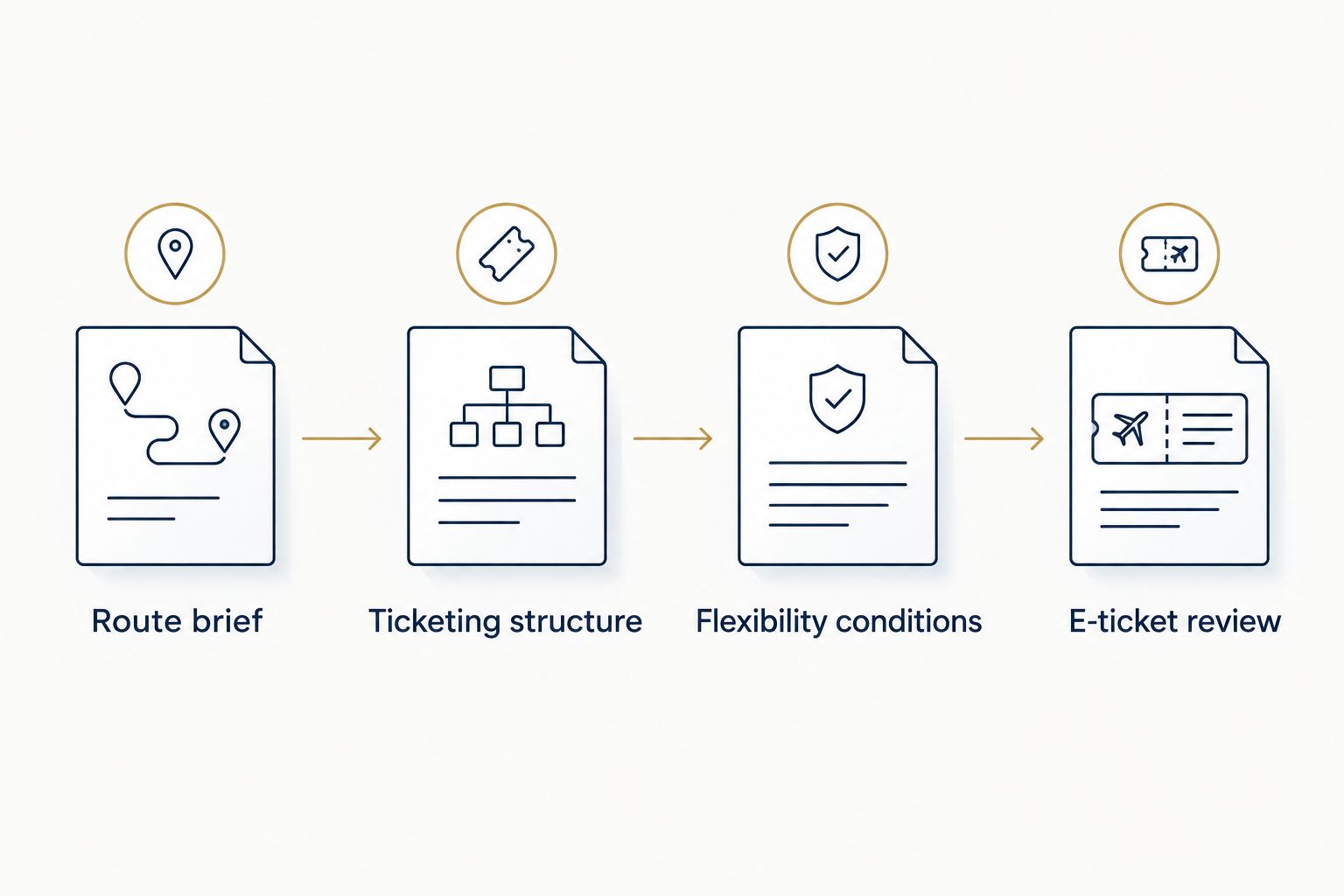
The process is simple when the information stays together: Route brief, Ticketing structure, Flexibility conditions, then E-ticket review. Use these four checkpoints whenever another traveler or approver joins the conversation.
Global Business Flights provides business class booking through a dedicated consultant. The benefit is a personal point of coordination from quote to e-ticket; the limitation is that your permitted changes still depend on the selected airline fare rules.
When your brief is ready, contact the travel consultant with the complete route and the change scenario that matters most to you.
When your itinerary changes
Use a related workflow when a meeting moves or you want to extend a stay. Request the change before treating the revised trip as confirmed. An email asking for a later flight is not an issued replacement ticket.
- Send the current booking reference and requested adjustment. Identify the flight you want to change and the flights you want to preserve. Include any alternative date you can accept.
- Request the effect on the whole booking. Ask about fare differences, applicable change conditions, cabin changes and any consequences for later segments. Do not approve a revised flight in isolation from the remaining itinerary.
- Authorize the agreed revision. Follow the consultant's instructions and request the updated travel documents when the change has been completed.
- Check the new documents. Verify the changed flight, the unchanged flights and the passenger details. Keep the latest issued documents clearly separated from superseded versions.
For a 2026 corporate itinerary, include the approval contact again if the revision requires authorization. A standing travel policy does not replace approval for an exception.
Expected result: Your revised documents match the journey you intend to take, and you understand whether the remaining conditions have changed.
Troubleshooting
The itinerary is together, but the tickets are separate
Ask the consultant to identify the flights covered by each ticket. Then review the connection and change implications before accepting the arrangement. A single email or reservation display does not establish a through-ticket journey.
The main flight is business class, but another segment is not
Review the cabin shown for every flight. Ask whether an alternative meets your cabin requirement, or decide explicitly whether the mixed-cabin itinerary suits your journey. Do not approve it based only on the longest flight.
The fare permits changes, but the revision has an additional amount
A change permission and a fare difference address separate things. Ask the consultant to distinguish the applicable change conditions from the difference associated with the revised flights, and approve the full revision before it is processed.
You want to skip a booked flight
Contact the consultant before departure rather than simply missing the segment. Airline conditions can affect subsequent flights after a missed segment; ask what change is required to preserve the journey you still intend to take.
One traveler needs a different return
Send that passenger's requested itinerary separately and ask how the booking should be handled. Do not assume a group reservation gives every passenger identical options or that one person's change leaves all other arrangements untouched.
Customize your workflow
Build your 2026 travel brief around the decision you expect to face. For leisure travel, that can be a longer stay; for corporate travel, it can be a meeting that finishes later than planned.
- For a leisure extension: Identify which flights are personal additions and whether the return date is fixed.
- For several passengers: List each person's route and any individual departure or return requirements.
- For managed corporate travel: Provide the approval process, policy requirements and the person authorized to request changes.
Keep those details in one current brief. Global Business Flights supports individual travelers and managed corporate travel accounts, so make clear which booking context applies when requesting your personal quote.
FAQ
Can I put a multi-city business class trip on one flexible fare?
Ask a consultant to assess whether your route can be issued together with suitable change conditions. A single ticket can contain multiple fare components, so confirm the rules for the complete journey before approval.
Does one booking reference mean all my flights are on one ticket?
No. A booking reference identifies a reservation, not necessarily a single ticket covering every flight. Ask which ticket covers each segment and retain the issued e-ticket receipts.
Does a flexible business class ticket include a refund?
Not automatically. Permission to change flights does not establish refund eligibility. Request the cancellation and refund conditions separately from the change conditions.
Can I combine different airlines in a multi-city itinerary?
A multi-city itinerary can include different airlines, but the ticketing arrangement depends on the proposed flights and applicable arrangements. Ask whether the flights will be issued together and how connections and baggage will be handled.
What should I send when requesting a multi-city business class flexible fare?
Send the complete city sequence, travel dates, passenger requirements and the changes you expect to need. Identify fixed commitments, acceptable alternatives and any corporate approval requirements.
Can I change just the return flight after starting my trip?
The applicable fare rules determine whether and how you can change the return after departure. Ask the consultant to assess that scenario before booking, then request a revision before treating a new return as confirmed.
Can a travel consultant merge tickets I have already bought?
Do not assume existing tickets can be merged into one flexible fare. Provide the current ticket details and ask the consultant to explain the permitted options under their conditions.
One last thing
The most useful flexibility question is specific: ask what happens if your final meeting moves and you need to return on a different date. Keep that answer beside the issued ticket.
A clear answer about your likely change is more useful than a general promise of flexibility. It turns a broad booking preference into a condition you can understand before you travel.