
To book cheap business class flights in 2026, compare the complete itinerary, adjust your dates or departure airport where practical, and check the fare rules before choosing. Look beyond the initial quote: a less expensive ticket is not a better fit if its connections, cabin assignment or change conditions work against your trip. Use the same travel requirements for every quote so you can compare like with like.
- Find cheap business class flights by comparing complete itineraries, fare conditions and practical date alternatives.
- Confirm the cabin on every flight; a business class itinerary can include an economy connection.
- Global Business Flights suits premium travelers who prefer a dedicated consultant to a self-service booking engine.
- Choose the fare that fits your journey, not simply the lowest initial quote.
Why this matters
Business class describes a cabin, not a uniform travel experience. The airline, aircraft, route and individual flight determine what you actually book. Fare conditions then determine how easily you can change that journey.
For travelers who prefer personal assistance, Global Business Flights arranges business and first class tickets through phone and online quote requests, with a dedicated travel consultant supporting the process from quote to e-ticket. That service is a different booking approach from selecting and purchasing an itinerary yourself.
Start with the journey you need, then compare the fares that meet it. This keeps an attractive quote from distracting you from an unsuitable departure, a difficult connection or a cabin you did not intend to book.
How do you book cheap business class flights in 2026?
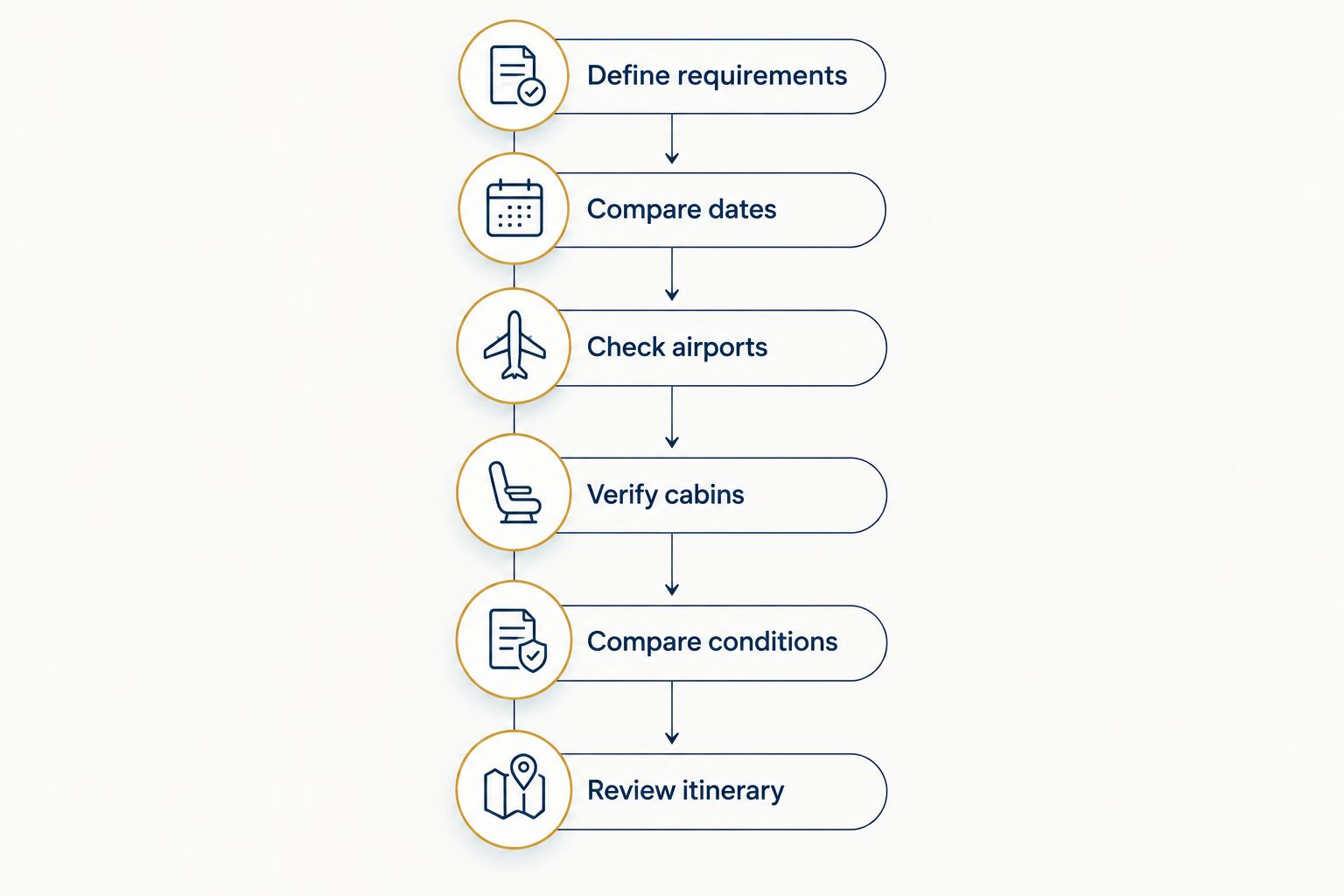
Use a consistent search brief, compare realistic alternatives and review the exact ticket conditions before authorizing a booking. The following steps work whether you research independently or ask a travel consultant to prepare options.
1. Define the journey you actually need
Write down your origin, destination, travel dates and passenger details. Separate fixed requirements from preferences. An arrival before an important meeting is a requirement; a preferred departure time might be negotiable.
Include the cabin you want on connecting flights, not just the longest flight. If you need a particular seat feature, describe that requirement explicitly rather than assuming the business class label guarantees it.
For a leisure trip, your hotel dates and traveling companions help define the boundaries. For corporate travel, include the approval process and any company booking requirements before requesting a quote.
2. Compare practical date alternatives
Search your preferred itinerary first, then compare alternative departure and return dates you can genuinely use. Keep the passenger count and cabin requirements unchanged so the comparison remains useful.
Do not assume a particular weekday always produces the best fare. Compare the actual flights for your trip. A different date only helps if its effect on accommodation, work commitments and the rest of your journey remains acceptable.
3. Check nearby airports and connections
Compare a nonstop itinerary with a connecting itinerary when both suit your plans. If a nearby departure airport is practical, include it as a separate option rather than treating it as interchangeable with your preferred airport.
Consider the full journey from your starting point to your final destination. Ground transport, an overnight stop or an awkward arrival can outweigh the benefit of a more attractive airfare. Check whether the itinerary involves changing airports during a connection.
4. Verify the cabin on every flight
Read each flight segment separately. Confirm the booked cabin, the operating airline and the connection details. A journey described as business class can include a connecting segment in another cabin.
If a lie-flat seat is essential, ask for confirmation of the scheduled aircraft and seat configuration for the relevant flight. Aircraft assignments can change, so treat the scheduled layout as something to verify, not a permanent promise.
5. Compare the ticket conditions
Ask for the change, cancellation and refund conditions attached to the specific fare. Clarify the difference between permission to change a ticket and the financial consequences of making that change.
Also confirm baggage allowances and any seat-selection conditions that matter to you. Do not substitute a general airline policy for the rules of the ticket you are considering. The fare rules belong in the comparison, not after the purchase.
6. Review the final itinerary before approval
Check passenger names against the travel documents, then review airports, travel dates, local departure and arrival times, and cabins. Pay particular attention to overnight flights and arrivals on a different calendar day.
Approve the itinerary only after you understand the terms and the total payable amount. After ticketing, check the e-ticket details against the itinerary you approved and retain the booking information for your journey.
Should you book directly or use a travel consultant?
Choose the booking method that matches how much comparison and coordination you want to handle yourself. Neither booking directly nor using an agency establishes that a particular fare is the best fit; the itinerary and its conditions still need scrutiny.
| Booking approach | Best for | Main advantage | Main limitation |
|---|---|---|---|
| Booking directly with the airline | Travelers who prefer to research and manage their own booking | You review the airline's booking options and complete the purchase yourself | You handle the comparison and check the details yourself |
| Booking through a travel consultant | Travelers who want help comparing fare options and coordinating requirements | You can explain your priorities and discuss the proposed itinerary | You need to understand the agency's terms as well as the airline's fare rules |
Global Business Flights is best for business class travelers who want a dedicated consultant rather than a self-service booking engine. Its stated service includes individual leisure travel, multi-passenger bookings and managed corporate travel accounts.
The trade-off is the booking format: you request and review a quote rather than completing an independent self-service purchase. Ask who handles changes after ticketing and which terms apply before you approve the itinerary. Personal assistance does not replace reading the fare conditions.
Why business class fare comparisons vary
A useful comparison controls for the details that change the journey or the ticket. In 2026, use these factors as a checklist rather than treating every business class result as equivalent:
- Travel dates: A different departure or return date changes the itinerary being quoted. Compare dates you can actually use.
- Departure and arrival airports: An alternative airport changes the ground journey as well as the flight search. Include both in your decision.
- Routing: Nonstop and connecting itineraries involve different travel commitments. Compare the complete route, not just the headline cabin.
- Cabin by segment: A mixed-cabin itinerary is not the same as business class throughout. Identify exactly where the cabin changes.
- Fare conditions: Tickets with different change or refund rules are different purchases. Compare those conditions alongside the itinerary.
- Passenger requirements: A quote for your actual traveling party answers a different question from a search for an individual traveler. State who needs to travel together.
These factors explain why two quotes need closer inspection before you call one the better option. They are not a formula for predicting a discount. A comparison is useful only when you know what changed between the options.
How can you search without being flexible on dates?
Fixed travel dates narrow the comparison, but they do not remove every useful choice. Keep the dates fixed and examine airports, departure times, routing and ticket conditions instead.
For a work trip, begin with the required arrival time and work backward through the proposed itinerary. An overnight journey, a connection and the transfer to your destination all belong in that review. A scheduled arrival is not the same as being ready for your meeting.
For a holiday, compare each option against your accommodation and onward plans. Avoid changing several requirements at once: if you alter the airport, routing and dates together, it becomes difficult to tell which trade-off you are accepting.
When requesting a 2026 quote, make your non-negotiable details explicit. A consultant can then focus the discussion on relevant alternatives instead of presenting journeys you cannot take.
What should you include in a personal quote request?
A clear brief makes the resulting options easier to assess. You do not need aviation terminology; explain where you need to be, when you need to arrive and what matters most during the journey.
Include:
- Your departure city and destination, including acceptable alternative airports.
- Preferred outbound and return dates, plus any practical flexibility.
- The passengers traveling together and any separate return plans.
- Your preferred cabin and any essential seating requirements.
- Your position on connections, airport changes and overnight stops.
- Any need to change or cancel the trip after booking.
- Corporate approval requirements, if the journey is for work.
Then ask for the proposed itinerary and ticket conditions together. Compare both before deciding. If the quote differs from your brief, ask which requirement changed and why that option is being presented.
For multi-passenger travel, clarify whether everyone needs the same flights and cabin. For corporate travel, distinguish the traveler's preferences from the company's requirements so the booking can be reviewed on the right basis.
Explore your fare options
Share your travel plans and discuss business or first class options with a dedicated travel consultant.
Is the lowest quoted business class fare the best choice?
The lowest quoted fare is the best choice only when its itinerary and conditions meet your needs. A less convenient airport, an unwanted cabin segment or restrictive change conditions can make another option more suitable.
Compare the whole journey in writing. If you cannot explain why one option differs from another, ask for clarification before approving either.
Can you book business class for several travelers together?
You can request a multi-passenger business class booking, but the quote should reflect the actual group and its requirements. Do not assume an individual search represents the booking conditions for everyone traveling.
Tell the consultant whether staying on the same flights is essential. Include any passengers with different dates or destinations at the start of the discussion.
What should corporate travelers prioritize?
Corporate travelers should prioritize the required arrival, company policy and the ability to handle a changed schedule. Those requirements determine which fare options deserve consideration.
For recurring travel in 2026, ask how a managed corporate account would handle traveler preferences and booking approvals. Confirm the service arrangement rather than assuming every agency account works the same way.
FAQ
What's the best way to find cheap business class flights?
Find cheap business class flights by comparing practical dates, airports and routes while keeping your cabin requirements consistent. Review the complete itinerary and fare rules before choosing.
Is booking business class through an agency better than booking directly?
An agency suits travelers who want help comparing and coordinating options; direct booking suits travelers who prefer to manage the purchase themselves. Compare the actual itinerary and terms rather than assuming either method always wins.
Does business class always include a lie-flat seat?
Business class does not always include a lie-flat seat. Check the scheduled aircraft and seat configuration for the specific flight, and remember that aircraft assignments can change.
Can a business class ticket include an economy flight?
A business class itinerary can include a segment in economy. Check the cabin shown for every flight before approving the booking.
Should I choose a flexible business class fare?
Choose a flexible fare when its specific change conditions match your plans. Read those conditions carefully because permission to change does not automatically remove every additional charge.
How does Global Business Flights handle booking requests?
Global Business Flights accepts phone and online quote requests and works through a dedicated travel consultant rather than a self-service booking engine. Its stated service covers support from quote to e-ticket for business and first class travel.
What should I check after receiving my e-ticket?
Check passenger names, airports, dates, local flight times and cabins against the itinerary you approved. Keep the e-ticket and booking details accessible for your journey.
One last thing
Before booking business class in 2026, read the itinerary as a journey rather than a search result. Start at your front door, follow every transfer and flight, and finish at the place you actually need to reach.
If a detail matters to your comfort or schedule, have it confirmed before you approve the ticket. That final review is where an appealing fare becomes an informed travel decision.