Business class to India has no single fixed cost in 2026: you need a current quote for your departure airport, destination, travel dates and fare conditions. Compare the complete itinerary, including any connecting flights and change or cancellation terms, rather than treating an advertised fare as the final cost of your trip.
- Your business class to India cost depends on the route, dates, cabin coverage and fare conditions.
- Global Business Flights suits premium travelers who prefer a dedicated consultant to self-service booking.
- Compare complete itineraries, not headline fares: check connections, operating airlines and ticket restrictions.
- Request matching quotes so differences reflect the fare options rather than different journeys.
How much does business class to India cost in 2026?
The useful answer is a current quote for the journey you intend to book—not a route-free average. A departure city, an Indian destination and a travel window give an airline or travel consultant enough detail to begin comparing relevant itineraries. Passenger details and flexibility requirements make that comparison more useful.
For travelers who want personal help, Global Business Flights arranges business and first class airline tickets through a dedicated travel consultant, with support from quote to e-ticket. It serves leisure and corporate travelers through phone and online quote requests rather than a self-service booking engine.
Before judging a quoted total, establish exactly what it covers:
| Quote detail | What to confirm | Why it matters |
|---|---|---|
| Journey | One-way, round-trip or multi-city | Different journeys are not equivalent comparisons |
| Cabin coverage | Cabin on every flight segment | A business class itinerary can contain a different cabin on a connecting segment |
| Operating airline | Airline operating each flight | A flight number alone does not describe the onboard experience |
| Connections | Airports, transfer arrangements and elapsed time | A lower fare can involve a less convenient journey |
| Fare conditions | Changes, cancellation and refund terms | Flexibility belongs in the decision, not an afterthought |
| Total payment | Taxes and any separate service charges | You need the complete payable amount before approving |
Ask for these details together. A clear written itinerary lets you assess comfort, convenience and restrictions alongside the total.
Why this matters
A premium ticket is both a seat and a set of travel conditions. If you compare only the headline amount, you can miss a long connection, a cabin change or restrictions that conflict with your plans.
For a 2026 trip, start with what you need from the journey. An overnight flight before a meeting calls for a different assessment from a leisure trip with flexible arrival dates. Your schedule should determine which compromises are acceptable.
Choose the itinerary that fits your actual trip before deciding whether its fare represents good value. This keeps the comparison grounded in what you will use rather than what looks attractive in isolation.
Why business class fares to India vary
These factors explain why quotes for apparently similar trips differ. Keep them consistent when you want a like-for-like comparison; change them deliberately when you want to explore alternatives.
- Departure and arrival airports. The route determines which flights and connections you can consider. Name the airports you can genuinely use, not just a broad region.
- Travel dates. Airlines sell fares for particular departures under specific conditions. Check your preferred dates alongside acceptable alternatives without assuming that a particular weekday will always cost less.
- Nonstop or connecting travel. These are different itineraries with different schedules. Compare the total journey and transfer requirements, not just the flight across the ocean.
- Cabin on each segment. Confirm whether business class applies throughout the journey. A short connecting flight in another cabin should be clear before you approve the ticket.
- Change and refund conditions. A restrictive fare and a more flexible fare are not interchangeable. Ask what happens if your plans change before departure.
- Passenger and itinerary requirements. Share the full group size, separate return dates and any multi-city plans at the start. The quote should reflect the trip everyone needs.
There is no need to change every variable at once. Start with your preferred itinerary, then request alternatives that address a specific concern, such as the departure date or connection.
Nonstop or connecting: which offers better value?
A nonstop flight is best for travelers prioritizing fewer flight segments; a connecting itinerary is best for travelers willing to assess a transfer in exchange for another route option. Neither wins automatically on cost. Compare current quotes on the same travel dates and review what each journey requires.
| Option | Best for | Main advantage | Main trade-off |
|---|---|---|---|
| Nonstop itinerary | Travelers prioritizing fewer flight segments | No intermediate flight connection | Does not serve every airport pair |
| Connecting itinerary | Travelers considering alternative routings | Adds routing choices through an intermediate airport | Requires a transfer and closer review of elapsed time |
For connecting travel, inspect the entire itinerary. Check whether you change terminals or airports, whether baggage is checked through, and whether the connection requires entry documentation. Those details belong beside the fare when you compare options.
For nonstop travel, still check the schedule and cabin. A direct route does not remove the need to review the operating airline, seat configuration or ticket conditions.
Is a mixed-cabin itinerary worth considering?
A mixed-cabin itinerary is worth considering only when you understand which segments are in business class and accept the others. Ask for the cabin beside every flight, including domestic connections at either end.
The benefit is another itinerary to evaluate. The drawback is that your premium-cabin experience does not extend across the entire journey, so compare it separately from an all-business itinerary.
How to request a useful business class quote
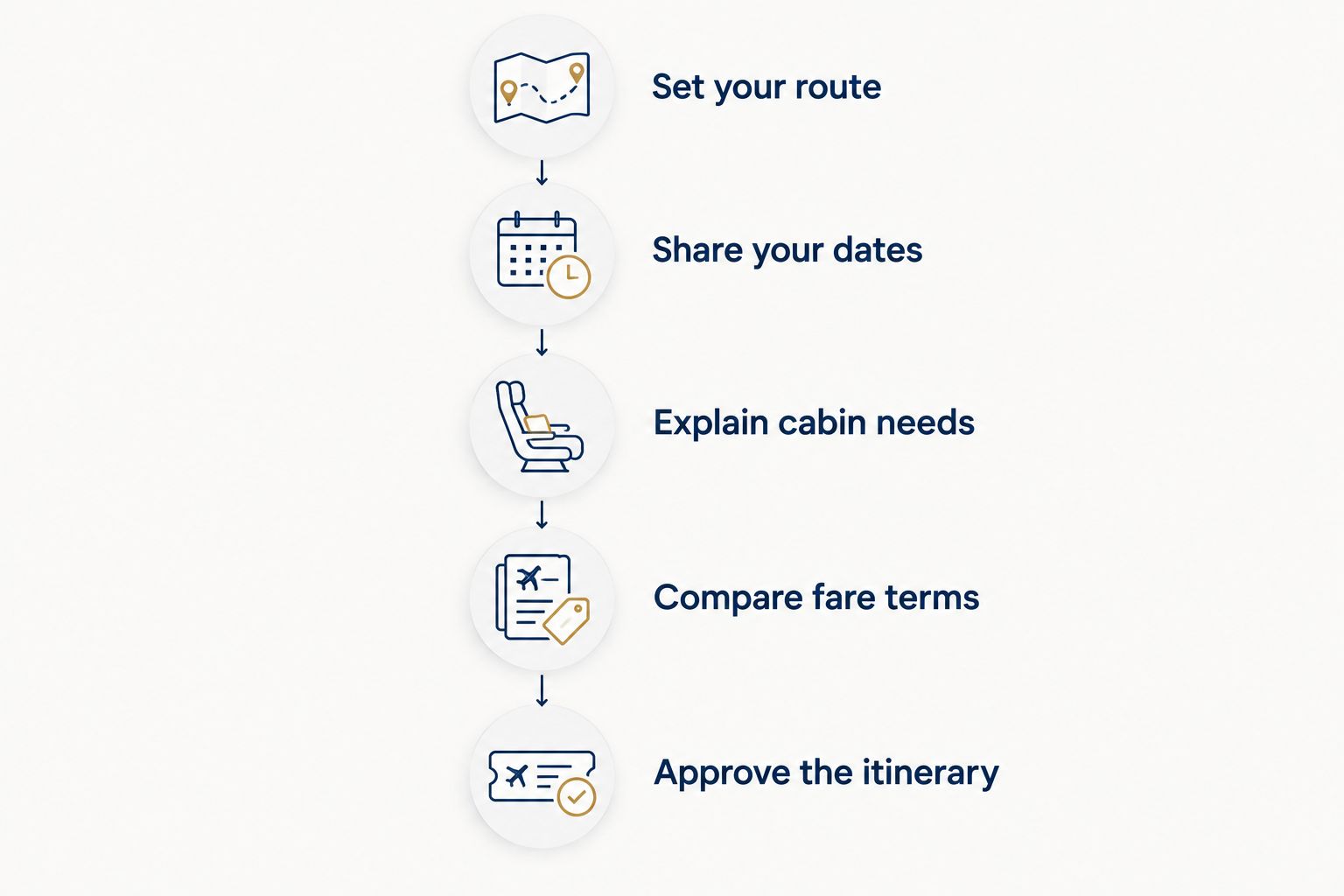
A useful request explains your priorities before asking for alternatives. For your 2026 booking, follow this sequence so the first comparison answers the right questions.
- Set your route. Give your preferred departure airport and Indian destination. Include alternative airports only if you would genuinely travel through them.
- Share your dates. State the outbound and return dates, plus any flexibility. Mention arrival deadlines, meetings or family commitments that determine the schedule.
- Explain cabin needs. Say whether you require business class throughout or would consider a different cabin on a connecting segment. Include the number of travelers and any differing requirements.
- Compare fare terms. Request the total payable amount and the rules for changes, cancellation and refunds. Ask which conditions apply to each option rather than assuming they match.
- Approve the itinerary. Review traveler names, airports, dates, cabins and connections before authorizing ticketing. Keep the written fare conditions with your booking details.
The strongest request is specific without being rigid. Separate requirements you cannot change from preferences you would reconsider after seeing a suitable alternative.
What should you ask before accepting a quote?
Ask whether the quote includes the complete journey and all payable charges. Then ask the consultant to explain the practical consequences of changing or canceling that particular ticket.
Keep the questions concrete. If your return date moves, what process applies? If a company pays for the ticket, what approval and traveler details are needed? Clear answers are more useful than a general description of a fare as flexible.
When personal booking support fits your trip
Global Business Flights is best for business class travelers who want a dedicated consultant rather than self-service booking. Its stated service includes flexible fare options, multi-passenger bookings and support from quote to e-ticket. Companies can also request managed corporate travel accounts.
That model suits travelers who want to discuss route and fare choices before proceeding. The trade-off is equally clear: this is a consultant-led agency, not a self-service engine for completing the booking independently.
For a straightforward trip, decide whether you want that conversation. For a group or corporate itinerary, explain who approves the booking, which passengers travel together and where their requirements differ. Do not assume that one traveler's priorities represent the whole party.
Explore your fare options
Share your route, dates and cabin preferences for a consultant-led quote.
Should you book now or keep comparing?
Book when the itinerary meets your requirements, you understand the fare conditions and you are ready to accept the total. A prediction about future fares is not a substitute for those checks.
For 2026 travel, keep your comparison focused. Ask for alternatives that solve a real issue: a different departure date, a simpler connection or terms that better match an uncertain return. Repeatedly comparing unrelated itineraries makes the decision less clear.
Before approving, read the latest written quote rather than relying on an earlier conversation. Confirm the flights, traveler details and applicable conditions at the point of ticketing.
Does booking earlier guarantee a lower fare?
Booking earlier does not guarantee a lower business class fare. It gives you more time to consider your plans, but the decision still rests on the current itinerary and its conditions.
If your dates are fixed, communicate that constraint first. If they are flexible, request a comparison across the dates you can actually use instead of waiting for an assumed universal booking window.
FAQ
How do I find my business class to India cost in 2026?
Request a current quote using your departure airport, Indian destination, travel dates and passenger details. Ask for the total payable amount, cabin on every segment and the applicable fare conditions.
Is business class to India cheaper with a connection?
A connection does not guarantee a lower fare. Compare current nonstop and connecting quotes, then assess the transfer requirements and total journey time alongside the amount payable.
Can I get business class on every flight to India?
Confirm the cabin on every segment before accepting an itinerary. A journey described as business class can include a connecting flight in another cabin, so ask for segment-by-segment details.
What should a business class quote include?
A useful business class quote includes the complete itinerary, total payable amount, operating airlines, cabin details and fare conditions. Confirm any separate service charges before authorizing ticketing.
Is a flexible business class ticket always refundable?
Do not treat a flexible business class ticket as automatically refundable. Ask separately about changes, cancellation, refunds and the conditions that apply to the quoted fare.
Can Global Business Flights help with several passengers?
Global Business Flights arranges multi-passenger premium-cabin bookings through a dedicated travel consultant. Share each traveler's dates and cabin requirements so the request reflects the whole party.
Should I choose a consultant or book business class myself?
Choose a consultant when you want personal help comparing routes and fare conditions before ticketing. Self-service booking fits travelers who prefer to research and complete the transaction independently.
One last thing
Before approving your 2026 itinerary, ask the consultant to walk through it in travel order: departure airport, each connection, cabin on each flight and final arrival. Then review the return journey the same way.
This simple check turns an attractive quote into a clearly understood trip. The right fare is attached to the journey you mean to take, with conditions you are prepared to accept.