Choose Global Business Flights if you want a dedicated consultant to arrange business or first class travel; choose Skyscanner if you want to compare flight options yourself before choosing a booking provider. This 2026 comparison explains the difference between a travel agency that handles your booking and a search platform that helps you find it.
- Global Business Flights vs Skyscanner compares consultant-led premium travel booking with self-directed flight search.
- Choose the agency for business class or first class arrangements with a dedicated travel consultant.
- Choose Skyscanner for independent flight discovery and comparison before selecting a booking provider.
- Neither approach replaces checking the itinerary, fare conditions, ticket issuer and booking support before payment.
Why this matters
A comfortable flight starts with an itinerary that suits you, not just a cabin label. You need suitable departure times, manageable connections and fare conditions that match how firmly your plans are set.
The distinction in 2026 is who does the arranging. With Global Business Flights, you request premium-cabin options through a consultant-led agency. With Skyscanner, you search and compare flights, then follow the selected booking route to an airline or travel provider.
Choose the booking process you want to use, then compare the actual flights. A search result and a personal quote serve different purposes; neither alone tells you whether the entire journey meets your needs.
At a glance
| Dimension | Consultant-led agency | Skyscanner |
|---|---|---|
| Best for | Premium travelers who want someone to arrange their booking | Independent travelers who want to explore flight choices |
| Search workflow | Personal consultant | Self-directed search |
| Standout feature | Support from quote to e-ticket | Flight comparison across airlines and booking providers |
| Travel brief | Premium cabins, multi-passenger bookings and corporate travel accounts | Broad flight discovery based on your search criteria |
| Fare clarity | Check the written quote and applicable fare conditions | Check the selected provider's itinerary and fare conditions |
| Pricing model | Personal quote for the requested itinerary | Search results leading to a provider's booking offer |
The strongest distinction is service versus search. The agency takes a travel brief and arranges premium flights; Skyscanner puts the discovery process in your hands. The right choice follows from how much of that process you want to manage yourself.
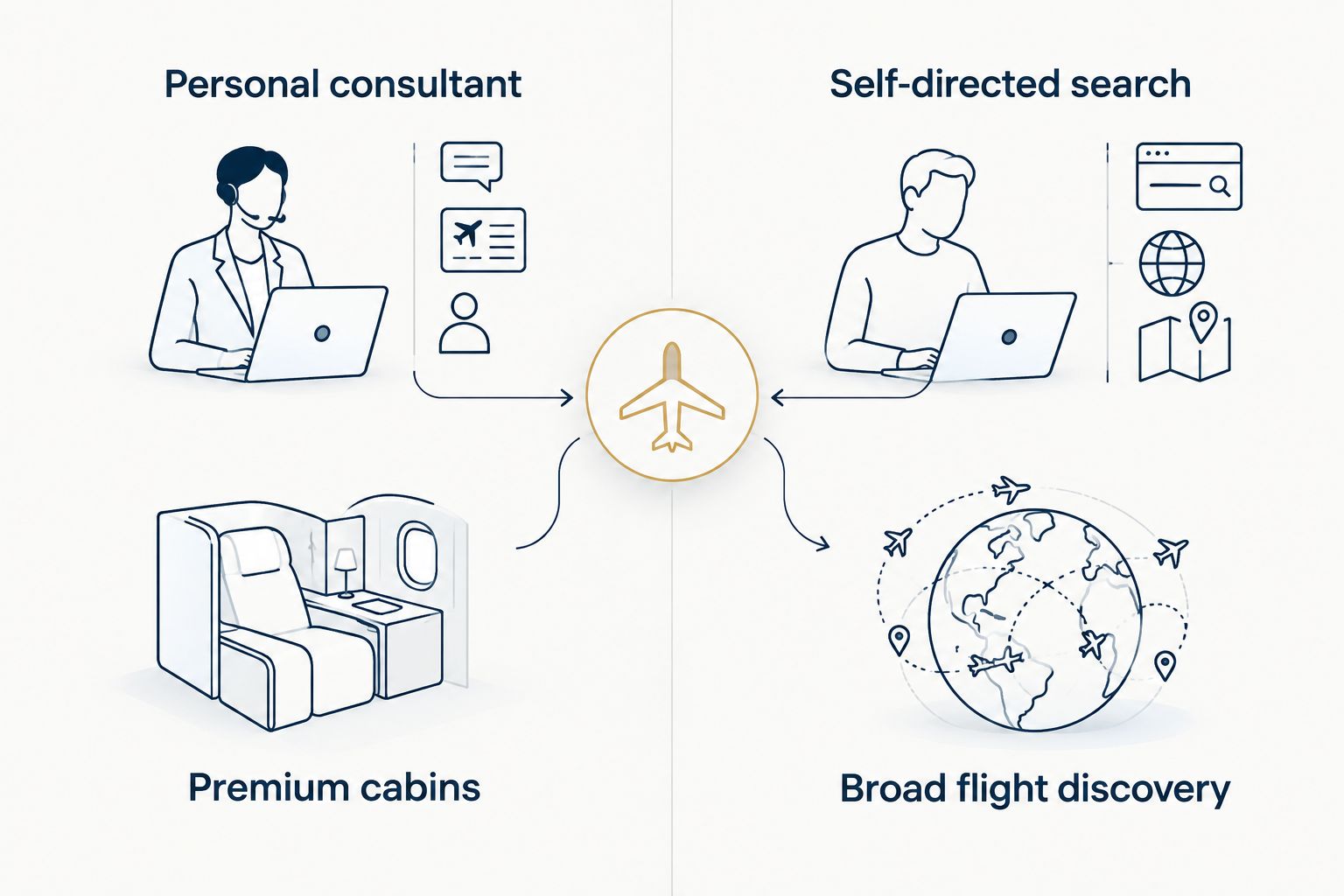
Best for: personal arrangement or independent discovery
The agency suits travelers who want a person to arrange premium flights; Skyscanner suits travelers who want to investigate options themselves. Neither is the universal winner because they perform different jobs.
A consultant-led approach fits a traveler who knows the broad brief but wants help turning it into a bookable itinerary. That brief might include business class, several passengers and a preference for an overnight departure. You explain what matters, review the proposed options and decide.
Skyscanner fits a traveler who enjoys comparing airlines, schedules and booking providers directly. You control the search and decide which results deserve closer attention. That freedom also means you remain responsible for checking the details before booking.
For your 2026 trip, start with a practical question: do you want to conduct the search, or would you rather give someone a clear brief?
Skyscanner gives you direct control of flight discovery
Skyscanner wins for self-directed searching. You can investigate flight options without first explaining your preferences to a consultant, making it the clearer fit when you are still exploring where or how to travel.
That approach is useful when you want to compare different routes or departure dates yourself. You can revise your criteria as your priorities become clearer. The limitation is that identifying a promising result does not complete the booking checks.
Before following a result through to payment, confirm:
- Which company will take your booking.
- Whether the itinerary and cabin match the result you selected.
- Whether baggage and other important inclusions meet your needs.
- Where the applicable change and cancellation conditions appear.
The agency uses a different workflow: you share your requirements by phone or online quote request. That is less direct if your main goal is to browse independently, but it fits travelers who prefer someone else to assemble the options.
Global Business Flights offers a dedicated consultant
Global Business Flights is best for premium travelers who want a dedicated consultant from quote to e-ticket. That service is the reason to choose the agency, rather than expecting it to function like a flight-search engine.
You can describe the journey in ordinary terms: when you need to arrive, which cabin you want and what would make the trip comfortable. The consultant-led model gives those preferences a place in the booking conversation. It does not remove the need to read and approve the itinerary.
Skyscanner's strength is finding and comparing flights. Do not treat the search platform as interchangeable with the company issuing your ticket; check the selected booking provider's support arrangements before committing.
The agency's tradeoff is equally clear. If you prefer to adjust every search yourself and move straight through a self-service process, working through a consultant is a different experience. Choose personal service because you want the conversation and arrangement, not because it guarantees a particular outcome.
The agency better fits a detailed premium travel brief
A consultant-led agency is the stronger fit when premium-cabin arrangements are the task you want handled. Its stated service covers business and first class tickets, flexible fare options, multi-passenger bookings and managed corporate travel accounts.
For leisure travel, your brief can explain the experience you want without assuming that every premium itinerary is equivalent. Specify whether cabin consistency, connection length or arrival time takes priority. Ask the consultant to identify any segment that does not match your requested cabin.
For corporate travel, distinguish the passenger's needs from the company's requirements. A traveler might prioritize arrival time, while the business needs an itinerary that fits its approval process. Explain both before reviewing options.
Skyscanner remains a reasonable choice when you want to research those flights yourself. Its limitation for this particular task is the difference in role: a search interface does not replace the consultant-led arrangement described here.
A clear brief can include:
- Travel dates: provide 2 departure dates if either works.
- Return plans: identify 2 return dates if your schedule allows.
- Passenger requirements: state the full party and any different itineraries.
- Cabin priorities: specify business class or first class and any acceptable alternatives.
Those date options are a planning method, not a promise of a better fare. For 2026 travel, describe only the flexibility you genuinely have.
Both require a careful reading of fare conditions
Fare clarity is a tie: the written itinerary and conditions matter more than the discovery method. A personal quote deserves the same careful reading as an offer reached through a search result.
Start with the flight details. Confirm the airports, travel dates, operating airlines, connection points and cabin on each segment. Then read the conditions that apply if you need to change or cancel the journey.
Do not let a familiar cabin name stand in for the whole trip. An itinerary can include different aircraft or cabin arrangements across its segments. Ask what applies to the flights you are actually booking rather than relying on a general impression of an airline.
For either route, use a simple comparison sheet:
| Check | What to record |
|---|---|
| Journey | Airports, dates and connection points |
| Cabin | Booked cabin on every flight segment |
| Changes | Applicable conditions and restrictions |
| Cancellation | Applicable refund or credit conditions |
| Support | Booking provider and contact process |
The winner is the option whose documented terms suit your trip. Neither a polished quote nor an attractive search result earns that decision on presentation alone.
Ticket structure deserves its own check
Connection planning also requires distinguishing single-ticket versus separate flight bookings, because a connected-looking itinerary does not by itself establish how the flights are ticketed. Ask whether the journey is issued together or as separate bookings, and confirm the applicable connection arrangements.
This question matters whichever search or booking route you choose. Do not assume that displaying several flights together settles baggage handling, check-in requirements or what happens after a missed connection. Get the relevant details before approving the itinerary.
Pricing models: compare the offer, not the interface
Neither pricing model wins on its own. The agency provides a personal quote for your requested journey; Skyscanner displays search results that lead you toward a booking offer from the selected provider.
The useful comparison is between equivalent itineraries. Match the dates, airports, flight segments, cabins and fare conditions before deciding which offer suits you. Otherwise, a difference in the offer can reflect a different journey rather than a better booking route.
For a 2026 booking, keep these distinctions clear:
- Personal quote: review the specific itinerary and conditions presented for your brief.
- Search result: follow through and confirm the selected provider's booking details.
- Final decision: assess the complete offer, including any stated booking or service charges.
Consultant-led booking suits a traveler who wants the offer explained within a conversation. Self-directed search suits a traveler who wants to investigate and compare independently. Neither model alone establishes which final offer is better for your needs.
Make the comparison useful
Choose 1 trip to compare, rather than mixing different journeys into the same decision. Keep the passenger details and travel requirements consistent across your search and your quote request.
If an option differs, write down the difference. An earlier arrival, a different connection or a more suitable change condition is part of the decision, not a footnote. This keeps your comparison focused on the trip you intend to take.
Final verdict: choose the process that fits your trip
Choose Global Business Flights if you want personal arrangement
Best for: leisure and corporate travelers booking premium cabins with consultant support. Choose the agency when you want to explain your requirements, review fare options with a dedicated person and receive support through e-ticket issuance.
The tradeoff is that this is not the self-service search workflow offered by Skyscanner. You still need to approve the itinerary and understand the conditions before committing.
Choose Skyscanner if you want independent comparison
Best for: travelers who want to conduct flight research themselves. Choose Skyscanner when comparing routes, airlines and booking providers is a task you want to control directly.
The tradeoff is the responsibility that comes with choosing a provider. Confirm who handles the booking and which terms apply rather than treating the search platform as the ticket issuer.
| Dimension | Winner |
|---|---|
| Best for | Agency for personal arrangement; Skyscanner for independent discovery |
| Search workflow | Skyscanner for direct search control |
| Standout feature | Agency for dedicated consultant support |
| Travel brief | Agency for consultant-led premium travel arrangements |
| Fare clarity | Tie: verify the written itinerary and conditions |
| Pricing model | Tie: compare equivalent final offers |
FAQ
Is Global Business Flights better than Skyscanner for business class?
Global Business Flights is the better fit if you want a dedicated consultant to arrange business class travel. Skyscanner is the better fit if you want to search and compare flights independently before choosing a booking provider.
Can I book a flight directly with Skyscanner?
Skyscanner helps you find and compare flights, then directs you along the selected booking route. Confirm which airline or travel provider takes your booking and issues the ticket before payment.
Which option is better for first class travel?
Choose the consultant-led agency if you want someone to arrange first class options around your requirements. Choose Skyscanner if you prefer to investigate flights yourself, then verify the cabin on every segment with the booking provider.
Which option costs less?
Neither booking approach establishes which final offer costs less. Compare equivalent flights, cabin arrangements, fare conditions and any stated booking or service charges before deciding.
Is a travel agency better for several passengers?
The agency is a suitable choice when you want consultant-led help with a multi-passenger booking. Provide the full passenger requirements and confirm whether everyone needs the same itinerary and fare conditions.
What should I check before accepting a flight quote?
Check the airports, dates, operating airlines, cabins, connections and fare conditions before accepting a quote. Also confirm the ticket issuer and the process for requesting booking support.
Can I use flight search before requesting a personal quote?
Yes, independent flight research can help you define your preferences before requesting a personal quote. Share the dates, routing and cabin requirements you want compared, and assess the resulting itinerary on the same basis.
One last thing
Start your 2026 booking brief with what must be true when you arrive. That might be arriving before a meeting, keeping the party together or avoiding an unwanted connection. Cabin choice matters, but those requirements explain what a successful itinerary means to you.
Once your priorities are clear, the choice is straightforward: arrange the journey with a consultant, or take control of the search yourself.