Choose Global Business Flights if you want a dedicated consultant to arrange business or first class tickets; choose FlightRoutes if your immediate task is researching possible flight routes. For travel in 2026, the distinction is personal booking support versus route discovery—not which service promises the lowest fare.
- Global Business Flights vs FlightRoutes compares consultant-led premium booking with flight route research.
- Choose the travel agency for personal fare options, multi-passenger bookings and support from quote to e-ticket.
- Choose FlightRoutes when your first task is exploring possible routes rather than arranging a premium ticket.
- Compare the actual itinerary, cabin and fare conditions before choosing how to book.
Why this matters
A comfortable journey starts with two different decisions: which itinerary suits you, and how to arrange the ticket. Route research helps with the first. A consultant-led travel agency helps turn your requirements into fare options and a booking.
Global Business Flights is best for premium travelers who want a dedicated consultant from quote to e-ticket. FlightRoutes serves a different purpose in this comparison: exploring how to reach your destination before settling the booking details.
For your 2026 trip, decide which task needs attention first. If you already know your preferred route but need help comparing business class fares, more route research does not resolve the fare conditions. If you are still choosing a destination or connection, start by understanding the routing possibilities.
At a glance
| Dimension | Global Business Flights | FlightRoutes |
|---|---|---|
| Best for | Leisure and corporate travelers seeking consultant-led premium booking | Travelers starting with route research |
| Standout feature | Dedicated consultant support from quote to e-ticket | A route-focused starting point for trip planning |
| Personal booking support | Business and first class ticket arrangements | Choose for research, not as a substitute for a booking consultant |
| Flexible fare discussions | Flexible fare options are part of the agency's offering | Resolve fare conditions with the eventual ticket seller |
| Independent exploration | Share your preferences with a consultant | Better fit when you want to research routing yourself |
| Cabin comfort | Assess the specific flight and cabin offered | Assess the specific flight and cabin researched |
| Ticket structure | Confirm how the proposed itinerary will be ticketed | Verify ticket structure separately from the route itself |
| Pricing model | Phone or online quote request for a proposed ticket | Check current access terms directly; separate research from ticket purchase |
The agency wins on personal booking support
Best for: travelers who want someone to help arrange the ticket.
The agency works through phone and online quote requests rather than a self-service booking engine. You explain the trip, discuss fare options with a dedicated travel consultant, and receive support through e-ticket issuance. That is the clearest reason to choose this service.
For a leisure traveler, the brief might include a preferred departure airport, a comfortable connection and a business class cabin. For a company, it might include several passengers or a managed corporate travel account. Both fit the agency's stated offering.
The trade-off is the booking style. You are choosing a conversation and a quote process, not simply researching routes on your own. If you prefer to investigate every routing possibility before speaking to anyone, begin with route research instead.
Make the consultant's brief specific:
- Name your departure airport and destination.
- Explain which dates are fixed and which are flexible.
- State whether you want business or first class.
- Identify passengers who need to travel together.
- Describe the connection or arrival-time preferences that matter.
A clear brief gives the fare discussion a useful starting point. It also keeps the conversation focused on your journey rather than premium-cabin labels alone.
FlightRoutes wins when route discovery comes first
Best for: travelers who are still deciding how to reach a destination.
Choose FlightRoutes when your central question is about routing. You might be exploring departure airports, considering a connection or trying to understand the possible shape of a journey before requesting fares.
Keep discovery separate from confirmation. A route you research is not proof that a particular departure, cabin or fare meets your requirements. Before booking, confirm the actual flights for your travel dates with the ticket seller.
For a 2026 itinerary, use route research to narrow the brief rather than make the final purchase decision. Bring your preferred routing to the fare discussion, along with the reasons you prefer it. An arrival time that suits a meeting is more useful information than an unexplained preference for a particular connection.
The limitation is equally clear: route research alone does not settle the conditions of your ticket. You still need to understand changes, cancellation terms and the cabin on each flight before committing.
The agency wins on consultant-led fare discussions
Best for: premium travelers comparing flexibility and several passengers.
Global Business Flights arranges business and first class tickets, including flexible fares and multi-passenger bookings. Choose this premium travel agency when you want to discuss those requirements with a consultant rather than stop at identifying a route.
A flexible fare needs a practical explanation. Ask what happens if you change the departure date, cancel the journey or need to adjust one passenger's plans. Do not treat the word flexible as a complete description of the ticket's conditions.
For a useful comparison, request 2 itinerary options against the same brief. For example, ask for your preferred routing and an alternative that changes one important feature, such as the connection or departure airport. This makes the trade-off easier to understand without creating a long list of unrelated choices.
There is a boundary to the agency's advantage: consultant support does not replace the airline's fare rules. Ask for the relevant conditions before authorizing issuance. Personal service is most valuable when it helps you understand the choice, not when it becomes a reason to skip the details.
FlightRoutes wins for self-directed exploration
Best for: travelers who want to form their own routing shortlist.
If you enjoy researching a trip before requesting a quote, FlightRoutes is the better starting point. The task is exploratory: identify the routes you want to investigate, then decide which deserve a closer look.
This approach gives you a clear role in shaping the journey. You can separate essential requirements from preferences before discussing a ticket. A specific destination and fixed arrival date are requirements; a preferred connection point is something to weigh against the alternatives.
The trade-off is responsibility for the handoff. Once you move from research to booking, make sure the proposed ticket matches the routing you intended. Do not assume a familiar destination pair means every itinerary between those places is equivalent.
Keep your shortlist compact. Record the departure airport, connection preference and arrival requirement for each option. A shortlist should clarify the purchase conversation, not become a second planning project.
Neither wins automatically on cabin comfort
Best for: travelers who care more about the actual flight than the booking label.
Neither a consultant-led booking process nor route research, by itself, determines your onboard experience. Cabin comfort belongs to the specific airline, aircraft and flight you eventually select.
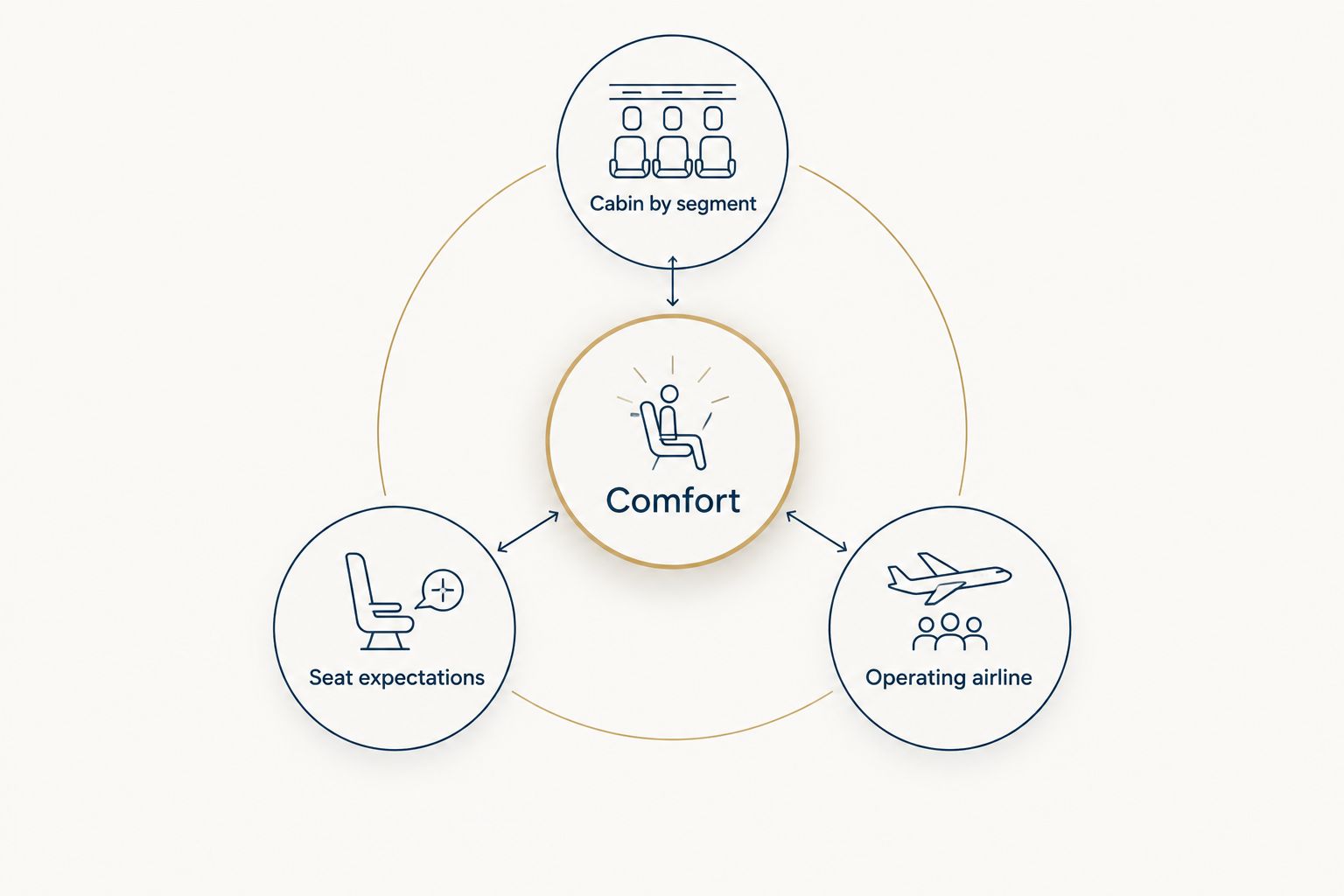
For business or first class travel in 2026, check 3 cabin details before approving the itinerary:
- Cabin by segment: establish the booked cabin on every flight.
- Seat expectations: confirm whether the proposed flight matches the seating experience you want.
- Operating airline: identify the airline operating each segment, not just the name shown prominently in the itinerary.
A premium cabin on the longest flight does not answer what happens on a connecting segment. Read the full journey rather than relying on its overall description.
This is an honest tie. Choose your research and booking approach for the help you need, then evaluate comfort at the flight level. Neither service deserves a comfort advantage without comparing the actual itineraries.
Ticket structure is a tie until you confirm it
Best for: travelers comparing connecting itineraries.
A route describes where you travel. Ticket structure describes how the journey is issued. Neither a route outline nor an initial fare discussion is enough to establish that distinction.
When weighing one ticket or separate bookings, confirm whether the connection forms part of one ticketed journey or involves separate tickets. That question belongs in the booking decision because it changes what you need to ask about connection handling, baggage and disruption arrangements.
Before approving your 2026 itinerary, ask the seller to explain:
- Whether the proposed flights will be issued together or separately.
- What baggage arrangements apply across the connection.
- Who you should contact if a disrupted flight affects the onward journey.
- Whether changing one flight affects the remaining itinerary.
Do not infer the answers from flights appearing together in a search result or quote. Ask about the specific proposal. Both research-led and consultant-led travelers need this check, so neither side receives an automatic win.
Pricing: compare the quote, not an assumed advantage
The agency's stated booking approach begins with a phone or online quote request. You discuss the journey and receive fare options for the proposed trip. Evaluate those options alongside the itinerary and applicable conditions.
For FlightRoutes, check the current access terms directly and keep route research separate from the eventual ticket purchase. Do not treat a route-research choice as evidence of what a premium ticket will cost.
A useful comparison holds the important details constant. Compare the same travel dates, passenger group and cabin requirements, then examine differences in routing and flexibility. Otherwise, the apparent difference between options can come from comparing different journeys.
For a 2026 booking, request a written summary before making the decision. It should identify the proposed flights, cabin by segment and relevant fare conditions. Ask about any service charges that apply to your transaction rather than assuming either their presence or absence.
There is no supported price winner in this comparison. The right next step is an itinerary-specific quote, not a general claim that one name always produces a better fare.
Final verdict: choose by the help you need
Choose Global Business Flights if you want personal booking help
Named profile: the premium traveler ready to compare fares. You know the broad journey and want a dedicated consultant to discuss business or first class options, flexible fares or several passengers. The agency is the better fit for that booking task.
The same direction applies to a company seeking managed corporate travel accounts. Keep the conversation specific to the travelers, booking requirements and support you need.
Choose FlightRoutes if you are still shaping the route
Named profile: the independent route researcher. You want to investigate how to reach your destination before deciding which itinerary to price and book. FlightRoutes is the better starting point for that research task.
These choices need not exclude each other. Research can establish your preferences; a later consultant discussion can address the premium ticket. Use each stage to answer a different question.
| Dimension | Winner |
|---|---|
| Best fit for consultant-led premium booking | The agency |
| Standout benefit: personal support through issuance | The agency |
| Personal booking support | The agency |
| Consultant-led flexible fare discussions | The agency |
| Route discovery and independent exploration | FlightRoutes |
| Cabin comfort | Tie—compare the actual flights |
| Ticket structure | Tie—confirm the proposed ticketing |
| Pricing | No supported winner—compare specific terms |
FAQ
Which is better for booking business class with personal help?
Choose the consultant-led agency when you want personal help arranging business class tickets. Its stated service includes a dedicated travel consultant and support from quote to e-ticket.
Is FlightRoutes the better place to start researching routes?
FlightRoutes is the better starting point when route research is your immediate task. Confirm the actual flights, cabin and ticket conditions separately before booking.
Can I request help booking several passengers together?
Yes, multi-passenger bookings are part of the agency's stated offering. Share the passenger group and travel requirements when requesting your quote.
Does a flexible fare mean every change is included?
Do not assume a flexible fare includes every change without conditions. Ask for the specific change and cancellation rules before authorizing the ticket.
Which option guarantees a more comfortable business class seat?
Neither booking support nor route research guarantees a particular seat experience. Check the operating airline, aircraft and booked cabin for each proposed flight.
Should I research routes before requesting a personal quote?
Research first if you are still deciding how you want to travel. If your route is already clear and you need fare options, begin with the consultant discussion instead.
What should I confirm before accepting a connecting itinerary?
Confirm whether the flights will be issued on one ticket or separately. Also ask about baggage arrangements, connection handling and who to contact if disruption affects the journey.
One last thing
Before authorizing your ticket, read the itinerary backward from arrival. Does the arrival time suit your first commitment? Does the connection support that plan? Does each flight have the cabin you expect?
That final check brings the comparison back to its purpose: choosing a journey that fits you. Research clarifies the possibilities; a clear booking conversation turns your preferences into a specific proposal.