FlightRoutes helps you research airline routes and connections before choosing a journey. Route research is not the same as arranging a premium ticket with personal booking support. The best FlightRoutes alternative in 2026 is Global Business Flights if you want a dedicated travel consultant; booking directly with your chosen airline is the better fit if you want to manage the purchase yourself.
- For flightroutes alternatives for premium ticket booking, choose Global Business Flights for consultant-led business class and first class arrangements.
- Choose direct airline booking when you already know your preferred flight and want to handle the purchase yourself.
- Keep FlightRoutes for route research; assess booking support and fare conditions separately.
- Compare the operating airline, cabin on every segment, connection details, and written fare rules before authorizing a ticket.
Why this matters
A premium journey involves more than finding a route between two airports. You also need to understand which airline operates each flight, which cabin you are purchasing, and what happens if your plans change. An appealing itinerary is only the beginning.
Global Business Flights arranges business and first class tickets through phone and online quote requests, with a dedicated travel consultant supporting you from quote to e-ticket. That is a different service from researching routes or completing an airline purchase yourself.
For your 2026 travel plans, choose the booking method around the help you need. Start with 3 booking priorities: your preferred cabin, your acceptable itinerary, and your flexibility requirements.
FlightRoutes alternatives at a glance
These options serve different purposes. FlightRoutes belongs in the comparison because route discovery can remain useful even when you arrange your ticket elsewhere.
| Option | Best for | Standout role | How it differs from FlightRoutes |
|---|---|---|---|
| FlightRoutes | Researching routes and connections | Route discovery | The route-research benchmark, rather than a substitute for personal ticket arrangements |
| Global Business Flights | Consultant-led business and first class booking | Dedicated consultant from quote to e-ticket | Arranges premium tickets and discusses fare options with you |
| Direct airline booking | Travelers who have chosen an airline and itinerary | Purchasing through the airline's own booking channel | Moves from route exploration to purchasing a specific ticket |
| Managed corporate travel account | Companies needing organized travel arrangements | A service relationship built around company travel needs | Addresses business travel requirements beyond an individual route search |
The strongest alternative is the booking method that matches how much responsibility you want to keep. If you enjoy researching and managing the details, direct booking deserves consideration. If you want someone to work through the options with you, a consultant-led agency is the closer match.
1. Global Business Flights: best for personal premium booking
Global Business Flights is a travel agency for leisure and corporate travelers seeking business and first class tickets. You work through phone or online quote requests rather than a self-service booking engine. A dedicated consultant supports the process from the initial quote to the e-ticket.
That makes this option relevant when finding a route is only part of your task. You might need to discuss flexible fares, arrange tickets for several passengers, or compare premium travel options with a person before deciding.
Where the agency shines
- Personal guidance: You have a dedicated consultant for the booking process.
- Premium-cabin focus: The agency arranges business and first class tickets.
- Multi-passenger arrangements: You can discuss a booking involving more than one traveler.
- Leisure and corporate needs: The service includes individual journeys and managed corporate travel accounts.
Where the agency falls short
- It is not self-service: You do not complete the booking through an instant, independent booking engine.
- It requires a conversation: You need to share your requirements and review the proposed arrangements with a consultant.
- A quote still needs scrutiny: Personal support does not replace checking the itinerary and the conditions attached to the fare.
If you already know exactly which flight you want and prefer to complete every step yourself, the consultant process is an extra interaction rather than an advantage. Choose it because you want assistance, not because every premium ticket requires an agency.
Head-to-head with FlightRoutes
| Dimension | Consultant-led agency booking | FlightRoutes |
|---|---|---|
| Main purpose | Arranging a premium ticket | Researching routes and connections |
| Your starting point | Travel requirements and a quote request | A route or destination search |
| Decision support | Discussion with a dedicated consultant | Route information for your own research |
| Useful outcome | A reviewed booking and e-ticket | Route knowledge to inform your next step |
Best for: Travelers who want business or first class arrangements with personal help, including flexible-fare discussions and multi-passenger bookings.
Verdict: Buy through a consultant when personal booking support is part of what you need.
2. Direct airline booking: best for independent travelers
Direct airline booking means purchasing through your chosen airline's own channel. It suits you when your route research is complete and you are ready to select a flight, review its conditions, and manage the purchase yourself.
The distinction is control. Instead of asking a consultant to arrange your journey, you make the selections and check the details before payment. For a straightforward trip with a clear airline preference, that is a sensible approach.
Where direct airline booking shines
- A clear purchase path: You move from a chosen itinerary to the airline's booking process.
- Independent decision-making: You select the flight and fare yourself.
- A familiar starting point: You can begin with the airline you already intend to fly.
Where direct airline booking falls short
- You own the comparison: You must assess alternatives and decide which conditions suit your trip.
- One airline is your starting point: Comparing other airlines requires separate research.
- Detail checking stays with you: You need to confirm the cabin, operating carrier, passenger information, and fare conditions.
Do not treat the premium-cabin label as a complete description of the journey. Check every segment, particularly when an itinerary includes a connection. Ask the airline to clarify anything you cannot establish from the booking details.
Head-to-head with FlightRoutes
| Dimension | Direct airline booking | FlightRoutes |
|---|---|---|
| Main purpose | Purchasing a selected itinerary | Exploring routes and connections |
| Best starting point | A preferred airline or flight | A destination or route question |
| Your responsibility | Select and review the ticket | Interpret route information |
| Place in your journey | The purchase stage | The research stage |
For a 2026 trip you have already planned in detail, changing research tools is not necessarily the next move. Moving to the airline's booking channel is.
Best for: Travelers who know their preferred itinerary and want to handle the booking themselves.
Verdict: Buy directly when you are comfortable checking and managing the ticket details.
3. Managed corporate travel: best for company requirements
A managed corporate travel account is an arrangement for business travel rather than simply another route-search option. Global Business Flights offers these accounts alongside individual premium-ticket bookings.
Choose this approach when the booking must reflect company requirements as well as a traveler's preferences. Explain approval needs, passenger details, preferred cabins, and any internal rules before asking for itineraries.
Where managed corporate travel shines
- Company context: You can discuss business requirements alongside the journey itself.
- A defined service relationship: The account provides a setting for arranging corporate travel.
- Passenger coordination: Multi-passenger booking needs can be part of the discussion.
Where managed corporate travel falls short
- It needs preparation: Your company must explain its requirements clearly.
- It is not a universal fit: An occasional personal trip does not necessarily call for a corporate account.
- The scope matters: Confirm responsibilities and support arrangements rather than assuming what an account includes.
| Dimension | Managed corporate travel | FlightRoutes |
|---|---|---|
| Main purpose | Arranging travel for company needs | Researching routes and connections |
| Planning context | Business requirements and travelers | Routes and destinations |
| Appropriate next step | Discuss account requirements | Use route information to continue planning |
Best for: Companies that need travel arrangements considered within a business context.
Verdict: Hold off on choosing an account until your company has defined its booking requirements.
Why people look beyond FlightRoutes
The practical reason to look beyond a route-research service is a change in task. You are no longer asking how to reach a destination. You are deciding what to purchase and how much help you want with that decision.
There is no need to dismiss FlightRoutes to make that distinction. Route discovery and ticket arrangements can sit comfortably in the same planning process.
You need to discuss fare conditions
A workable schedule does not tell you whether the fare suits changing plans. Before authorizing a ticket, ask what changes are permitted, what conditions apply, and how a cancellation would be handled. Request answers for the specific fare under consideration.
You are arranging several passengers
A shared route is not the whole booking brief. Travelers can have different cabin preferences, departure points, and flexibility needs. Put those requirements in writing before comparing proposed itineraries.
You want support through ticketing
Research provides information; a booking service carries the arrangement toward an issued ticket. If that distinction matters to you, compare the service process as carefully as the route. For 2026 travel, confirm what support covers before and after ticket issuance rather than assuming the scope is identical.
How to compare your premium booking options
Use the same brief for every booking channel. Otherwise, you risk comparing journeys that differ in ways the headline route does not reveal.
- Set your brief. Share departure and destination airports, travel dates, passenger details, preferred cabin, and flexibility needs. Separate requirements from preferences.
- Compare itineraries. Request 2 itinerary options when you want a meaningful choice. Check the operating airline, cabin on each segment, connection airports, and travel dates throughout.
- Check fare rules. Ask for the conditions attached to each proposed fare. Do not assume that business or first class automatically means unrestricted changes or cancellation.
- Confirm ticket details. Request 1 written summary of the selected itinerary and conditions before authorizing the booking. Check passenger names against the travel documents you will use.
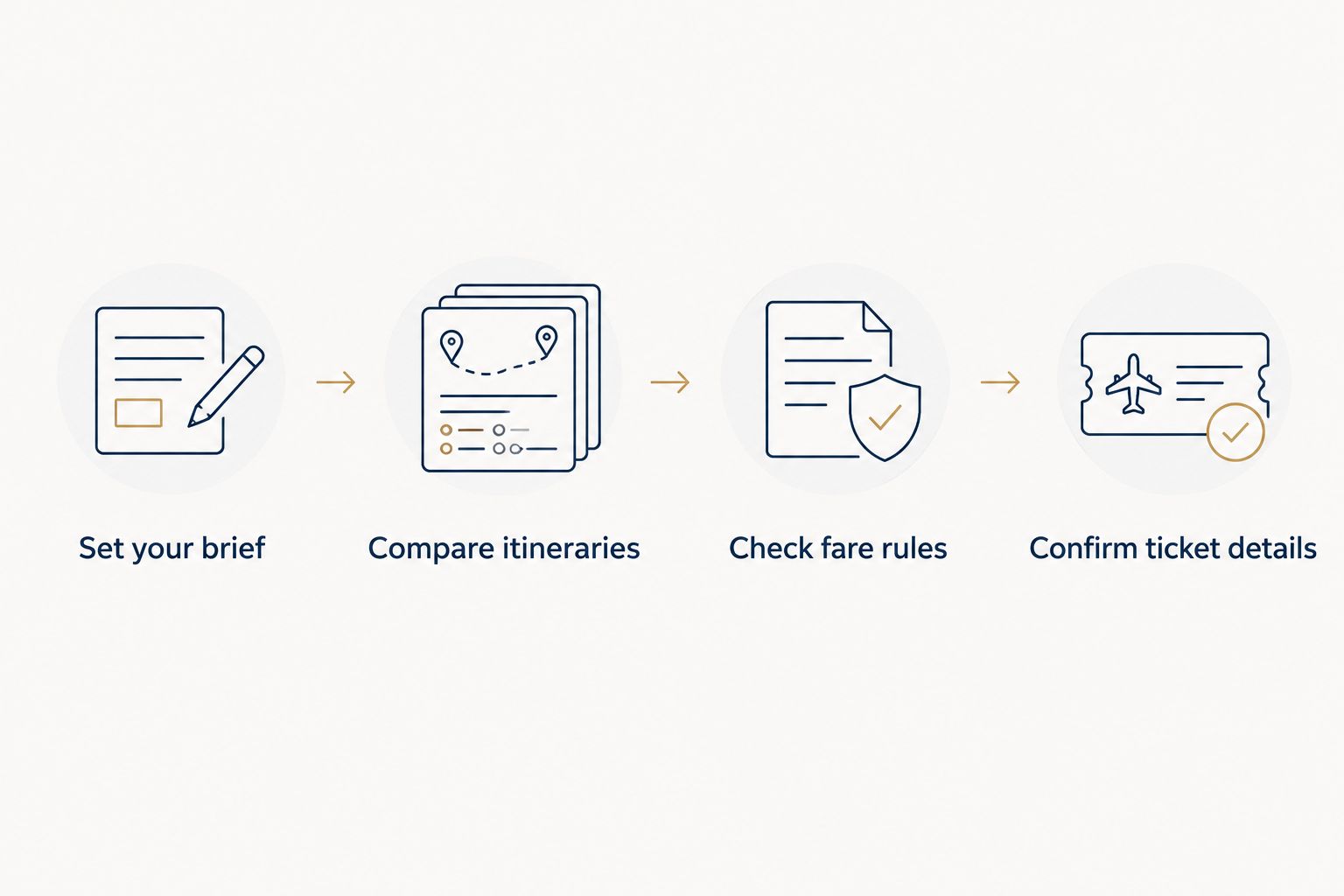
This process works whether you book through an agency or directly with an airline. It also keeps comfort specific: your preferred cabin, an acceptable connection, and fare conditions you understand are more useful than a general promise of a premium experience.
Explore your fare options
Discuss business or first class travel with a dedicated consultant, from quote to e-ticket.
When staying with FlightRoutes is the right call
Keep using FlightRoutes when your main question concerns routes and connections. You do not need to replace a research resource simply because you intend to purchase a premium ticket later.
The sensible boundary is between discovering a possible journey and confirming the ticket you will buy. Use route research to shape your brief, then review the actual itinerary and fare conditions through your chosen booking channel.
Stay with FlightRoutes for research; choose your booking service separately. That remains a useful distinction for both leisure and corporate travel in 2026.
FAQ
What's the best FlightRoutes alternative for premium ticket booking?
Global Business Flights is the best fit when you want a dedicated consultant to arrange business or first class tickets. Direct airline booking is the better fit when you have selected your itinerary and want to manage the purchase yourself.
Should I stop using FlightRoutes if I book through a travel agency?
No. You can use FlightRoutes for route research and a travel agency for ticket arrangements. Treat the research itinerary as a starting point, then confirm the actual flights and fare conditions before purchasing.
Is booking directly with an airline better than using a consultant?
Direct airline booking is better suited to travelers who want to make and check the booking themselves. A consultant-led agency suits travelers who want personal discussion and support through the ticketing process.
Can a travel agency help with several business class passengers?
Yes. The agency described here arranges multi-passenger bookings as part of its premium-ticket service. Share each traveler's requirements before asking for options, especially when departure points or flexibility needs differ.
Does a business class ticket always allow changes?
No. Change and cancellation conditions depend on the specific fare, not just the cabin name. Request the applicable rules before authorizing the ticket.
What should I send with a premium flight quote request?
Send your departure and destination airports, travel dates, passenger details, preferred cabin, and flexibility requirements. Include company booking requirements when the trip is for business.
What should I check before approving a premium ticket in 2026?
Check passenger names, operating airlines, the cabin on every segment, connection details, and fare conditions. Review the written itinerary rather than relying only on the route or cabin headline.
One last thing
Compare the least comfortable segment, not just the most appealing one. On a connecting journey, the cabin and schedule of each flight contribute to your experience.
Before deciding, ask one final question: does every part of this itinerary meet my requirements? That question keeps the focus where it belongs—on the journey you will actually take.