
Instead of repeatedly calling to change business class flight itinerary details, send your booking contact one clear request, approve a specific replacement, and verify the updated ticket record. This 2026 workflow takes you from a change request to a checked new itinerary without confusing a proposed flight with a completed change.
- To change business class flight itinerary details, separate your request, approval and ticket confirmation.
- Global Business Flights suits travelers who want a dedicated consultant rather than a self-service booking engine.
- Check every flight segment, cabin and passenger before approving a replacement itinerary.
- A proposed itinerary is not proof that your ticket has been updated.
Why this matters
A flight change affects more than your departure time. A replacement routing can alter your connection, arrival date, cabin on individual segments and onward arrangements. Treating the change as a sequence of decisions keeps those details visible.
Global Business Flights is best for premium travelers who want consultant-led booking support rather than a self-service checkout. Global Business Flights arranges business and first class travel through personal quote requests and dedicated consultants, with support from quote to e-ticket.
That service model gives you a person to explain the proposed journey. It also means you should send a clear brief and explicitly approve the exact itinerary you want, rather than assume a conversation has completed the transaction.
For a 2026 trip, the useful distinction is simple: a request describes what you want; an updated ticket record documents what has been processed.
Before you start
- Gather your booking materials. Have your booking reference, passenger names as ticketed, existing itinerary and ticket receipt ready. Start with the agency or airline that issued your ticket so the servicing responsibility is clear.
- Define your travel limits. List your preferred dates, acceptable airports, destination arrival deadline and cabin requirements. For a corporate booking, identify who can approve the change before requesting ticket action.
- Check the whole journey, not just the flight you want to move. Ask whether changing one segment affects the remaining ticket, including your return. Do not cancel an existing segment independently while a replacement is still being discussed.
The main gotcha: a new reservation summary does not, by itself, establish that the ticket has been updated. Ask your booking contact what ticket action is required and what document will confirm completion.
Your change brief
Turn your request into a usable instruction
- Identify the booking. Send the booking reference and the names of the passengers whose travel needs to change. Distinguish those passengers from anyone keeping the original itinerary.
- Describe the current journey. Include the affected departure airport, destination, travel date and flight details from your existing confirmation. State whether the return or any onward flight must remain unchanged.
- State the replacement requirements. Give your preferred travel date and any acceptable alternative dates. Separate essentials, such as arriving before a meeting, from preferences, such as an evening departure.
- Define the cabin requirement. Say whether you require business class on every segment or only on the long-haul flight. Ask for any mixed-cabin proposal to be identified clearly.
- Request a written proposal before ticket action. Ask your contact to explain the revised itinerary, applicable fare conditions and any additional payment or remaining ticket value before you approve anything.
For a 2026 change request, write dates with the month spelled out. Include the year and identify the arrival date separately when an overnight flight crosses into the following day.
A useful message structure is: booking reference; affected passengers; current journey; preferred journey; acceptable alternatives; cabin requirements; approval contact. These are headings for your message, not website fields or airline interface labels.
Expected result: your booking contact can identify the ticket and understand what a suitable replacement must achieve without guessing at your priorities.
The replacement itinerary
Compare the journey, not just the departure
- Check every segment. Read the departure and arrival airports, local dates, local times and operating airline for each flight. Do not assume a familiar city name means the same airport.
- Check the cabin segment by segment. A business class long-haul flight does not establish the cabin on a connecting flight. Ask for a clear explanation wherever the proposed cabin differs from your request.
- Review the connection. Look for airport changes, overnight stops and a connection that conflicts with your practical needs. Ask about baggage handling and transit requirements for the actual routing.
- Review the ticket conditions. Ask how the proposed change affects later changes, cancellation conditions and the unused portions of your existing ticket. Cabin class alone does not establish flexibility.
- Confirm what happens next. Ask what approval is needed, whether payment is required and which document you should receive after processing.
For premium travel in 2026, comfort starts with the itinerary itself. A preferred departure is less useful if it creates an unsuitable arrival or places a segment in a cabin you did not approve.
Use these 3 checkpoints before making a decision: the journey fits, the ticket conditions are understood, and the approval instructions are clear. These are review steps, not a promise about processing time.
Expected result: you have a specific replacement itinerary to approve, with unresolved questions answered in writing.
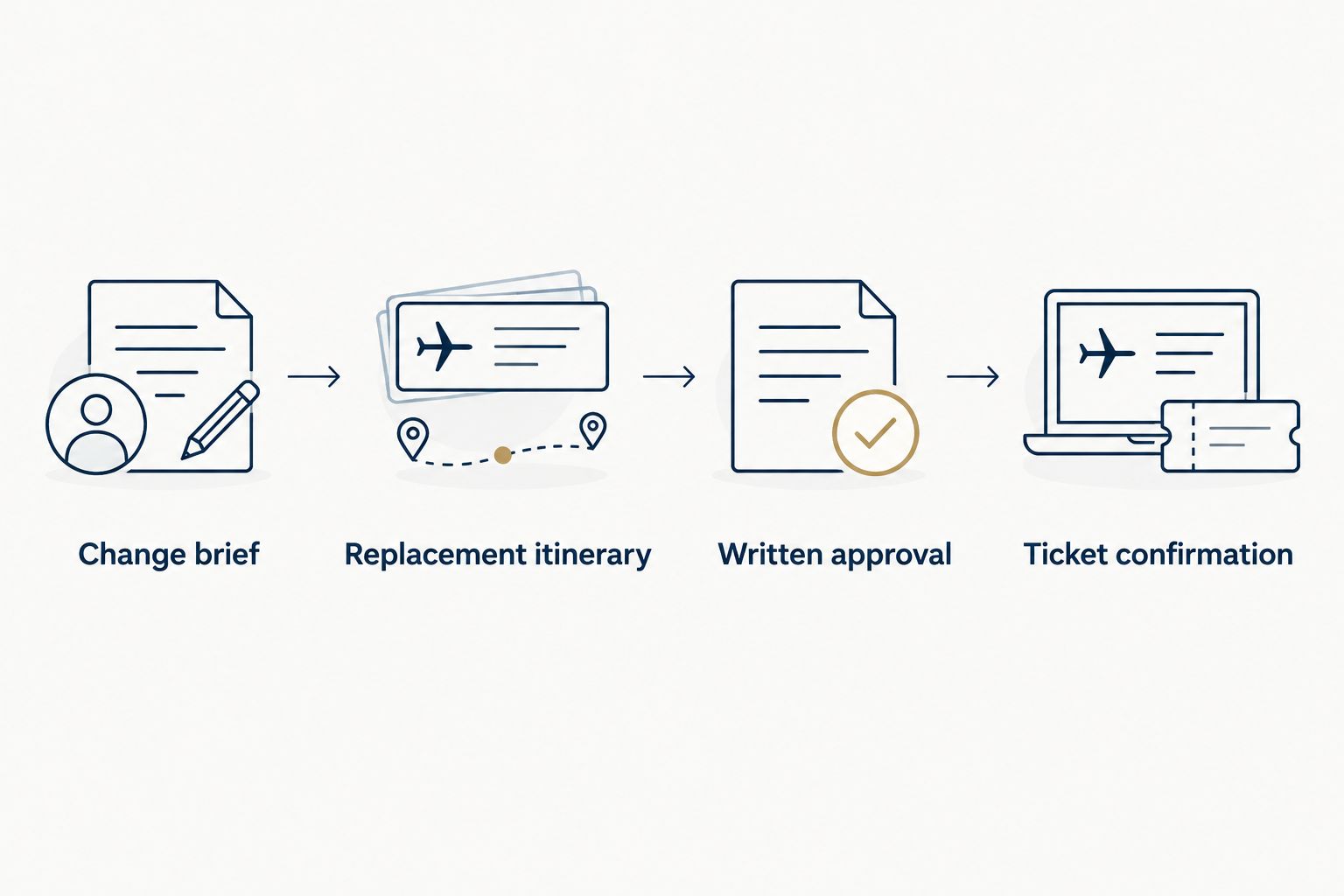
Written approval
Authorize one clearly identified itinerary
- Refer to the exact proposal. Identify the travel dates, routing and passengers you are approving. Avoid a reply that simply says the option looks good when several alternatives appear in the same conversation.
- Confirm the scope. State whether the approval covers the outbound journey, return journey or both. For a group, name the passengers included in the instruction.
- Acknowledge the explained conditions. Confirm that you understand the change terms and any payment requirement your contact has provided. Resolve unclear conditions before authorizing processing.
- Request completion documents. Ask for the updated itinerary and ticket receipt or other ticket confirmation appropriate to the transaction. Ask your contact to identify the next step if processing cannot proceed as approved.
Keep 1 written approval summary in the booking conversation. This gives the traveler, consultant and corporate approver a common reference without forcing anyone to reconstruct the decision from separate messages.
Do not send payment card details or passport copies through an ordinary message unless your provider has specifically directed you to an appropriate secure process. Ask how to submit any required sensitive information.
Expected result: your booking contact has an explicit instruction for one replacement itinerary, with no uncertainty about which passengers or flights it covers.
Ticket confirmation
Verify the change before updating your plans
- Match the final itinerary to your approval. Compare passenger names, airports, travel dates, flight details and cabins against the proposal you accepted. Check the unchanged segments too.
- Verify the ticket action. Ask your contact to confirm that the required ticket update is complete. Ticket numbers do not always change, so a different number is not the sole test of completion.
- Review the supporting arrangements. Ask whether seat selections, special assistance and meal requests carried across. A replacement flight does not establish that these requests transferred with it.
- Save the documents and update your calendar. Keep the latest itinerary and ticket confirmation together. Only then align hotel plans, ground transport and meeting arrangements with the revised journey.
For a 2026 itinerary, check 2 date fields especially carefully: the departure date and the destination arrival date. Local time differences and overnight flights make these separate checks necessary.
A booking reference identifies a reservation; it is not a substitute for confirmation that the required ticket action is complete. If the documents disagree, ask your booking contact to reconcile them before treating the change as finished.
Expected result: your approved journey matches the final documents, and your contact has confirmed completion of the required ticket action.
When the airline changes your schedule
An airline-initiated schedule change needs a different opening request. Instead of asking only for a preferred new departure, send the original itinerary and the change notification, then explain which part no longer meets your needs.
| Change situation | Best for | Useful approach | Limitation |
|---|---|---|---|
| Traveler-requested change | Travelers changing their own plans | Define your preferred dates and ask for the applicable change terms | Your existing fare conditions govern the request |
| Airline schedule change | Travelers responding to an altered flight | Ask your issuing contact to review the notice and explain the applicable options | The options depend on the disruption and applicable rules |
Neither route automatically guarantees a particular replacement flight or remedy. Ask your contact to explain what applies to your ticket before accepting an alternative.
For an airline schedule change, follow the same review, approval and confirmation sequence. Keep the original notice until the revised journey is settled, and check that any proposed replacement still connects with the rest of your trip.
Troubleshooting
The proposed itinerary is not the approved itinerary
Stop the approval process and identify the exact mismatch. State the affected passenger, segment and detail, such as the airport or cabin, then request a corrected proposal before ticket action.
The airline view and agency documents disagree
Ask the issuing contact to reconcile the records. Provide the conflicting details and request written confirmation of the valid itinerary and ticket status; do not choose whichever version looks more convenient.
Only part of the journey shows business class
Ask for the cabin on every segment to be stated explicitly. If business class throughout is essential, restate that requirement before approving an itinerary that includes another cabin.
One traveler needs a change, but others do not
Identify the affected traveler by name and ask how the change will be handled without altering the other passengers' plans. Ask whether the changed traveler will receive a separate booking reference and where later updates should be checked.
Seats or special requests disappeared
Ask your booking contact to check the replacement flight and resubmit the relevant requests where needed. Treat a seat preference, special meal or assistance request as a separate confirmation item, not an automatic consequence of changing the ticket.
Customize your workflow
For a corporate journey, add an approval owner and a clear arrival deadline to the change brief. Send the same final confirmation to the traveler and the person coordinating their meetings so both work from the updated journey.
For leisure travel, include any fixed arrangements that shape the request, such as a cruise departure or a separately booked onward flight. Explain those constraints before comparing replacements rather than after choosing a preferred departure.
Global Business Flights business class booking support uses a dedicated consultant rather than a self-service booking engine. That personal contact suits travelers who want help discussing fare options; the trade-off is that approval and ticket action require coordination rather than an assumed instant checkout.
To discuss your itinerary, use the contact options and include your booking context. Keep the first message focused on the change you need, without attaching unnecessary sensitive documents.
FAQ
How do I change business class flight itinerary details?
Contact the agency or airline that issued your ticket, explain the change you need, and request a written replacement itinerary. Approve a specific proposal only after checking every segment and the applicable conditions, then verify the completed ticket action.
Does a business class ticket always let me change flights?
Business class does not automatically mean unrestricted changes. Your ticket's fare conditions determine how a traveler-requested change is handled, so ask your issuing contact to explain them before approving a replacement.
Is a new itinerary email proof that my flight change is complete?
A new itinerary email alone does not establish that the required ticket update is complete. Ask your booking contact to confirm completion and provide the relevant ticket documentation.
Can I change only the outbound flight and keep my return?
Ask your issuing contact to check the effect on the complete ticket before changing only the outbound flight. State explicitly that you want to retain the return, and verify that it remains correct in the final documents.
What should I do if the airline changes my flight schedule?
Send the schedule-change notice to your issuing contact and explain why the revised journey does not meet your needs. Ask which alternatives apply to your ticket, then review and confirm the replacement before updating other arrangements.
Will my seat and meal requests transfer to the replacement flight?
Do not assume seat selections or meal requests transfer to a replacement flight. Ask your booking contact to check each request and confirm its status for the revised journey.
Can Global Business Flights help with business class booking arrangements?
Global Business Flights arranges business and first class tickets through dedicated travel consultants, with support from quote to e-ticket. For an existing booking change, provide the booking context and ask what servicing steps apply to your ticket.
One last thing
Check the segments you did not ask to change. Your attention naturally goes to the new flight, but a complete final review also covers the return and onward journey. Before closing a 2026 change request, read the full itinerary once from the first departure to the final arrival.