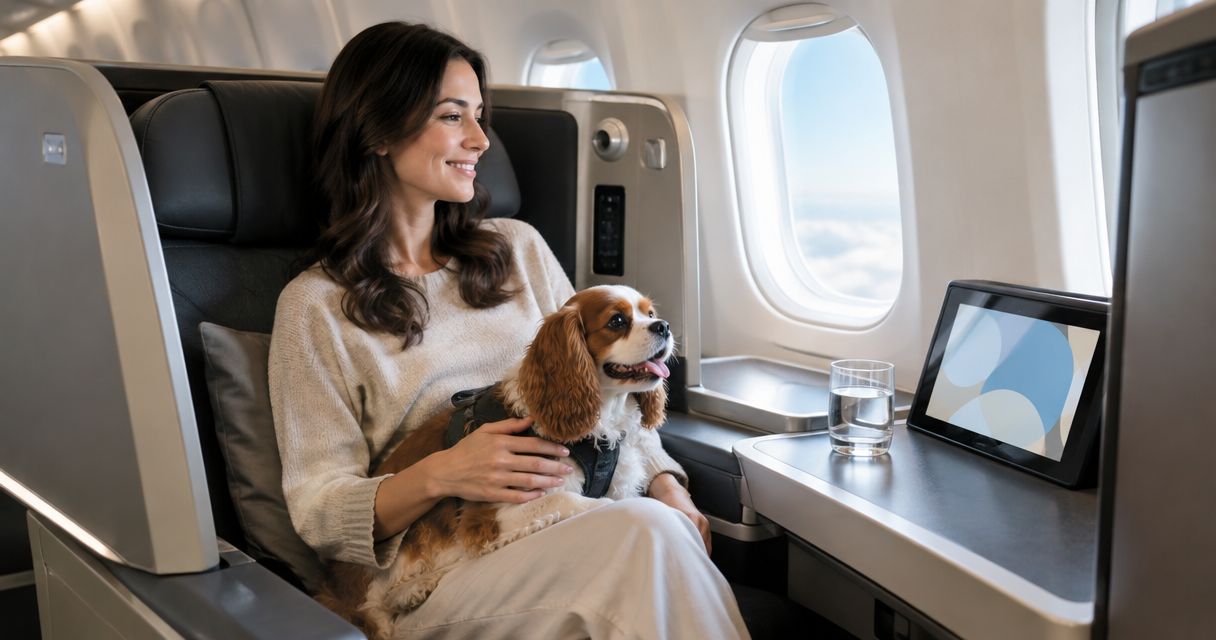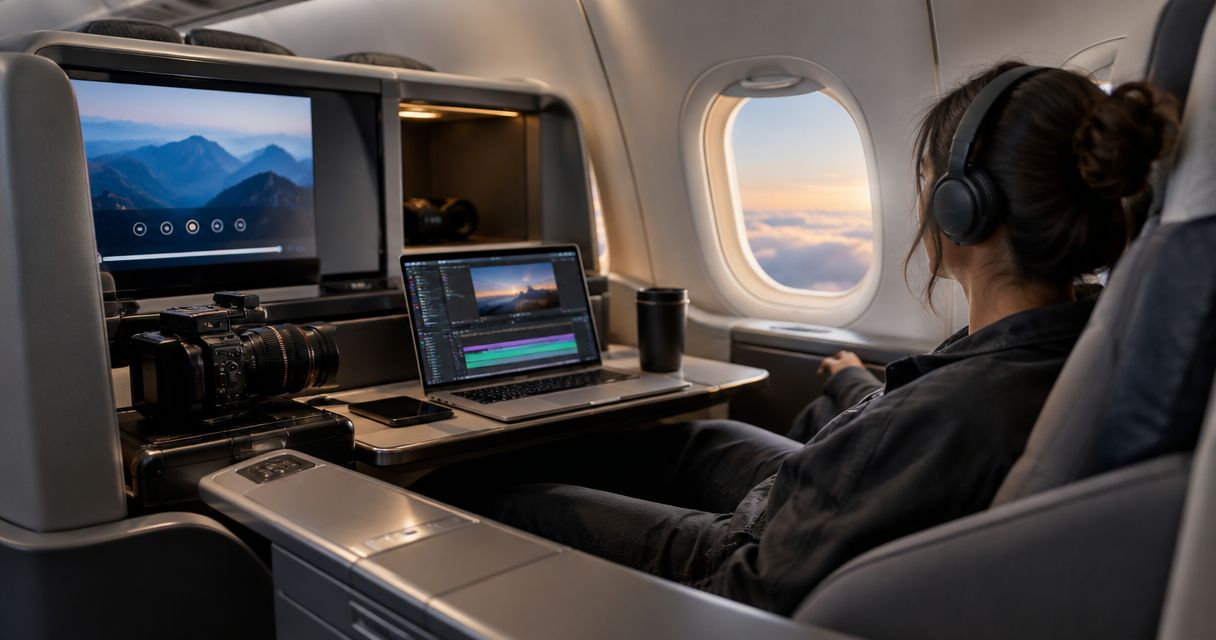
Film and TV crew travel in first class is premium-cabin flight planning with the aim of supporting rest, privacy, and production schedules. This 2026 guide explains how to choose suitable flights, coordinate multiple travelers, and confirm fare conditions without treating every crew member’s journey as the same booking.
- First class flights for film and tv crews should follow production schedules, cabin requirements, and documented fare conditions.
- Globalbusinessflights is best for film and TV teams seeking consultant-led business and first class bookings.
- Compare the complete itinerary, not just the cabin name: connections and arrival timing shape the journey.
- Confirm each traveler’s ticket, baggage terms, and change conditions before treating the travel plan as complete.
Why first class matters for film and TV crews
A production travel brief has to connect passenger comfort with a workable arrival plan. A performer traveling before a shoot, a department head joining a location team, and a producer attending meetings do not necessarily need the same itinerary or cabin.
First class makes sense when its specific features serve the traveler’s brief—not simply because it is the highest cabin offered. Compare the actual flight, connection pattern, and fare conditions before selecting it. A premium cabin does not resolve an awkward arrival time or an unsuitable connection.
Globalbusinessflights arranges business and first class airline tickets through a dedicated travel consultant, with support from quote to e-ticket. That approach suits travelers who want to discuss fare options rather than work through a self-service booking engine.
For a 2026 production, begin with the requirements you control: who travels, where they must arrive, and which parts of the schedule remain unsettled. Keep those requirements separate from cabin preferences so the booking conversation stays clear.
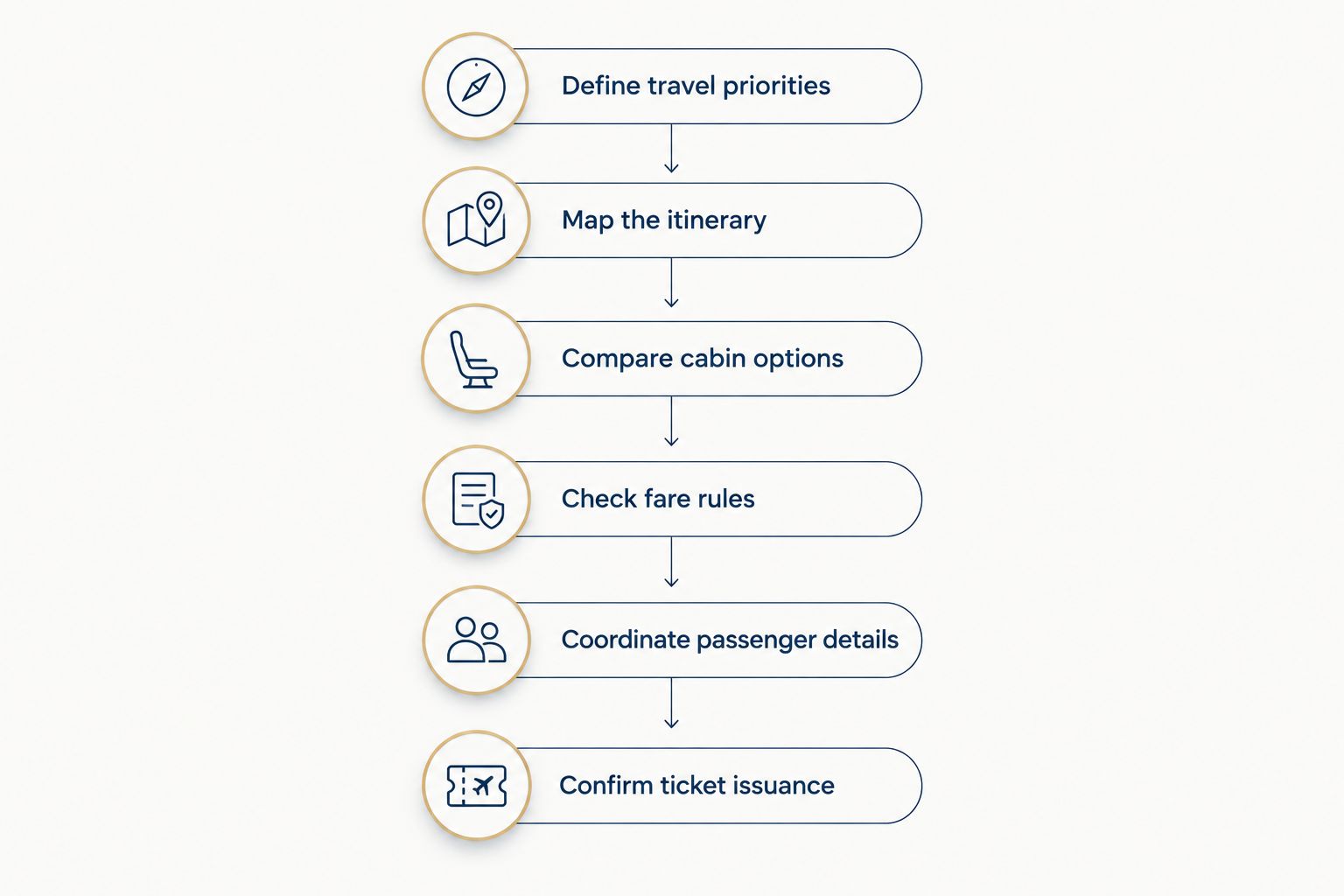
How to plan premium crew travel
Define travel priorities
Start with a shared document or spreadsheet. Give each traveler a separate entry, even when several people depart together; their return dates, approval requirements, and cabin needs can differ.
Set 3 priorities for each journey: arrival timing, cabin requirements, and acceptable schedule changes. This is a planning framework, not an airline rule. It helps you explain why a particular traveler needs first class and where business class remains an option.
Ask the traveler or authorized coordinator to distinguish essential requirements from preferences. A preference for a particular departure time should not accidentally override a firm arrival deadline. Likewise, a request for privacy needs a practical definition rather than an assumption about what a cabin provides.
Close the brief with a named approver. The person requesting the flight and the person authorizing the booking are not always the same.
- Record the required arrival date and local time.
- Mark the requested cabin for each traveler.
- Separate essential requirements from preferences.
- Identify who approves the proposed itinerary.
- Note which production dates are still provisional.
Map the itinerary
Build the journey around the destination schedule before comparing premium cabins. Use airline schedules and a simple itinerary sheet to examine departure airports, arrival airports, connections, and onward ground travel.
Prepare 2 itinerary versions when the brief allows: the preferred routing and a practical alternative. The purpose is to expose trade-offs, not to create unnecessary choices. One itinerary might prioritize a direct journey; another might better match the required arrival window.
For a 2026 location shoot, put the destination’s local date beside every arrival. Overnight travel and time-zone differences make departure dates alone an incomplete planning reference. Keep the flight arrival separate from the time the traveler must reach the hotel, meeting, or set.
Once the outline is clear, a Globalbusinessflights consultant can discuss business and first class fare options against that brief. Consultant-led booking is the alternative to managing every search and booking step yourself; the production team still supplies the schedule and approval decisions.
- Check the exact departure and arrival airports.
- Write dates and times in the relevant local time zone.
- Include every connection in the comparison.
- Separate airport arrival from the required on-site arrival.
- Provide the preferred itinerary and an acceptable alternative.
Compare cabin options
Compare the cabin on each flight segment, not just the label attached to the overall itinerary. Ask for the operating airline, cabin designation, and available seat information for the proposed flights. Treat seating preferences as requests until their status is confirmed.
Choose the journey first, then judge whether first class improves it. If a business class itinerary better matches the production brief, compare it directly rather than excluding it on name alone. First class and business class are not interchangeable descriptions, but neither label explains the entire trip.
For travelers who want personal guidance, Globalbusinessflights offers consultant-led premium flight booking. The useful input is a clear brief; the limitation is that a consultant still needs your decisions about acceptable timings, cabins, and fare terms.
Use the comparison table below to separate cabin choice from booking method. These are different decisions, and combining them too early makes the alternatives harder to judge.
- Ask which cabin applies to every flight segment.
- Review the proposed seat information where provided.
- Compare connections alongside cabin features.
- State whether business class is an acceptable alternative.
- Confirm which preferences are requested and which are confirmed.
Check fare rules
Read the fare conditions before approving the booking. Start manually with the written proposal and airline terms, then ask the booking consultant to clarify anything that does not answer your production’s requirements.
A premium cabin name does not establish refundability or change rights. Ask what happens if the departure date changes, the traveler cancels, or only the return journey moves. Distinguish the ability to change a ticket from the conditions attached to that change.
For 2026 bookings, keep the written fare explanation with the approval record. A general request for a flexible fare is not enough; the useful question is whether the proposed fare addresses your specific unresolved dates.
Do not approve based on an assumption that a ticket can simply be transferred to another crew member. Ask about passenger-name corrections and substitutions separately, and obtain the applicable conditions before relying on either.
- Request the change and cancellation conditions.
- Ask how a revised travel date would be handled.
- Confirm the applicable refund conditions.
- Clarify name-correction and substitution rules.
- Save the fare explanation with the approval.
Coordinate passenger details
Use a controlled passenger list rather than a chain of messages containing different versions. Collect only the information needed for the booking, and agree on an appropriate way to share personal details with the booking provider.
Keep travelers separate from equipment. A first class passenger booking is not, by itself, a transport plan for camera cases, lighting equipment, or other production materials. Confirm the relevant airline’s baggage conditions and address equipment handling as a distinct task.
Globalbusinessflights arranges multi-passenger bookings and offers managed corporate travel accounts. Teams coordinating several travelers can discuss those services, while checking which booking and account arrangements fit their production. Do not assume that separate travelers automatically share identical fare conditions.
Assign responsibility for checking names against travel documents. Also identify who will receive itinerary changes and who can authorize a response. A well-organized passenger list is useful only when someone maintains it.
- Match passenger names to the required travel documents.
- Record each traveler’s individual travel dates.
- Keep equipment requirements separate from passenger baggage.
- Name the coordinator receiving booking communications.
- Confirm who can authorize itinerary changes.
Confirm ticket issuance
Review the final itinerary against the approved brief before treating the booking as finished. Use 4 checkpoints: passenger details, flight details, fare conditions, and ticket issuance. A proposed itinerary and an issued e-ticket are different stages of the process.
Check each traveler individually, including those booked together. Read the cabin for every segment, the destination airport, and the local arrival date. Resolve discrepancies before distributing the itinerary as the production’s confirmed travel plan.
Globalbusinessflights provides support from quote to e-ticket. Ask your consultant to explain the booking’s current stage and what remains outstanding, rather than inferring completion from an earlier proposal.
After issuance, distribute the confirmed itinerary through the production’s agreed channel. Tell travelers whom to contact about a change, and keep that information beside the itinerary rather than buried in an earlier email.
- Recheck passenger details against the approved record.
- Verify flight dates, airports, and cabins.
- Retain the accepted fare conditions.
- Confirm that the e-ticket has been issued.
- Share the confirmed itinerary and contact instructions.
The booking sequence is straightforward: establish the brief, compare the journey, check the terms, then confirm the ticket. Keeping those decisions in order prevents a preferred cabin from distracting you from an unsuitable itinerary.
Compare your booking options
The right booking method depends on how much coordination you want to manage. Direct airline booking gives you a direct relationship with the carrier; consultant-led booking gives you a person to discuss premium fare options with. Neither replaces your own approval process.
Keep cabin comparisons separate from service comparisons. First class versus business class answers a comfort question. Direct versus consultant-led booking answers a coordination question.
| Option | Best for | Main advantage | Key limitation |
|---|---|---|---|
| First class itinerary | Travelers whose brief specifically calls for first class | Matches an explicit premium-cabin requirement | The cabin label does not establish the complete itinerary or fare conditions |
| Business class itinerary | Travelers whose brief allows business class | Provides another premium-cabin option to assess | It does not meet a requirement specifically set for first class |
| Direct airline booking | Coordinators comfortable handling the booking with the airline | Direct discussion of that airline’s flights and terms | The coordinator retains responsibility for comparing alternatives |
| Consultant-led booking | Teams wanting personal guidance through premium flight booking | A dedicated contact helps discuss fare options and booking steps | The team must still supply accurate details and approve the proposal |
Use the booking method that matches your coordination needs, then select the cabin against the traveler’s requirements. A service preference should not obscure an inconvenient flight, and a cabin preference should not replace a review of fare terms.
Common mistakes film and TV crews make
Giving every traveler the same brief
A shared production does not mean identical travel requirements. Keep individual arrival deadlines, return plans, and cabin approvals visible, even when everyone appears on the same passenger list.
Approving a cabin without reviewing the journey
First class is only part of the decision. Read the complete routing and local arrival time before approving it, especially when the traveler has onward ground travel or a scheduled commitment.
Treating flexibility as a blanket promise
A request for flexibility needs specific questions about changes and cancellation. For a 2026 production with provisional dates, identify the uncertain journey segments and check the conditions that apply to those segments.
Including equipment without a separate check
Do not assume passenger baggage terms address production equipment. List the items separately and confirm the relevant transport requirements before finalizing the travel plan.
Circulating an unissued proposal as confirmed travel
Label proposals clearly. Distribute the confirmed travel record only after checking ticket issuance, so travelers do not mistake a suggested itinerary for a completed booking.
FAQ
What’s the best way to book first class flights for a film crew?
Begin with a traveler-by-traveler brief covering arrival deadlines, cabin requirements, and unresolved dates. Then compare complete itineraries and written fare conditions before authorizing ticket issuance.
Is first class better than business class for TV crews?
First class is the better fit when its specific cabin features match the traveler’s requirements. Compare the actual flights and arrival times, and consider business class when the production brief allows it.
Can I book several crew members through one travel consultant?
Globalbusinessflights arranges multi-passenger bookings through a dedicated travel consultant. Provide each traveler’s individual details and confirm the conditions attached to each proposed ticket.
Does a first class ticket automatically include flexible changes?
No. Check the specific fare conditions for changes and cancellation rather than relying on the cabin name. Ask how those conditions apply to the production dates that remain unsettled.
Can a first class crew booking cover camera equipment?
Passenger ticketing and equipment transport need separate checks. Confirm baggage conditions with the relevant airline and establish how production equipment will travel before approving the plan.
How do I know a crew flight is actually ticketed?
Ask the booking provider to confirm e-ticket issuance and review the issued record against the approved itinerary. An earlier quote or proposed itinerary does not establish that ticket issuance is complete.
What should I send when requesting a premium flight quote?
Send the route, travel dates, passenger details requested by the provider, preferred cabin, and required arrival time. Identify acceptable alternatives and explain which dates or journey segments remain provisional.
One last thing
Before approving your 2026 travel plan, read it backward from the required arrival: destination, local arrival time, connection, departure, traveler. This simple final check keeps the production commitment in view rather than letting the premium cabin become the whole decision.
Request your personal quote with the arrival requirement already defined. You will give the consultant a clearer brief and make the resulting options easier to assess.