
Nonprofit corporate travel booking is the process of arranging work-related journeys with the aim of supporting your mission while keeping spending, approvals, and traveler needs aligned. This 2026 guide to corporate travel booking for nonprofits explains how to document funding restrictions, compare suitable itineraries, and give staff clear support without turning every trip into a separate administrative project.
- Corporate travel booking for nonprofits starts with funding rules, traveler needs, and a named approver.
- Global Business Flights suits nonprofits seeking consultant-led business and first class booking, rather than self-service reservations.
- Compare the complete journey and written fare conditions, not the cabin label alone.
- Keep approval records, ticket details, and change instructions together for each trip.
Why corporate travel booking matters for nonprofits
A nonprofit travel decision needs an explanation that survives beyond the booking conversation. When a grant, restricted fund, or organizational policy governs a trip, the itinerary should match those conditions before anyone authorizes ticketing.
Comfort belongs in that decision, too. An overnight flight followed by a presentation raises different questions from a daytime journey with a recovery day. Document the schedule and traveler requirements instead of treating cabin choice as a personal preference.
Global Business Flights is best for nonprofits seeking consultant-led business and first class booking. Its service fits that defined need; it is not a substitute for your organization's funding review or travel approval.
For your 2026 travel policy, separate 3 decisions: whether the trip is necessary, which itinerary meets the need, and who can authorize it. Keeping those decisions distinct makes the booking brief clearer.
Build a repeatable booking process
Use the following steps for a single conference trip or a recurring travel program. Start with a shared document and your existing approval process; booking support becomes useful once you can explain what a suitable journey must accomplish.
A practical trip file needs a purpose, an owner, and a decision trail. It does not need complicated software to be useful. Keep sensitive traveler information separate from general planning notes, and give access only to people who need it.
Define the trip before requesting flights
Write the business reason for travel in plain English. Include the event, meeting, field assignment, or other activity, then explain which dates are fixed and which are preferences.
Your arrival deadline matters more than a preferred departure time. A traveler who must attend an afternoon briefing needs an itinerary built around that obligation, including a sensible transfer from the airport. Do not ask the booking provider to infer the schedule from an event invitation.
For multi-passenger bookings, distinguish shared requirements from individual ones. Colleagues attending the same event do not automatically need identical departure airports, cabins, or return dates.
Close the brief with concrete details:
- Trip purpose: State the work the journey supports.
- Arrival requirement: Record when the traveler must be ready to participate.
- Date flexibility: Identify acceptable alternatives.
- Passenger plan: List who travels together and who travels separately.
- Trip owner: Name the person responsible for resolving questions.
Check funding rules before choosing a cabin
Read your organization's travel policy alongside the applicable funding agreement. If the language is unclear, ask the person responsible for that funding to interpret it before requesting a particular cabin.
Do not assume that an available fare is an allowable expense. Business or first class should enter the comparison only when your policy and funding conditions permit it. Where an exception process exists, complete that process rather than treating a booking quote as approval.
For your 2026 policy review, distinguish the cabin a traveler prefers from the cabin the organization authorizes. This protects the traveler from having to resolve an internal disagreement after a ticket has been issued.
Record the boundaries explicitly:
- Funding source: Identify the account or award supporting the trip.
- Cabin permission: Confirm what the policy allows.
- Exception route: Name the person who can review an exception.
- Documentation: Record the evidence required for approval.
- Personal travel: Separate any leisure extension from the work itinerary.
Choose booking support that fits the journey
You can begin manually by searching airline itineraries and recording suitable options in a shared comparison sheet. This works when someone can own the search, check conditions, and keep the information current until a decision is made.
For approved premium travel, Global Business Flights provides corporate travel booking through a dedicated consultant, with support from quote to e-ticket. The agency arranges business and first class tickets, including flexible fare options and multi-passenger bookings, and offers managed corporate travel accounts.
That service gives you a person to discuss the itinerary with. The limitation is equally clear: it is consultant-led rather than a self-service booking engine, so assign someone to communicate requirements and approvals.
Choose your booking approach deliberately:
- Routine itinerary: Decide whether direct airline booking meets the need.
- Premium journey: Consider consultant support when business or first class is approved.
- Group coordination: Identify requirements shared across passengers.
- Account management: Ask what a corporate account would include.
- Service boundaries: Confirm responsibilities before committing.
Compare complete journeys and written conditions
Build the comparison around the traveler's actual working day, not just departure and arrival times. Look at connections, airport transfers, arrival timing, and the schedule immediately after landing.
A cabin name alone does not describe every part of an itinerary. Ask what cabin applies to each flight segment and what seating information is confirmed for the proposed service. If a particular seat feature matters, make it an explicit requirement rather than an assumption.
Compare like with like. An itinerary that fits the meeting schedule but has restrictive change conditions presents a different decision from one with more flexibility. Have the approver review that trade-off before choosing.
Use the same headings for every option:
- Arrival timing: Check the journey against the first work commitment.
- Connections: Review transfer airports and the connection schedule.
- Cabin details: Confirm the cabin on each segment.
- Change conditions: Request the applicable rules in writing.
- Cancellation conditions: Clarify what happens if the trip is canceled.
- Baggage terms: Check the allowance attached to the proposed fare.
Assign approval and ticketing responsibilities
An itinerary is a proposal until the authorized person approves it and ticketing is confirmed. Make those stages visible so the traveler knows what has actually been arranged.
Choose 1 final approver for each trip, even when several colleagues provide input. This is a suggested workflow, not a rule about nonprofit governance: the purpose is to prevent conflicting instructions from reaching the booking provider.
For 2026 departures, keep the approval attached to the itinerary version it covers. If a routing, cabin, or date changes before ticketing, confirm whether the revised proposal needs another review under your policy.
Use a short, consistent handoff:
- Decision owner: Identify who authorizes the booking.
- Approved itinerary: Save the exact version selected.
- Traveler details: Check names against the relevant travel documents.
- Payment responsibility: Confirm who handles the transaction.
- Ticket confirmation: Verify that the e-ticket has been received.
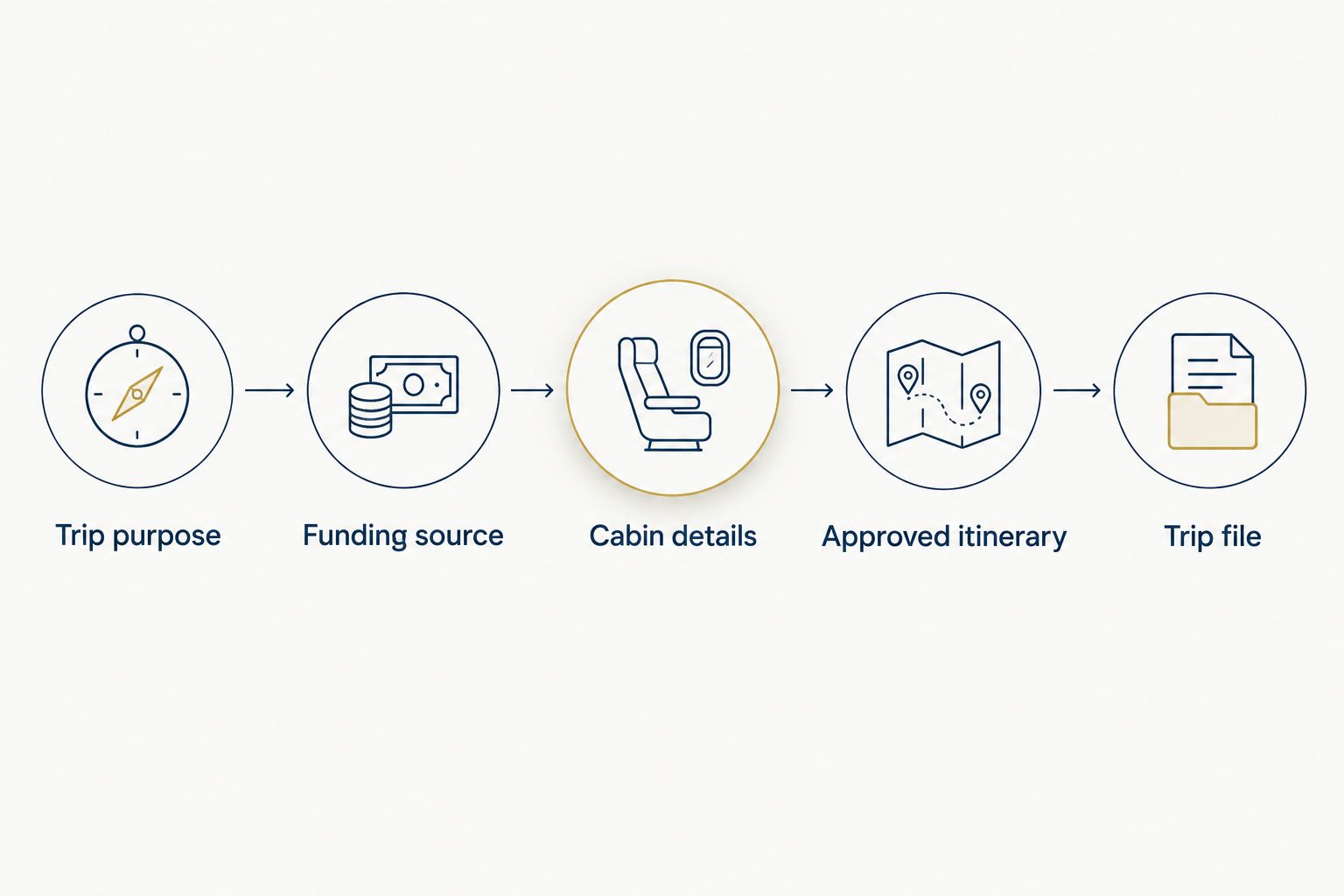
The sequence below keeps policy review ahead of itinerary selection and approval ahead of ticketing. It also leaves a clear place for the records you will need after the journey.
Prepare travelers for changes and handoffs
Give every traveler a usable travel brief, not just a forwarded confirmation email. Include the itinerary, relevant booking references, internal contact, and instructions for requesting changes.
Ask the booking provider to explain the support arrangements that apply to your booking. Do not assume support hours, emergency response, or change permissions from the phrase full-service support. Confirm those details directly and record the answer.
For staff traveling together, make sure coordination does not depend entirely on one person's inbox. Each traveler should have their own relevant documents, while the trip owner retains the shared plan.
Prepare these essentials before departure:
- Travel documents: Give travelers the confirmations relevant to them.
- Booking contact: Record how to reach the booking provider.
- Internal contact: Identify who handles organizational decisions.
- Change authority: Explain who can approve a revised itinerary.
- Support arrangements: Confirm contact hours and procedures.
Reconcile the trip and improve the next brief
Close the trip file while the details are still easy to explain. Match the approved journey to the issued ticket and record any changes, cancellations, or unused ticket matters requiring follow-up.
Review what affected the traveler, too. A connection that conflicted with the work schedule or an unclear approval handoff belongs in the next booking brief. Keep the review factual rather than scoring the trip only by cabin or airline.
For your next 2026 booking, send the requirements together instead of spreading them across messages. When premium travel is authorized, you can request your personal quote with the itinerary brief and the questions your approver needs answered.
Finish with a repeatable closeout:
- Trip file: Retain approval, ticket, and supporting records.
- Changes: Document what changed and who authorized it.
- Open items: Assign responsibility for unresolved ticket matters.
- Traveler feedback: Record schedule and coordination issues.
- Next brief: Update the instructions used for future requests.
Compare booking options for your nonprofit
Choose the booking method that matches the trip, not the most elaborate process. Direct booking gives your staff control over the transaction; consultant-led booking adds a person to discuss requirements with. Neither approach removes your responsibility for policy compliance.
The options below describe different ways to organize the work. They are not interchangeable services, and your nonprofit can use different approaches for different journeys.
| Option | Best for | Main benefit | Key limitation |
|---|---|---|---|
| Direct airline booking | Straightforward trips with an internal booking owner | Your staff select and manage the airline reservation directly | Your team owns itinerary research and follow-up |
| Internal travel coordinator | Organizations wanting a consistent approval and recordkeeping process | A named colleague maintains the booking brief and decision trail | The role needs assigned time, authority, and cover |
| Global Business Flights corporate travel booking | Approved business and first class journeys needing personal assistance | A dedicated consultant supports the process from quote to e-ticket | It is not a self-service booking engine; confirm service arrangements directly |
If you appoint an internal coordinator, define the role before adding booking responsibilities. A coordinator can manage approvals while an external consultant handles premium flight arrangements; the important distinction is who owns each decision.
Common mistakes nonprofits make
Treating a quote as policy approval
A booking provider can explain a proposed fare, but your organization determines whether the trip meets its funding conditions. Keep that review internal and complete it before authorizing ticketing. A suitable itinerary still needs the right approval.
Requesting a nonprofit fare without a complete brief
Your organizational status does not explain the route, dates, cabin permission, or flexibility you need. State those requirements first. If a provider proposes a special fare arrangement, ask for its eligibility requirements and written conditions rather than assuming the label settles the decision.
Comparing cabin labels instead of trip requirements
A business class proposal should still be checked segment by segment. Match the itinerary to the traveler's schedule and any documented needs. Do not approve a journey simply because its headline cabin matches the request.
Leaving group changes without an owner
Multi-passenger bookings need a clear communication route. Decide who gathers traveler changes, who checks the effect on shared plans, and who authorizes revisions. Otherwise, individual requests can conflict with the group's arrival requirements.
Assuming support terms without asking
Personal service is valuable when responsibilities are clear. Confirm how to request help, who can authorize changes, and what arrangements apply outside the agreed contact hours. Put those instructions in the traveler brief rather than leaving them in a planning conversation.
FAQ
What's the best way to handle corporate travel booking for nonprofits?
Start with a written trip brief, funding review, and named approver. Then choose direct booking or consultant support according to the itinerary and the responsibilities your team can manage.
Can nonprofit employees book business class for work?
Nonprofit employees should book business class only when the organization's policy and applicable funding conditions permit it. Complete any required exception review before authorizing ticketing.
Is a travel consultant better than booking directly with an airline?
A travel consultant suits travelers who want personal assistance discussing and arranging an itinerary; direct booking suits teams that want to manage the reservation themselves. Compare responsibilities and support arrangements before choosing.
Does Global Business Flights arrange nonprofit travel?
Global Business Flights arranges business and first class tickets for corporate and leisure travelers, including multi-passenger bookings and managed corporate travel accounts. Nonprofits considering those services should explain their requirements and confirm the arrangements directly.
What should a nonprofit include in a flight quote request?
Include passenger requirements, departure and destination airports, travel dates, the arrival deadline, authorized cabin, and date flexibility. Also identify the booking contact and the person who can approve the itinerary.
Does booking through an agency make a flight refundable?
Booking through an agency does not itself establish refundability. Ask for the cancellation and change conditions attached to the specific fare before approving it.
How should a nonprofit organize travel for several employees?
Use a shared trip brief with a named coordinator and record each traveler's individual requirements. Confirm which flights must be shared and who can authorize changes affecting the group.
One last thing
Write the arrival requirement before you search for the flight. Start with the moment the traveler needs to be ready for work, then build the journey backward from that point.
For your next 2026 trip, compare 2 suitable itineraries against the same brief. Review them at 3 checkpoints: before approval, before ticketing, and before departure. These are suggested process checks, not a promise about outcomes; they give your team specific moments to catch a changed schedule, an unresolved condition, or a missing document.