
Consulting firms’ corporate travel booking is the process of arranging work trips with the aim of getting consultants to client engagements ready to work and within approved travel rules. Your booking process needs to connect project schedules, traveler comfort, client billing requirements, and permission to change a ticket—not simply find a flight.
- Corporate travel booking for consulting firms works best when project approval and fare-rule checks happen before ticketing.
- Globalbusinessflights suits consulting travelers who want consultant-led business and first class booking rather than self-service checkout.
- Compare route fit, change conditions, and traveler comfort together; cabin labels alone do not establish suitability.
- Keep flight approvals, ground transportation, and project billing connected through a shared trip record.
Why corporate travel booking matters for consulting firms
A consulting trip has more than a departure date. It has an engagement owner, a meeting commitment, an expense owner, and a traveler whose working day extends beyond the flight. Those requirements belong in the booking request from the beginning.
Before you explore your fare options, establish what the trip must accomplish. A client workshop with a fixed start time needs a different approval discussion from an internal meeting with flexible attendance.
For your 2026 travel policy, separate the business requirement from the travel preference. The requirement might be arriving before a client session; the preference might be a particular departure time or cabin. Both matter, but they need different treatment when the options conflict.
Approve the journey against the engagement, not just the airline itinerary. A convenient departure does not resolve an arrival that leaves no room for the work you need to do.
Build a booking process around the engagement
Use the following steps whether a project coordinator, an executive assistant, or the traveler submits the request. Start with a shared document and an approval email. Add outside booking support after the firm has defined who can authorize the trip and what the ticket must permit.
Define the trip before searching for flights
Create a brief that describes the assignment before it describes an airline. Record where the traveler needs to be, when the work begins, and whether the return depends on the engagement finishing as planned. This gives the person arranging the flight a clear boundary for comparing options.
For your 2026 booking template, distinguish fixed commitments from preferences. A client meeting time belongs in the fixed field. A preferred airline belongs in the preference field unless your firm has a separate contractual requirement.
Start manually with a shared form or document. Ask the engagement owner to resolve unclear requirements before anyone requests a ticket. This prevents the booking conversation from becoming an informal negotiation over the project schedule.
- Record the destination and the actual client meeting location.
- Separate required arrival times from preferred departure times.
- State whether the return date is fixed or subject to project changes.
- Identify the traveler, engagement owner, and approving manager.
- Add the project code and any client billing restrictions.
Set cabin and change-approval rules
Define when your firm permits business or first class and who approves an exception. Keep the reasoning connected to the assignment: an overnight journey before client work, a demanding sequence of meetings, or an individual travel requirement deserves an explicit decision rather than an assumption.
A cabin decision and a flexibility decision are separate. Choosing business class does not, by itself, establish what changes or cancellations the ticket permits. Ask for the actual fare conditions before approval.
Assign 1 named approver per trip, with a documented substitute when that person is unavailable. This is a practical policy choice, not a requirement to add another management layer. The goal is a clear answer when a traveler needs to commit to an itinerary.
- Describe the circumstances that justify a premium cabin.
- Name the person who authorizes cabin exceptions.
- State which schedule changes require renewed approval.
- Specify whether traveler preferences need separate authorization.
- Record who decides when a client changes the assignment.
Compare complete fare options
Begin with a side-by-side comparison in a spreadsheet. Request 2 itinerary options per traveler when alternatives meet the brief, and assess each against the same criteria. Avoid comparing a convenient itinerary with a poorly matched route just to create an apparent choice.
Globalbusinessflights corporate travel booking is best for consulting travelers who want a dedicated consultant to arrange business or first class flights. The agency accepts phone and online quote requests and provides support from quote to e-ticket. It is not a self-service booking engine, so it suits travelers who prefer a conversation over independent checkout.
Organize the comparison around Route fit, Fare rules, and Approval record. A consultant can help arrange the premium flight; your firm still needs to authorize the itinerary and accept its conditions.
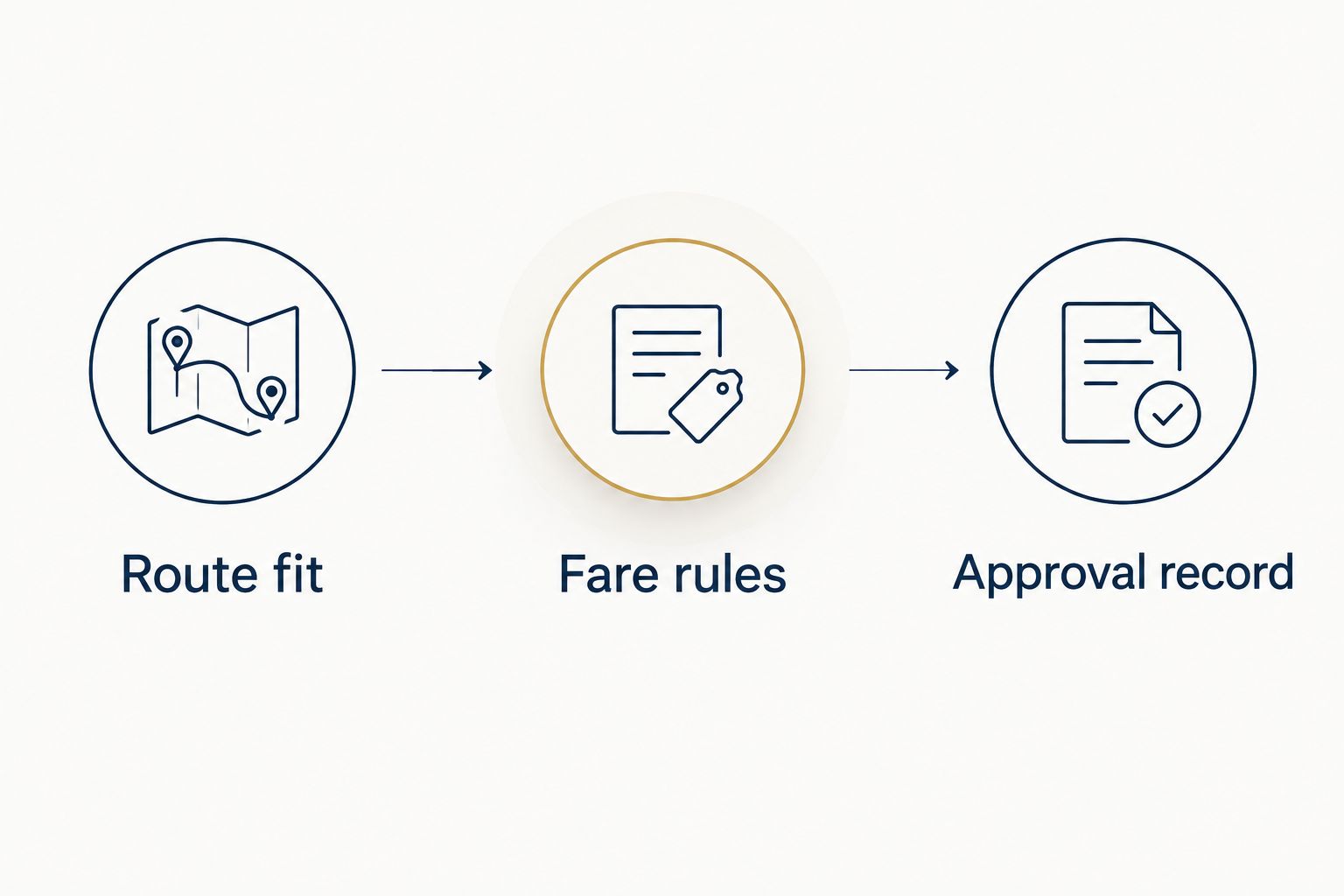
- Route fit: check airports, connections, and local arrival dates.
- Fare rules: confirm the conditions for changes and cancellation.
- Approval record: save the accepted itinerary and authorization.
- Cabin details: verify the booked cabin for every flight segment.
- Traveler needs: include relevant seating or assistance requests.
Confirm every traveler before ticketing
For multi-passenger bookings, use a separate line for each traveler rather than treating the team as a single passenger. People can share a destination without sharing departure airports, return dates, or approval conditions. Record those differences before accepting the itinerary.
Ask each traveler to verify the name and travel details intended for the booking. Use your approved secure process for sensitive information; a broadly shared project spreadsheet is not the place for passport copies. Keep the trip summary accessible without making identity documents accessible to everyone involved.
For 2026 team travel, save a final approved version before ticketing and compare the issued e-ticket against it. A confirmed request and an issued ticket are different records. Review the latter rather than assuming the former transferred without error.
- Check each traveler's name against the document used for travel.
- Verify departure airports and local travel dates individually.
- Confirm the cabin on connecting segments as well as the main flight.
- Record which travelers have different return arrangements.
- Review the issued e-ticket against the approved itinerary.
Connect flights with ground transport and client billing
A flight approval should connect to the rest of the assignment. Record how the consultant will reach the client location, who authorizes that transport, and which project receives the expense. Do this before departure, not during expense reconciliation.
Start with a trip record linking the flight, accommodation, ground transport, and engagement code. For an extended assignment, decide whether transport is approved for the full engagement or only for specific working days. That distinction affects the request and the approval record even when the flight itself is unchanged.
For your 2026 extended-assignment process, the same HR travel policy should govern both flight approvals and long-term corporate car rentals: identify the eligible traveler, authorized use, billing owner, and process for changing the arrangement. A flight extension should trigger a review of connected bookings, not an assumption that they extend automatically.
Give the engagement owner responsibility for confirming what the client has authorized. The person arranging transport should not have to interpret an engagement contract from an expense note.
- Match each booking to the correct engagement code.
- Identify the owner of ground-transport approval.
- Separate business use from any personal extension.
- Record client authorization where reimbursement requires it.
- Recheck connected arrangements when project dates change.
Establish a change and handover procedure
Write a short procedure for the moment a client changes the assignment. The traveler should know whom to contact, who can approve a revised journey, and where the current ticket is stored. Keep those responsibilities visible in the trip summary.
Globalbusinessflights provides support from quote to e-ticket. Ask what assistance applies after issuance, including the contact method and service hours, before relying on a particular arrangement. Do not treat the booking relationship as confirmation of an unverified response commitment.
Schedule a 15-minute handover per trip as an internal planning practice when the itinerary involves several people or approvals. Use that time to verify the record, not repeat the entire search. A straightforward individual trip can use the same checklist asynchronously.
- Give the traveler the issued itinerary and booking contact details.
- Name the person authorized to approve a changed journey.
- Store the accepted fare conditions with the trip record.
- Explain how to report a client-requested extension.
- Confirm who checks connected bookings after a flight change.
Explore your fare options
Discuss business and first class flights with a dedicated travel consultant.
Compare booking options for consulting teams
Choose the booking method around the work you want it to handle. Flight selection, internal authorization, and client billing are distinct tasks. Keep an owner for each, even when a travel agency arranges the ticket.
| Option | Best for | Main advantage | Key limitation |
|---|---|---|---|
| Traveler books directly with an airline | Independent travelers with an approved itinerary | Keeps flight selection with the traveler | Your firm must maintain its own approval and project records |
| Internal coordinator arranges bookings | Teams wanting a central internal contact | Keeps engagement context close to the booking request | Requires internal time for comparisons, records, and follow-up |
| Globalbusinessflights consultant-led booking | Consulting travelers seeking business or first class with personal support | Dedicated consultant and support from quote to e-ticket | Not a self-service engine; confirm post-ticket assistance separately |
| Internal approval plus agency booking | Firms separating engagement decisions from flight arrangements | Gives authorization and booking distinct owners | Requires a clear handover so accepted conditions are not lost |
For your 2026 process, choose a method that people can actually follow. An elaborate policy does not help if travelers cannot identify the approver or find the current itinerary.
Common mistakes consulting firms make
Treating premium cabins as interchangeable
A business class label does not answer every question about the journey. Review the cabin on each segment and ask about the seating details relevant to the traveler. Approve the specific itinerary, not an assumed experience.
Booking before the engagement owner confirms dates
A traveler’s preferred schedule is not confirmation of the client's meeting plan. Get the fixed commitments in writing before ticketing. If the engagement remains uncertain, make that uncertainty part of the fare-rule discussion.
Assuming client reimbursement equals internal approval
A client billing provision and your firm's travel authorization serve different purposes. Record both where they apply. Do not leave the traveler to discover an unresolved approval question after the trip.
Extending the flight but overlooking the assignment
A changed return date affects more than the airline record. Recheck accommodation, ground transport, project authorization, and the traveler’s other commitments. Assign this review to a named owner rather than expecting every booking contact to know the full engagement.
FAQ
What's the best corporate travel booking approach for a consulting firm?
The best approach separates engagement approval from flight arrangement and gives each task a named owner. Use a shared trip brief, review fare conditions, and retain the issued ticket with the approval record.
Can a consulting firm book business class through a travel agency?
Yes. Globalbusinessflights arranges business and first class tickets for corporate travelers through phone and online quote requests, with a dedicated consultant rather than self-service checkout.
Does business class automatically include flexible changes?
No. Review the conditions of the specific fare before approving it; the cabin name alone does not establish change or cancellation terms.
How should we arrange flights for several consultants?
Keep a separate traveler record within the team booking request. Verify individual names, departure airports, return dates, and cabin requirements before ticketing.
Who should approve a consultant's changed return flight?
The person named in your firm's change-approval procedure should authorize the revised journey. Record the client's request separately where it affects project billing or the engagement schedule.
Is an agency better than booking directly with an airline?
An agency fits travelers who want personal help arranging their flight; direct booking fits travelers who prefer to handle flight selection themselves. Neither replaces your firm's responsibility for engagement approval and expense allocation.
What should a consulting travel request include?
Include the traveler, destination, required arrival time, return-date flexibility, cabin authorization, and project code. Add the approving manager and any client billing restrictions so the booking request is actionable.
One last thing
Give the traveler a short approval summary alongside the itinerary. Include the engagement owner, the person authorized to approve changes, and the location of the accepted fare conditions. These details turn a booking record into something the traveler can use when the assignment changes.
Before accepting a flight, ask: if the client moves the meeting, who decides what happens next? A clear answer is a better foundation for corporate travel than an itinerary with no owner.