Yes, you can book business class flights for a group, including leisure travelers flying together and colleagues traveling for work. The right booking approach depends on the itinerary and passenger requirements; confirm each traveler's cabin, fare conditions, and ticketing arrangements rather than assuming everyone receives identical terms.
- You can book business class flights for a group; confirm the cabin and fare conditions for every traveler.
- Global Business Flights suits groups seeking business class booking through a dedicated travel consultant.
- Traveling on the same flight does not automatically mean adjacent seats or matching ticket rules.
- Agree on passenger details, approval responsibilities, and airport transfers before finalizing the itinerary.
Why this matters
A group trip brings separate needs into one itinerary. Someone needs an onward connection, another traveler wants to return later, and the organizer needs a clear approval process. A shared destination alone does not resolve those differences.
For your 2026 trip, start with what everyone must share: the arrival deadline, the required cabin, and any essential flight segments. Global Business Flights arranges business and first class tickets through a dedicated consultant, including multi-passenger bookings. That gives you a person to discuss the group's requirements with before accepting a quote.
Can you book business class flights for a group?
Yes. Start with a coordinated request, then confirm the booking method and ticket conditions for each passenger. You do not need to choose an airline's formal group arrangement before discussing the trip. Ask whether that arrangement or coordinated individual tickets fits your itinerary.
These approaches address different organizing needs. Neither should be treated as a promise of a particular fare, seating arrangement, or change policy.
| Booking approach | Best for | Main advantage | Main limitation |
|---|---|---|---|
| Coordinated individual tickets | Travelers with different return dates or personal requirements | Each itinerary can be considered separately | You must track each ticket's conditions and deadlines |
| Airline group arrangement, where offered | Travelers sharing a common itinerary | Provides a formal group-booking process to assess | Eligibility and contractual terms require airline confirmation |
| Managed corporate travel account | Companies organizing business travel | Provides an account-based approach to company travel | Internal approvals and traveler requirements still need clear ownership |
Use this sequence to prepare a workable request:
- Set the shared itinerary. List departure airports, destination, preferred dates, and the latest acceptable arrival.
- Record traveler needs. Note different return dates, accessibility requests, and whether every segment must be in business class.
- Compare the arrangements. Ask how the proposed booking method handles payment, changes, cancellations, and passenger details.
- Approve the tickets. Check the final itinerary and conditions for every passenger before authorizing issuance.
A coordinated booking is an organizing method, not a substitute for checking individual tickets. Keep that distinction clear throughout the process.
Coordinated individual tickets
Best for: groups whose travelers need different itineraries or fare conditions. A family might share the outbound flight but return separately. A corporate team might depart from different cities and meet at the destination.
The advantage is that you can discuss those differences explicitly rather than forcing everyone into the same travel pattern. The trade-off is administrative: the organizer must understand which conditions apply to which traveler.
Ask for a passenger-by-passenger summary. It should connect each name with the proposed flights, cabin, ticket conditions, and approval status. Do not use one traveler's confirmation as evidence that another traveler's arrangements are identical.
For a 2026 booking with mixed personal and business travel, separate the company-required itinerary from optional personal extensions. That makes the approval conversation clearer without assuming how an employer or airline handles the difference.
Airline group arrangements
Best for: travelers sharing an itinerary who want to assess a formal airline group-booking process. Ask whether the airline offers an appropriate arrangement for the proposed cabin and journey. Let the airline's terms establish eligibility rather than relying on a universal passenger threshold.
The potential benefit is a defined process for organizing the shared journey. The limitation is that its conditions need separate scrutiny. A group arrangement is not automatically more flexible, and the word group does not establish the cancellation or name-change rules.
Request written answers about passenger-name deadlines, payment responsibilities, ticket issuance, changes, and cancellations. If travelers need different return flights, ask how those differences would be handled before deciding on this approach.
Choose the arrangement by its terms, not its label. A formal group process only fits when its requirements match the trip you actually need.
Managed corporate travel accounts
Best for: companies that need an organized account-based approach to business travel. Start with the employer's travel requirements: permitted cabin, approval responsibilities, arrival deadlines, and any documentation needed for internal records.
The benefit is a clear company-level structure for discussing travel. The limitation is that an account does not remove the need for accurate passenger information or timely internal approval.
For corporate travel in 2026, identify who can approve the itinerary and who can authorize a change. Those roles need not belong to the same person, but the consultant should know whom to contact for each decision.
If colleagues are adding personal travel, describe that separately in the request. Ask how the proposed arrangements distinguish company travel from each passenger's additional requirements.
Why group booking arrangements vary
There is no single booking setup that fits every business class group. These factors determine what you need to compare:
- Shared flight requirements. Decide whether everyone must take the same flights or simply reach the destination by the same deadline.
- Different travel dates. Separate return dates create different itineraries to review and approve.
- Cabin requirements. Specify whether business class is required throughout the journey or only on selected segments.
- Fare conditions. Compare change and cancellation provisions for each proposed ticket rather than assuming they match.
- Passenger requirements. Record accessibility requests, seating preferences, and connection concerns before accepting an itinerary.
- Company approvals. Establish who approves the trip, who authorizes payment, and who handles later decisions.
These are planning criteria, not reasons to accept an unsuitable itinerary. If a proposal misses an essential requirement, identify the mismatch before ticket issuance.
What should you confirm about seats and cabins?
Confirm the cabin on every flight segment and treat adjacent seating as a separate request. A business class journey can involve connections, so review the full itinerary rather than only its longest flight.
Write down whether sitting together is essential or simply preferred. A couple traveling with a relative who needs assistance has a different requirement from colleagues who are comfortable sitting separately. Explain the practical need without assuming a particular seating outcome.
Ask which seating details are confirmed and which remain requests. Where a connecting itinerary is proposed, review both the inbound and onward segments with the consultant.
Your acceptance checklist should distinguish these points:
- The flight and date are correct.
- The booked cabin matches the requirement on each segment.
- Seating preferences have been recorded accurately.
- Any essential assistance request has been discussed.
- The organizer understands what remains unconfirmed.
This avoids treating a general statement about business class as confirmation of every detail that matters to your group.
How do you coordinate passengers without losing details?
Keep one shared itinerary record and designate one lead traveler as the contact for routine decisions. This is a practical organizing choice, not an airline requirement. Each passenger should still review their own personal details.
Use separate fields for confirmed information and open questions. A preferred return date is not the same as an approved flight, and a seating request is not the same as an assigned seat.
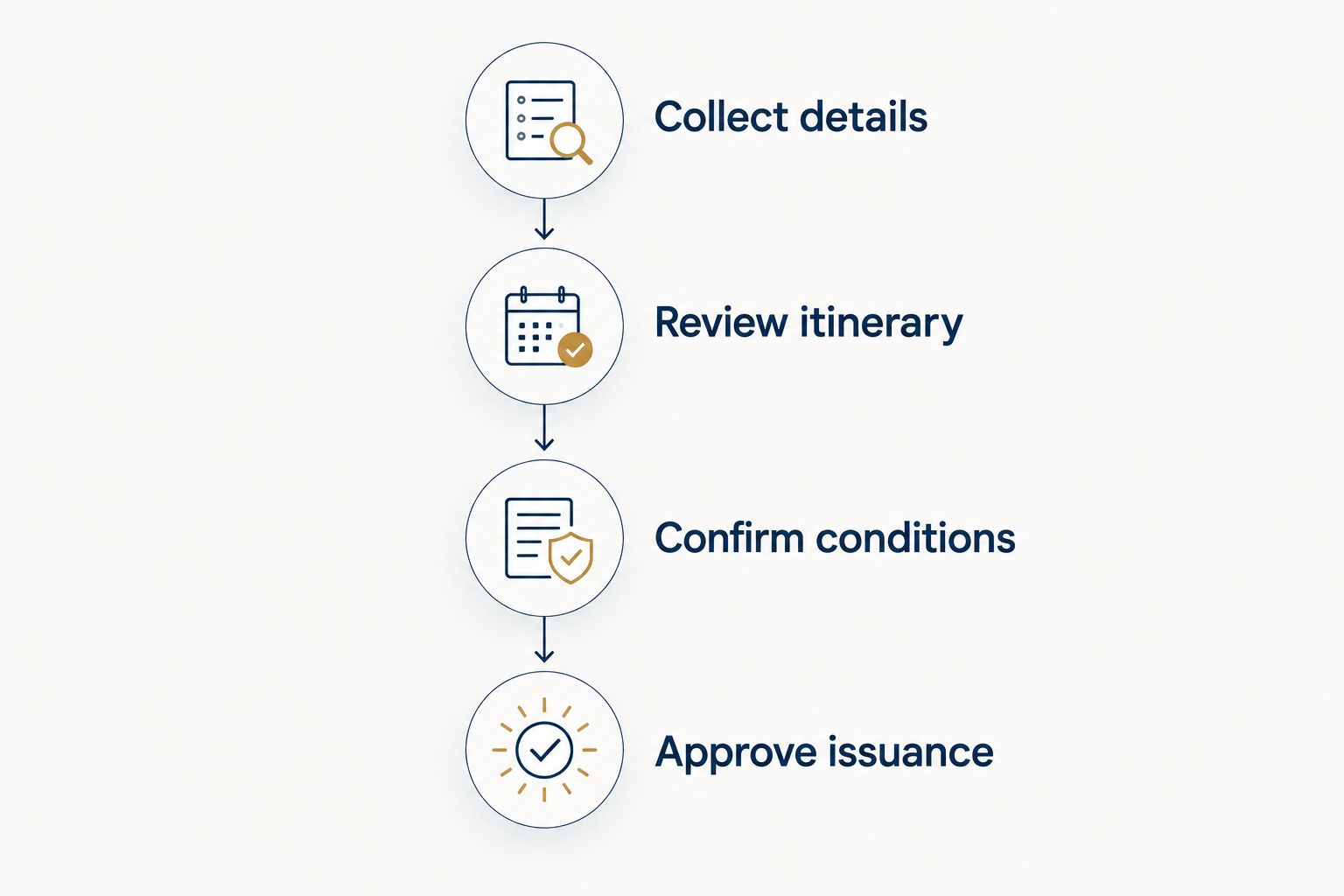
Follow this review order:
- Collect details. Ask each traveler to verify the name and other information required for the booking.
- Review itinerary. Check airports, dates, local departure and arrival times, and each connecting flight.
- Confirm conditions. Record the relevant payment, change, cancellation, and ticketing terms.
- Approve issuance. Obtain the required approval before instructing the consultant to issue tickets.
For your 2026 travel file, keep the approved itinerary separate from earlier proposals. Label revisions clearly so travelers do not mistake an old option for their confirmed journey.
How should you organize airport transfers?
Plan ground transport around the confirmed itinerary, not the group's destination alone. Travelers arriving at the same city airport can still need different pickup arrangements if they land on separate flights or continue to different addresses.
Start by separating arrivals from departures. Then note the flight, airport, destination address, passenger requirements, and the person responsible for coordinating each transfer. Avoid treating a flight booking as confirmation that ground transport has also been arranged.
For a New York arrival, booking airport transfers in advance belongs in the same planning discussion as split flight arrivals and the group's onward schedule. Confirm the transport provider's own meeting instructions and change arrangements instead of assuming they match the airline ticket conditions.
If some passengers arrive earlier, decide whether they will wait or travel onward independently. That decision affects how you organize the group even when everyone shares the same hotel or meeting venue.
What should you send with a quote request?
A clear request helps the consultant address the trip you want rather than a generic group itinerary. Send two acceptable departure dates if your plans genuinely permit them, and identify any requirement that cannot change.
Include:
- Departure airports and destination airports.
- Preferred dates and any acceptable alternatives.
- Passenger count and different return requirements.
- Required cabin for each part of the journey.
- The event, meeting, or arrival deadline the flights must support.
- Seating preferences and assistance requirements to discuss.
- The person responsible for approval and payment decisions.
Global Business Flights is best for groups seeking business class booking with a dedicated travel consultant. The agency supports travelers from quote to e-ticket, including multi-passenger bookings and companies needing managed corporate travel accounts.
The trade-off is that this is a consultant-led service rather than a self-service booking engine. It suits travelers who want to discuss their arrangements; it is not the same process as selecting and issuing tickets independently online.
When your requirements are ready, contact the team to request your personal quote. Ask for the proposed itinerary and applicable conditions in a form you can review with the passengers or company approver.
Explore your fare options
Discuss your group's itinerary, passenger needs, and fare conditions with a dedicated travel consultant.
Can everyone in the group have the same fare conditions?
Matching fare conditions should be confirmed for each passenger, not assumed from a shared flight. Ask the consultant to identify any differences before you approve the tickets.
Can group members return on different dates?
Different return dates belong in the initial booking request. Ask the consultant to assess the separate itineraries and explain how the proposed booking arrangement handles them.
Should you book the flights before everyone approves?
Obtain the necessary approvals before authorizing ticket issuance. Confirm the applicable conditions first so each traveler or company approver understands the commitment being made.
FAQ
Can I book business class flights for a group in 2026?
Yes, you can book business class flights for a group in 2026. Compare coordinated individual tickets with any applicable airline group arrangement, then confirm each passenger's itinerary and conditions.
How many people count as an airline group booking?
Confirm the passenger threshold with the airline for the proposed journey and cabin. Do not assume one universal threshold applies to every group arrangement.
Will everyone sit together in business class?
Traveling on the same flight does not establish adjacent seating. Record your seating preferences and ask which assignments are confirmed before accepting the arrangements.
Does a group booking mean everyone has identical ticket rules?
No, you should not assume every passenger has identical ticket rules. Check the change, cancellation, payment, and ticketing conditions attached to each proposed arrangement.
Can a company arrange business class travel through an agency?
Yes, a company can arrange business class travel through an agency. Global Business Flights serves corporate travelers and companies needing managed corporate travel accounts.
What should I prepare for a group flight quote in 2026?
For a group flight quote in 2026, prepare your airports, dates, passenger count, cabin requirements, and arrival deadline. Include different return plans and identify who will approve the booking.
One last thing
Ask every passenger to check the final itinerary, even when one person organizes the trip. The lead traveler can coordinate the booking, but each passenger is better placed to catch a misspelled name, an unsuitable return date, or a misunderstood personal requirement before tickets are issued.