
Yes, a travel agency can sometimes get better business class fares than you find booking directly, but an agency quote is not automatically the better offer. The comparison depends on the flights, cabin, ticket conditions and any agency service charges. For a 2026 trip, compare the complete booking rather than treating a lower headline fare as the final answer.
- Can a travel agency get better business class fares? Yes, sometimes—but compare identical flights and ticket conditions.
- Global Business Flights suits premium travelers who prefer a dedicated consultant to a self-service booking engine.
- Business class fare comparisons should include change rules, refunds, operating airlines and agency service charges.
- Flexible dates help you compare alternatives; they do not guarantee a lower fare.
Why this matters
A business class ticket is both a journey and a set of conditions. The cabin matters, but so do the rules that apply if your meeting moves, your return date changes or you cancel your holiday. A lower fare with unsuitable conditions is not necessarily a better purchase.
Global Business Flights arranges business and first class tickets through a dedicated travel consultant, with support from quote to e-ticket. That service suits travelers who want someone to explain their options rather than work through a self-service booking engine.
For your 2026 booking, start with what you need from the trip. Decide which dates are fixed, whether an overnight connection is acceptable and how much flexibility you need before comparing quotes.
Can a travel agency get better business class fares?
Yes, sometimes. The strongest evidence is a written comparison of equivalent itineraries and fare conditions—not a general promise that agencies always offer better fares.
Agencies can sell published airline fares, and some also access privately negotiated fares through airline or distribution relationships. That does not mean every agency has a special fare for every route. Ask what the specific quote includes rather than assuming the booking channel explains its value.
| Booking option | Best for | Main advantage | Main limitation |
|---|---|---|---|
| Travel agency with a consultant | Travelers who want personal help comparing premium itineraries | A consultant can explain the quoted itinerary and ticket conditions | Agency service charges and servicing terms need a separate check |
| Booking directly with an airline | Travelers comfortable choosing and managing their own itinerary | You deal directly with the airline for the purchase | You remain responsible for checking whether the itinerary and fare rules meet your needs |
Neither channel wins every comparison. A suitable agency quote can offer better value; a suitable airline-direct quote can also be the right choice. Compare the actual offers, not the reputation of the booking method.
What counts as a fair comparison?
Match the departure and arrival airports, travel dates, flight numbers, cabin on every segment and passenger details. Then compare the ticket conditions and total payable amount. If one quote uses a different connection or travel day, treat it as an alternative itinerary rather than a like-for-like saving.
Record when each quote was issued. A quote is an offer to review, not proof that the same fare will remain bookable later.
What makes a business class fare better?
A better fare meets your travel needs with conditions you understand. That might mean a lower total for the same journey, but it can also mean a more suitable return schedule or ticket flexibility you expect to use.
Cabin and journey
Check the operating airline and cabin for each flight, including connecting segments. A business class label on the main flight does not establish what you receive throughout the itinerary. Ask about any segment that is not clearly identified.
Review connection airports and arrival dates as carefully as departure times. A longer routing can change how much usable time you have at your destination, even when the ticket meets your cabin requirements.
Changes and refunds
Ask separately whether you can change the ticket and whether you can receive a refund. Those are different questions. A changeable ticket is not automatically refundable, and permission to change does not mean a replacement flight carries no additional charge.
Ask how fare differences, airline penalties and agency service charges apply. For an unused ticket, request the cancellation conditions in writing rather than relying on a broad description such as flexible.
Support and responsibility
Establish who handles voluntary changes after ticketing and how you should contact them. Also ask what to do if the airline changes the schedule or disrupts the journey. Clear responsibilities are more useful than a general promise of assistance.
A consultant adds value when you want help understanding the booking. The trade-off is that you need to understand the agency's own servicing process as well as the airline's ticket rules.
Why business class fare quotes vary
Business class quotes vary because the underlying journeys and ticket conditions differ. Before choosing between offers, check these factors:
- Travel dates: A different departure or return date creates a different itinerary to price. Compare the complete trip rather than assuming nearby dates cost the same.
- Routing: Nonstop and connecting journeys involve different flights. Judge any fare difference alongside total journey time and the connection itself.
- Ticket conditions: Change and refund permissions affect what you can do after purchase. Read the conditions attached to the quoted fare.
- Cabin by segment: Confirm whether every flight is in your requested cabin. Do not compare a mixed-cabin itinerary as though it were identical to an all-business itinerary.
- Passenger group: A quote must cover the actual travelers and their requested flights. Ask whether everyone is being quoted on the same terms.
- Agency charges: Separate ticket charges from agency booking or servicing charges. Ask which charges apply at purchase and which apply only if you request a change.
These checks explain differences without assuming that the lowest quote is misleading or that the highest quote includes more. Let the written details establish the distinction.
How to compare quotes before you book
Use the same travel brief for each quote. That keeps the comparison focused and gives a consultant a clear basis for explaining alternatives.
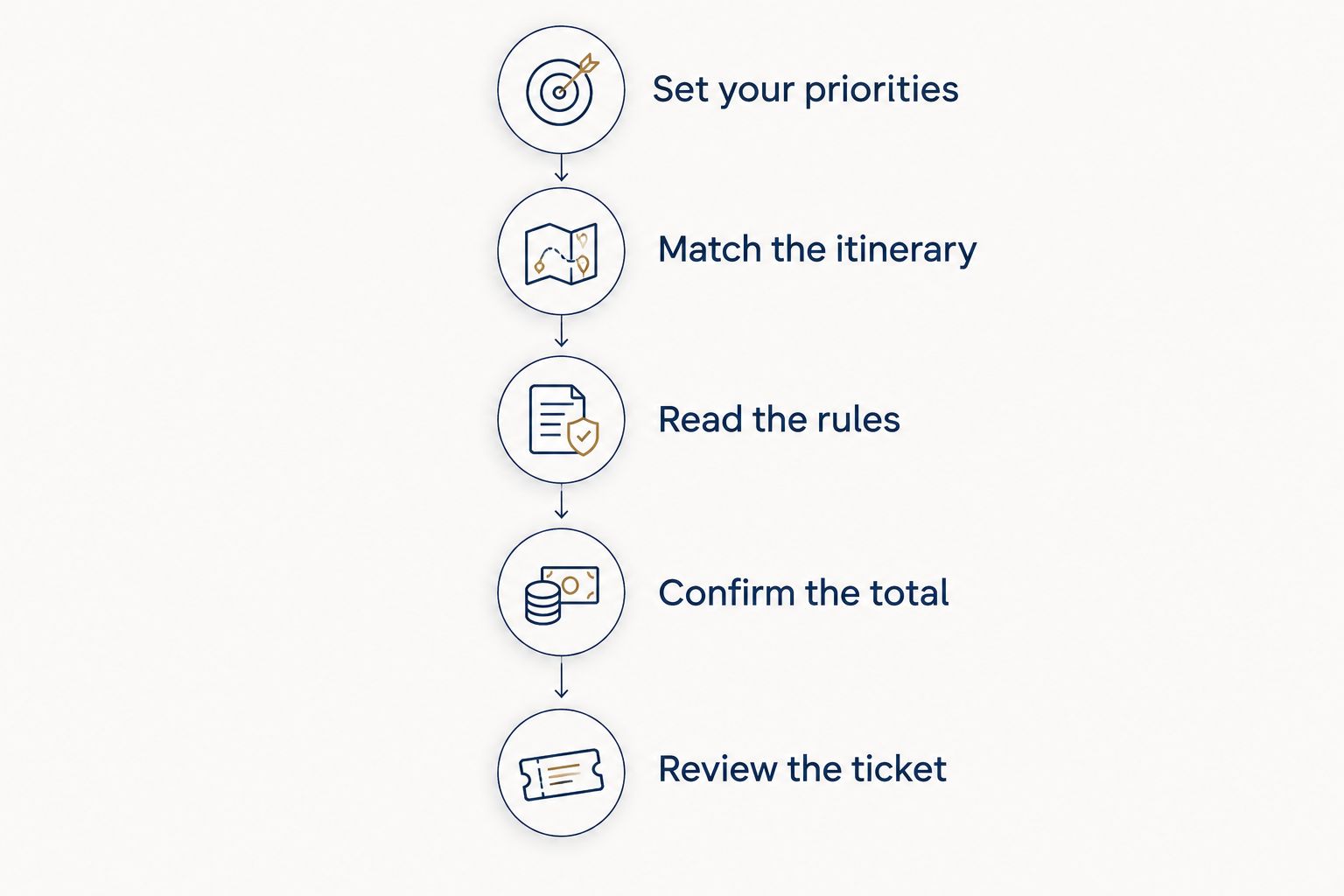
- Set your priorities. State your airports, travel dates, passenger details and requested cabin. Identify your fixed requirements and the preferences you can change.
- Match the itinerary. Check flight numbers, operating airlines, connections and arrival dates. Mark any difference before comparing the totals.
- Read the rules. Request the change, cancellation, refund and no-show conditions. Ask for an explanation of any unfamiliar wording.
- Confirm the total. Ask for the complete payable amount and a separate explanation of agency service charges. Check the currency before comparing offers.
- Review the ticket. After purchase, check names, dates, airports and cabin details against your approved itinerary. Raise any discrepancy promptly.
Keep your approved itinerary and the written fare conditions together. A clear record helps you distinguish what you requested, what you accepted and what was issued. It also gives you a practical starting point if you later need help with the booking.
When a dedicated consultant is the better fit
Global Business Flights is best for business and first class travelers who want a dedicated consultant rather than a self-service booking engine. Its service includes leisure and corporate travel, flexible fare options, multi-passenger bookings and support from quote to e-ticket.
That approach is relevant when your booking needs a conversation. You might need to explain different passenger departure points, distinguish fixed meeting dates from flexible leisure days or compare fare conditions before choosing. Give the consultant those details at the start.
The limitation is equally clear: a consultant-led service is not the same experience as selecting and purchasing everything yourself online. Ask how quotes are approved, how payment leads to ticketing and who handles later requests. For a 2026 corporate trip, clarify who in your company can approve the itinerary before you proceed.
Choose the service because the booking process fits your needs. Do not assume personal assistance means every fare is lower or every change is included.
How flexible dates improve the comparison
Date flexibility gives you more journeys to evaluate, not a promise of a better fare. Tell your consultant exactly which departure and return dates are acceptable. Keep arrival deadlines separate from preferences so that an alternative still serves the purpose of your trip.
On a route such as Toronto to Amritsar, comparing flexible-date fares means checking the return journey and connections alongside each alternative departure. A different outbound date is not an improvement if the revised itinerary conflicts with your arrival plans.
For your 2026 search, divide your brief into fixed and flexible requirements. Fixed requirements might include a meeting arrival deadline or traveling together; flexible preferences might include the departure day or connection airport. This gives every alternative a clear test.
Before accepting a different date, consider the whole trip. Accommodation arrangements, ground transport and time away from work still matter, even when they are not part of the airline quote.
Is booking business class through an agency always cheaper?
No. Booking business class through an agency does not guarantee a lower fare than booking directly with an airline. Compare the specific offers on matching flights and conditions before drawing that conclusion.
If the agency quote differs, ask what explains the difference. It might be a different itinerary, different ticket rules or a different fare source. The explanation should be clear enough that you can decide whether the offer suits you without relying on a savings claim.
Can an agency help with several travelers?
Yes, an agency can help arrange a multi-passenger booking. Give the consultant each traveler's requirements and confirm whether everyone needs to stay together throughout the journey.
For corporate travel, distinguish the traveler's preferences from the company's approval requirements. For leisure travel, identify any passenger whose dates or cabin needs differ. A shared itinerary is only useful when it works for the people taking it.
Should you choose a flexible fare?
Choose a flexible fare when its written conditions address changes you reasonably expect to need. Do not choose it on the label alone. Ask what changes are permitted, what remains payable and whether cancellation produces a refund or another outcome.
If your plans are fixed, compare the less flexible alternative as well. The right choice depends on the conditions you need—not the assumption that more flexibility is always necessary.
FAQ
Can a travel agency get better business class fares than an airline website?
Yes, sometimes, but an agency quote is not automatically lower or better. Match the flights, cabin, ticket conditions and total payable amount before choosing.
What's the best way to compare business class quotes?
Compare the same itinerary and cabin first, then review changes, refunds and agency service charges. Treat different dates or routings as alternatives rather than identical offers.
Does a flexible business class ticket include free changes?
A flexible business class ticket does not automatically include changes without additional charges. Check the fare rules for airline penalties, fare differences and any agency servicing charges.
Can Global Business Flights help with corporate travel?
Global Business Flights serves companies needing managed corporate travel accounts as well as individual premium travelers. Explain your approval requirements, traveler needs and preferred itinerary when requesting a quote.
Can I compare a nonstop flight with a connecting flight?
Yes, but they are different itineraries rather than a like-for-like fare comparison. Assess the connection, total journey time and arrival schedule alongside the ticket conditions.
What should I check before paying for a business class ticket?
Check passenger names, airports, dates, flight numbers, operating airlines, cabin details and the complete payable amount. Read the change and cancellation conditions before approving the booking.
Does an agency quote mean my ticket has been issued?
No, a quote is not an issued ticket. Ask how the agency confirms ticket issuance, then review the e-ticket against the itinerary you approved.
One last thing
A changeable ticket and a refundable ticket answer different needs. Before approving your 2026 booking, ask two separate questions: what happens if you move the trip, and what happens if you cancel it? Written answers make the fare comparison more useful than either label alone.