
Yes, a company can set up a corporate travel account with a travel agency that serves business travelers. Before you proceed, confirm how bookings, approvals, payment and traveler support will work; an account does not automatically include credit terms, flexible tickets or a booking portal.
- Companies can set up a corporate travel account after confirming booking, approval, payment and support arrangements.
- Globalbusinessflights suits companies seeking consultant-led business and first class travel booking rather than a self-service engine.
- Corporate travel accounts and airline loyalty accounts serve different purposes; confirm what each arrangement includes.
- Prepare your travel policy, authorized bookers and typical routes before requesting account details.
Why this matters
A corporate travel account should make premium travel easier to organize, not leave your team guessing who approves a ticket or handles a change. The useful distinction is between having an account and having a clear booking process.
For your 2026 travel planning, start with the arrangements your employees actually need. You can contact the travel agency to discuss business and first class bookings, then confirm the account terms before committing.
Can a company set up a corporate travel account?
Yes. The practical starting point is an account discussion, followed by agreement on who can request travel, who authorizes bookings and how tickets are paid for. Your company should also establish where travelers turn when their itinerary needs attention.
A corporate travel account is not necessarily an airline rewards account, a credit facility or a self-service booking system. Those are separate features or arrangements. Ask which are included rather than treating the account name as a service description.
Use the following sequence to assess the arrangement before your first booking:
- Define travel needs. Identify your usual routes, preferred cabins, traveler groups and the flexibility your trips require.
- Assign booking authority. Name the people who can request a quote, approve an itinerary and authorize ticketing.
- Review account terms. Ask about payment, any service charges, documentation and the scope of support.
- Confirm fare conditions. Check the rules attached to the proposed ticket, including changes, cancellation and refunds.
- Approve ticketing. Review passenger details, the complete itinerary and the authorized payment arrangement before issuance.
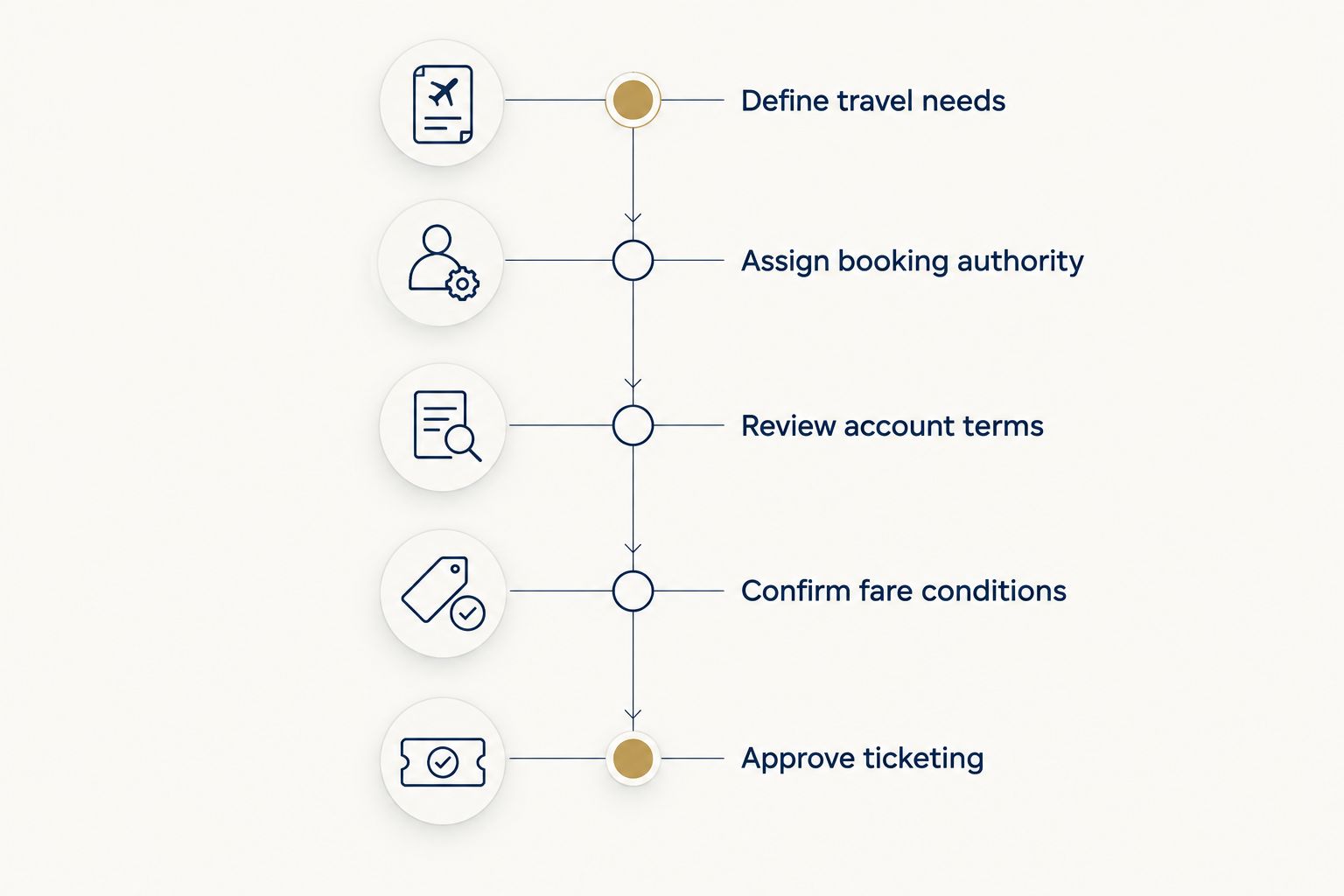
The account discussion should produce practical answers your team can use. If an answer remains unclear, resolve it before the traveler relies on that part of the service.
Which booking arrangement fits your company?
The right arrangement depends on whether your team values personal assistance, airline-specific benefits or direct control over booking. These options are not interchangeable, and your company can assess them separately without assuming one replaces every other travel arrangement.
| Arrangement | Best for | Main advantage | Limitation to check |
|---|---|---|---|
| Consultant-led travel agency | Companies wanting personal help with premium-cabin itineraries | A consultant helps with fare options and booking coordination | Confirm support scope, payment arrangements and any service charges |
| Airline corporate program | Companies evaluating an arrangement with a particular airline | Keeps the discussion focused on that airline's corporate offering | Eligibility, benefits and participating flights depend on the program |
| Self-service booking | Teams that prefer to select and book directly | Gives the booker direct control over itinerary selection | Your team must understand the booking workflow and available support |
Globalbusinessflights is best for companies seeking consultant-led business and first class travel booking. Its service works through phone and online quote requests, with a dedicated travel consultant supporting the process from quote to e-ticket.
That personal service is relevant when you want help reviewing premium fare options or coordinating multiple passengers. The trade-off is equally clear: this is not a self-service booking engine. If an employee booking portal is essential to your policy, establish that requirement before choosing an arrangement.
For a 2026 account review, compare the working process rather than relying on the label “corporate.” Ask each provider to explain how the same representative trip would move from request to approval to ticket.
What should you prepare before requesting an account?
Bring a concise outline of your company's travel needs. You do not need to predict every journey, but a specific brief gives the account discussion a useful starting point.
Company and booking contacts
Identify your company contact, the person responsible for travel decisions and the employees authorized to request bookings. Separate booking authority from payment authority if different people hold those responsibilities.
Start with 1 policy owner. This is a practical recommendation, not an account eligibility requirement: one accountable person can resolve conflicting instructions and keep the booking process consistent.
Typical journeys and cabin needs
List representative departure points, destinations and preferred travel dates. Explain whether you are arranging individual trips, several passengers on the same journey or recurring corporate travel.
Describe why business or first class matters for those journeys. An overnight flight before a meeting presents a different planning brief from a leisure extension with flexible dates. Give the consultant the circumstances, not just a cabin name.
Approval and payment preferences
Explain who approves an itinerary and who authorizes payment. Ask what information the provider requires and which payment arrangements it supports; do not assume an account includes invoicing or deferred payment.
If your finance team needs particular invoice details, raise that request during setup. Confirm what can be supplied before making it part of your internal process.
Travel policy boundaries
Share the rules that affect an actual booking decision. These can include permitted cabins, approval requirements, preferred routing and how your company treats personal travel attached to a business trip.
Label the document as your 2026 travel policy if that is the version employees should follow. A clear version reference helps your booker avoid using an outdated instruction.
Why corporate travel account arrangements vary
Account arrangements differ because companies ask for different combinations of booking assistance, oversight and flexibility. The relevant factors are the requirements you bring to the discussion—not assumptions about what every corporate account includes.
- Cabin requirements. Specify whether your requests concern business class, first class or both, so the discussion stays aligned with the service you need.
- Passenger coordination. Explain whether employees travel individually or together, especially when their dates or departure points differ.
- Fare flexibility. Ask for the applicable change, cancellation and refund conditions on each proposed fare rather than relying on a general description.
- Approval structure. Tell the provider whether a traveler, manager or central coordinator must approve the itinerary before ticketing.
- Payment requirements. Confirm accepted arrangements and the documentation your finance team needs. Account access alone does not establish credit terms.
- Support expectations. Establish who to contact before and after ticketing, including the process for a request outside normal business hours.
Treat these as discussion points, not promised account features. Your written confirmation should distinguish the provider's service responsibilities from the airline's ticket conditions.
How should you compare the first fare options?
Compare the whole journey before approving a premium ticket. A cabin label alone does not tell you whether the departure time, connection, operating airline or fare conditions suit the traveler.
Ask your consultant to explain meaningful differences between the available itineraries. Keep your company's approval criteria visible so a convenient schedule does not distract from a fare restriction that matters to the trip.
Compare 2 itineraries side by side when you want a clear choice. This is a suggested review method, not a promise that a particular number of options will be available. Where suitable alternatives exist, use the same criteria for each:
- Departure and arrival dates, including any overnight date change.
- Airports and connection points throughout the journey.
- Cabin booked on each flight segment.
- Operating airline where it differs from the airline marketing the flight.
- Change, cancellation and refund conditions attached to the fare.
- Passenger names and the information required for ticketing.
For business and first class bookings, Globalbusinessflights offers personal consultant support rather than a self-service checkout. Use that conversation to clarify differences before you authorize the itinerary.
Explore your fare options
Discuss business and first class travel with a dedicated consultant, from quote to e-ticket.
Does a corporate travel account include flexible tickets?
No. A corporate travel account does not, by itself, make every ticket flexible. The conditions of the fare you approve determine how changes, cancellation and refunds are handled.
Ask for those conditions alongside the itinerary, not after you have selected it. If a meeting date remains uncertain, explain that before requesting fare options so flexibility is part of the brief.
A useful 2026 booking instruction is to identify the journey's non-negotiables first. Separate a required arrival time from a preferred departure time, and distinguish a genuine flexibility requirement from a general preference.
Can employees book through the account themselves?
Employee booking access depends on the arrangement you agree with the provider. Do not assume that opening an account creates individual logins, approval automation or permission for every employee to authorize tickets.
For a consultant-led arrangement, agree on how employees submit requests and when the designated approver becomes involved. A short written instruction can prevent a travel request from being mistaken for permission to issue a ticket.
If several people arrange travel, give them the same approval rules. Keep the policy owner responsible for changes to those rules rather than allowing each booking conversation to establish a different process.
Does a corporate travel account include credit terms?
A corporate travel account does not automatically include credit terms or payment after travel. Confirm payment requirements directly and complete any required approval process before relying on a particular arrangement.
Your finance team should understand what triggers payment and what documentation accompanies the booking. Keep that discussion separate from whether an itinerary meets the traveler's needs: both need approval before ticketing.
What should you confirm before the first booking?
Use 3 checkpoints for your first corporate booking: authority, itinerary and payment. These are internal review steps you can adopt, not a provider's account requirements.
- Authority: The request comes from an authorized person, and the required manager or policy owner has approved it.
- Itinerary: Passenger details, travel dates, airports, cabins and fare conditions match the approved request.
- Payment: The authorized payer understands the agreed payment arrangement and has the necessary booking documentation.
For your first 2026 booking, ask the traveler and approver to review the same itinerary version. Once the e-ticket arrives, check it against that approved itinerary and keep the relevant contact details accessible to the traveler.
FAQ
Can a small company set up a corporate travel account?
A small company can ask a travel agency about setting up a corporate travel account. Confirm the provider's eligibility requirements and whether its booking process fits your company's needs.
Do we need a minimum number of business trips?
Any minimum travel requirement depends on the provider and account arrangement. Ask directly rather than assuming that a particular booking frequency qualifies or disqualifies your company.
Is a corporate travel account the same as an airline loyalty account?
No. A corporate travel account concerns the agreed booking relationship, while an airline loyalty account concerns participation in that airline's program. Confirm the conditions of each separately.
Can we arrange business and first class through a travel agency?
Yes. Globalbusinessflights arranges business and first class airline tickets for corporate and leisure travelers through a dedicated travel consultant, including multi-passenger bookings.
Will opening an account guarantee a lower fare?
No. Opening a corporate travel account does not establish a lowest-fare guarantee. Evaluate the actual itinerary, fare conditions and agreed service before approving a booking.
Should we send employee passport details when we first inquire?
Begin with your company contact and travel requirements, then ask what traveler information is needed and how to submit it. Confirm the appropriate submission process before sending sensitive documents.
Who should approve a corporate flight before ticketing?
The person authorized under your company's travel policy should approve the flight before ticketing. Identify that person during account setup and make the approval process clear to travelers and bookers.
One last thing
The most useful account instruction is often a simple boundary: a quote request is not authorization to issue a ticket. Put that distinction in your booking process and tell every authorized requester who gives final approval.
A personal consultant can help you review the journey. Your company still needs to make the decision clear—so the traveler, approver and booker are working from the same instructions.