Business travel for government contractors is the planning, approval and documentation of contract-related trips with the aim of meeting mission needs and supporting allowable travel charges. Unlike ordinary corporate travel, these trips require you to separate traveler comfort, company permission and the costs chargeable to a government contract.
- Business travel for government contractors starts with contract requirements, not a cabin preference.
- Global Business Flights suits travelers seeking personal premium-cabin booking support; reimbursement decisions stay with your company.
- Separate the fare you purchase from the amount you can charge to a contract.
- Keep approvals, fare comparisons and ticket records together for each trip.
Why business travel matters for government contractors
A convenient itinerary is only part of a sound booking decision. For your 2026 travel program, the contract, applicable cost rules and company policy determine which expenses need approval and documentation.
An approved upgrade is not automatically an allowable contract cost. Resolve both questions before ticketing.
How to plan contractor travel in 2026
1. Identify the rules before searching
Start with the contract and your company's travel policy. Ask your contracts or finance team which requirements govern the trip rather than assuming federal employee rules apply unchanged.
- Identify the contract and charge code.
- Confirm the required approval authority.
- Record the trip's business purpose.
- Check applicable travel clauses.
2. Choose the right booking channel
Use your required company channel first. If outside agency booking is permitted, Global Business Flights arranges business and first class tickets through a dedicated travel consultant, with support from quote to e-ticket.
Global Business Flights is best for travelers seeking personal premium-cabin booking support, not contract allowability decisions. Its consultant service supports fare selection; your authorized company team must still determine what can be booked and charged.
A manual starting point is to collect airline itineraries and record their conditions in a shared worksheet. A consultant offers another route for arranging premium fares, including flexible fares and multi-passenger bookings. Neither approach replaces the approvals your employer requires.
- Confirm whether outside booking is permitted.
- Identify the booking and payment owner.
- Share your route and timing requirements.
- State any approval conditions before requesting tickets.
3. Define the mission and arrival requirements
Write a trip brief before comparing fares. Include the actual work location, reporting time, required equipment and any company-approved restrictions on connections or travel days.
Work backward from the required arrival, not just the meeting invitation. An airport arrival and an on-site reporting time are different commitments. Include ground transportation, site access arrangements and any required check-in process in your planning.
For a multi-passenger booking, distinguish shared requirements from individual needs. Colleagues can have different departure cities, return dates or authorization limits even when they attend the same assignment. Make those differences visible before asking someone to arrange the group.
- Record the required arrival date and local time.
- Identify the airport and final work location.
- List traveler-specific schedule constraints.
- Note baggage or equipment requirements.
- Assign responsibility for ground transportation.
4. Compare the itinerary and its conditions
Build a written comparison yourself before requesting approval. Use the same travel dates, airports and operational requirements wherever possible so that the alternatives answer the same business need.
Keep 2 itinerary options in the review when a meaningful alternative exists: the preferred itinerary and a suitable comparison. This is a planning recommendation, not a universal federal requirement. Explain differences such as connections, arrival times, cabin coverage and change conditions rather than treating the headline fare as the whole decision.
For 2026 bookings, verify the operating airline and cabin on every flight segment. A premium label on the overall itinerary does not establish that every connecting flight provides the same cabin or seating arrangement.
- Compare the same required arrival window.
- Check the operating airline for each segment.
- Identify mixed-cabin portions explicitly.
- Read change and cancellation conditions.
- Record the comparison date and itinerary details.
5. Separate premium comfort from allowable cost
Read the rules that apply to the contract before treating business or first class as a reimbursable expense. Where FAR Part 31 applies, FAR 31.205-46 addresses travel costs, including airfare limitations and exceptions. Company permission alone does not establish that an exception applies.
Under that provision, airfare above the lowest priced airfare available to the contractor during normal business hours is generally unallowable unless a specified exception applies. Exceptions address circumstances such as unreasonable travel hours, excessively prolonged travel, mission-related scheduling requirements and medical needs, subject to the provision's terms.
Do not turn a comfort preference into an exception claim. Ask the responsible contracts or finance reviewer to identify the applicable basis and required evidence. If your company permits a premium purchase but limits the amount charged to the contract, document that distinction before payment.
- Confirm whether FAR Part 31 applies.
- Identify the applicable airfare limitation.
- Document any exception's actual circumstances.
- Obtain the required written authorization.
- Record any amount excluded from contract charges.
6. Check carrier and international requirements
Review international travel separately from cabin selection. The Fly America Act and applicable implementing requirements concern the use of U.S.-flag air carrier service for covered government-funded transportation; they do not establish a business class entitlement.
Coverage, exceptions and applicable Open Skies agreements require a trip-specific review. A foreign airline itinerary is not automatically acceptable because it is convenient, and a U.S. airline's marketing name alone is not enough information to resolve every question. Collect the flight details your company needs for its determination.
For international assignments in 2026, also confirm your employer's passport, visa, security and export-control review processes where relevant. A travel booking does not authorize you to carry controlled information or equipment across a border.
- Check applicable carrier requirements before ticketing.
- Record marketing and operating airline details.
- Route exception questions to your authorized reviewer.
- Confirm entry-document responsibilities.
- Review company security and equipment requirements.
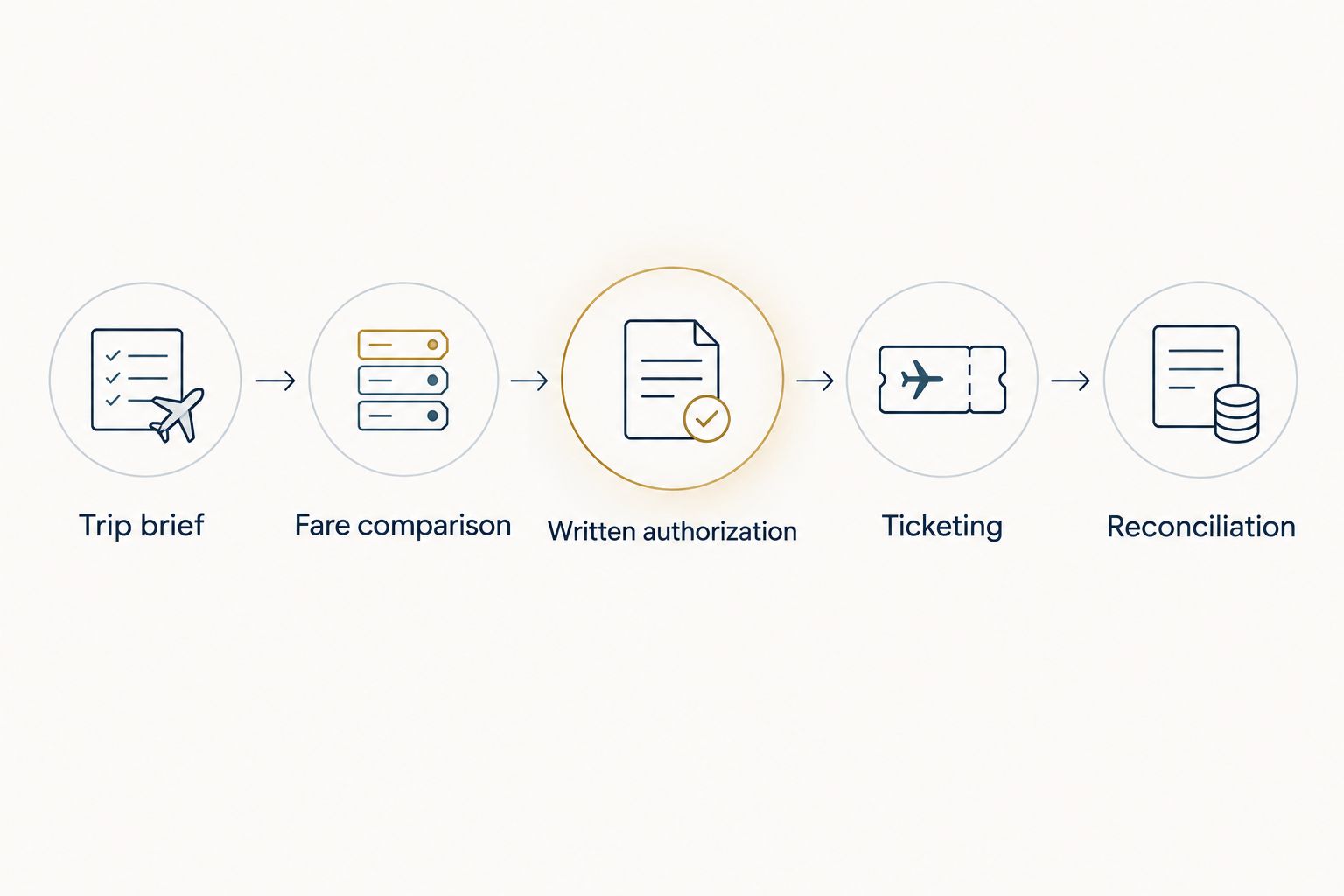
7. Approve, ticket and close the file
Create 1 trip file containing the request, approval, fare comparison, final itinerary and expense records. Use your existing expense system or an access-controlled folder; a new platform is not a prerequisite.
Before authorizing ticketing, check the passenger names, dates, airports and approved cabin against the final itinerary. Keep 1 named approval owner responsible for resolving changes rather than leaving the traveler to interpret conflicting messages.
After travel, reconcile the actual itinerary with the original authorization. Retain records of exchanges, refunds and unused tickets according to company requirements. Your 2026 travel file should explain both what was approved and what ultimately happened.
- Match passenger details to travel documents.
- Confirm final authorization before ticketing.
- Save the e-ticket and payment documentation.
- Record schedule changes and their approval.
- Reconcile expenses and unused ticket value.
The sequence matters: approval belongs before ticketing, and reconciliation belongs after travel. Keep those stages distinct even when an assignment changes quickly.
Compare your booking options
Choose a booking method around your employer's requirements and the support you need. The best booking channel is the permitted channel that can handle your itinerary and preserve the required records. None of these options makes a trip automatically allowable.
| Option | Best for | Main advantage | Key limitation |
|---|---|---|---|
| Direct airline booking | Travelers permitted to manage a straightforward itinerary | Direct access to the airline's booking process | You handle comparisons, approvals and record collection yourself |
| Company-designated travel channel | Travelers whose employer requires centralized booking | Keeps bookings within the company's designated process | Choices depend on the employer's policy and channel |
| Global Business Flights | Travelers permitted to use a consultant for business or first class | Dedicated consultant support from quote to e-ticket | Premium-fare booking support does not determine contract allowability |
Before switching channels, ask who handles changes and where the resulting documents must be stored. A booking made outside the required process creates a separate approval question, even when the itinerary itself meets the traveler's needs.
Explore your fare options
Discuss your route, cabin preferences and booking requirements with a dedicated travel consultant.
Common mistakes government contractors make
Treating federal employee benefits as contractor benefits
A government-funded assignment does not make a contractor employee a federal employee. GSA's City Pair Program is not available to contractor employees simply because they travel on government business. Verify eligibility for any government fare or program rather than selecting it based on the trip's purpose.
Confusing permission with reimbursement
A manager can approve a travel arrangement without establishing that every expense is chargeable to a contract. Keep the operational approval and the cost treatment clear. If different people own those decisions, obtain both determinations before making a nonrecoverable commitment.
Justifying premium travel after purchase
A receipt proves a purchase, not the reason an airfare exception applies. Capture the relevant scheduling, mission or medical documentation through your company's approved process before ticketing. Avoid placing sensitive personal or assignment information in an unrestricted booking note.
Comparing unlike itineraries
A fare comparison loses its purpose when the alternative misses the required arrival or uses different travel dates without explanation. State the mission requirement first, then show how each itinerary meets it. Document genuine differences instead of presenting an unsuitable alternative as a realistic choice.
Losing the record when plans change
An original approval does not explain a later rerouting, cabin change or extra travel day. Keep the revised itinerary and the decision behind it together. At expense review, reconcile the final trip rather than submitting the original booking as though nothing changed.
FAQ
Can government contractors book business class flights?
Government contractors can book business class when their company permits it, but charging the expense to a government contract requires a separate allowability review. Confirm the applicable contract terms, travel policy and any required exception documentation before ticketing.
Do government contractors have to follow the Federal Travel Regulation?
Contractor employees are not automatically subject to every Federal Travel Regulation provision in the same way as federal employees. Applicable contract terms and cost principles determine which requirements and reimbursement limits govern the trip.
Can a government contractor use GSA City Pair fares?
Contractor employees are not eligible for GSA City Pair Program fares simply because they travel on government business. Use a fare for which the traveler is eligible and follow the employer's required booking process.
Does the Fly America Act apply to contractor travel?
The Fly America Act can apply to covered government-funded contractor travel. Have your authorized company reviewer confirm coverage, carrier requirements and any applicable exception before purchasing an international itinerary.
What should I send a consultant for a premium flight quote?
Send your departure and destination airports, travel dates, required arrival time, passenger count and preferred cabin. Explain booking restrictions and approval requirements, but use your company's approved channels for sensitive assignment or personal information.
Is a manager's approval enough to expense first class?
A manager's approval alone does not establish that first class airfare is allowable under a government contract. The applicable rules, approval authority and supporting documentation determine how the expense must be treated.
What records should I keep for contractor business travel?
Keep the business purpose, authorization, itinerary comparison, final e-ticket, payment records and any required exception documentation together. Add approved changes and reconcile the completed trip under your company's retention and expense procedures.
One last thing
Review the return journey as carefully as the outbound flight. A mission-driven arrival requirement does not, by itself, explain every choice on the return itinerary. Evaluate each direction against the actual work schedule and applicable rules.
For your next 2026 trip, write the arrival requirement before requesting a quote. That small step gives the traveler, approver and booking consultant a shared definition of a suitable itinerary—and keeps comfort preferences separate from the evidence supporting a contract charge.