Sales teams’ business class travel is premium air travel planned around client meetings, with the aim of protecting preparation time and keeping demanding itineraries manageable. This 2026 guide to business class flights for sales teams explains how to balance onboard comfort, arrival schedules, fare conditions, and the needs of several travelers without treating every trip the same.
- Business class flights for sales teams should follow meeting demands, not job titles alone.
- Globalbusinessflights suits sales teams seeking consultant-led premium flight booking rather than a self-service engine.
- Compare arrival times, cabin details, and written fare conditions before choosing an itinerary.
- Separate multi-passenger booking needs from individual preferences, and name an internal approver.
Why business class matters for sales teams
Sales travel has a different purpose from a holiday: your arrival needs to support work that happens at a particular time. A comfortable seat has limited value if the itinerary puts a representative at the client’s office too close to the meeting or leaves no practical opportunity to prepare.
For your 2026 travel policy, assess business class against the actual assignment. Overnight travel, connected journeys, presentation responsibilities, and several meetings on the same trip deserve different consideration from a short daytime visit. Approve the travel conditions the assignment requires, rather than making the cabin a reward for seniority.
Business class does not guarantee sleep, punctuality, or a successful presentation. Its usefulness depends on the specific flight and fare. Compare the full journey, including the ground schedule and the rules that apply when a client changes plans.
How to plan business class travel for your sales team
Define the meeting requirements first
Start with a shared document or spreadsheet. Record when each traveler must be ready for work, not simply when the aircraft should land. Include the location of the first appointment and any preparation that must happen before it.
A traveler leading a presentation has a different brief from a colleague joining an informal relationship meeting. Give the approver enough context to make that distinction without requiring a long justification for every request.
Ask travelers to propose 2 departure windows when the meeting schedule permits. This is a planning choice, not a promise of a better fare: it gives whoever arranges the trip a clear boundary for comparing schedules.
For your 2026 brief, separate essential requirements from preferences. A particular airport might be essential because of the meeting location; a favored departure time might simply be convenient. That distinction makes alternatives easier to evaluate.
- Record the first appointment’s local date, time, and address.
- Identify who presents, negotiates, or carries meeting materials.
- Separate required arrival conditions from personal preferences.
- Note acceptable departure windows and return constraints.
- Assign an internal owner for the travel brief.
Set approval rules before comparing flights
Write a short cabin policy using your existing documents. Explain which travel circumstances qualify for business class, who approves exceptions, and what information the approver needs. Keep the policy understandable enough for a representative to use without interpreting informal precedents.
Avoid a rule based solely on route length. The work schedule also matters: a daytime flight followed by an open evening creates a different planning problem from an overnight journey followed by a presentation. Evaluate both the journey and the responsibilities awaiting the traveler.
Set 1 named approver for each trip, with a backup identified internally. This prevents several managers from giving different instructions while someone is trying to finalize the itinerary.
Your approval should cover the proposed journey and its fare conditions together. A cabin label alone does not tell the approver whether the ticket fits the company’s need to change or cancel plans.
- Define eligible trip circumstances in plain language.
- Specify who approves the itinerary and any exception.
- Record the business reason for premium travel.
- Include change and cancellation conditions in approval requests.
- State how travelers should report a changed meeting schedule.
Choose a booking approach that fits the assignment
You can begin manually by comparing airline itineraries and recording questions about each fare. This works when your team can manage the research, approvals, and booking communication internally. Keep each comparison attached to the same travel brief so that different schedules remain comparable.
For consultant-led coordination, Globalbusinessflights arranges business and first class tickets for individual travelers and companies, including multi-passenger bookings and managed corporate travel accounts. Its service works through phone and online quote requests, with a dedicated travel consultant supporting the process from quote to e-ticket.
Globalbusinessflights is best for sales teams that want consultant-led premium flight booking rather than a self-service engine. The trade-off is the communication step: you request and review options with a consultant instead of independently completing the booking in a self-service interface.
Neither method replaces your internal approval process. Send a clear brief and ask for the itinerary and relevant conditions in writing before authorizing ticketing.
- Decide whether your team wants direct booking or consultant assistance.
- Share the same requirements with everyone comparing options.
- Identify one company contact to consolidate traveler feedback.
- Request written itinerary details and fare conditions.
- Confirm approval before instructing anyone to issue tickets.
Compare the journey, not just the cabin
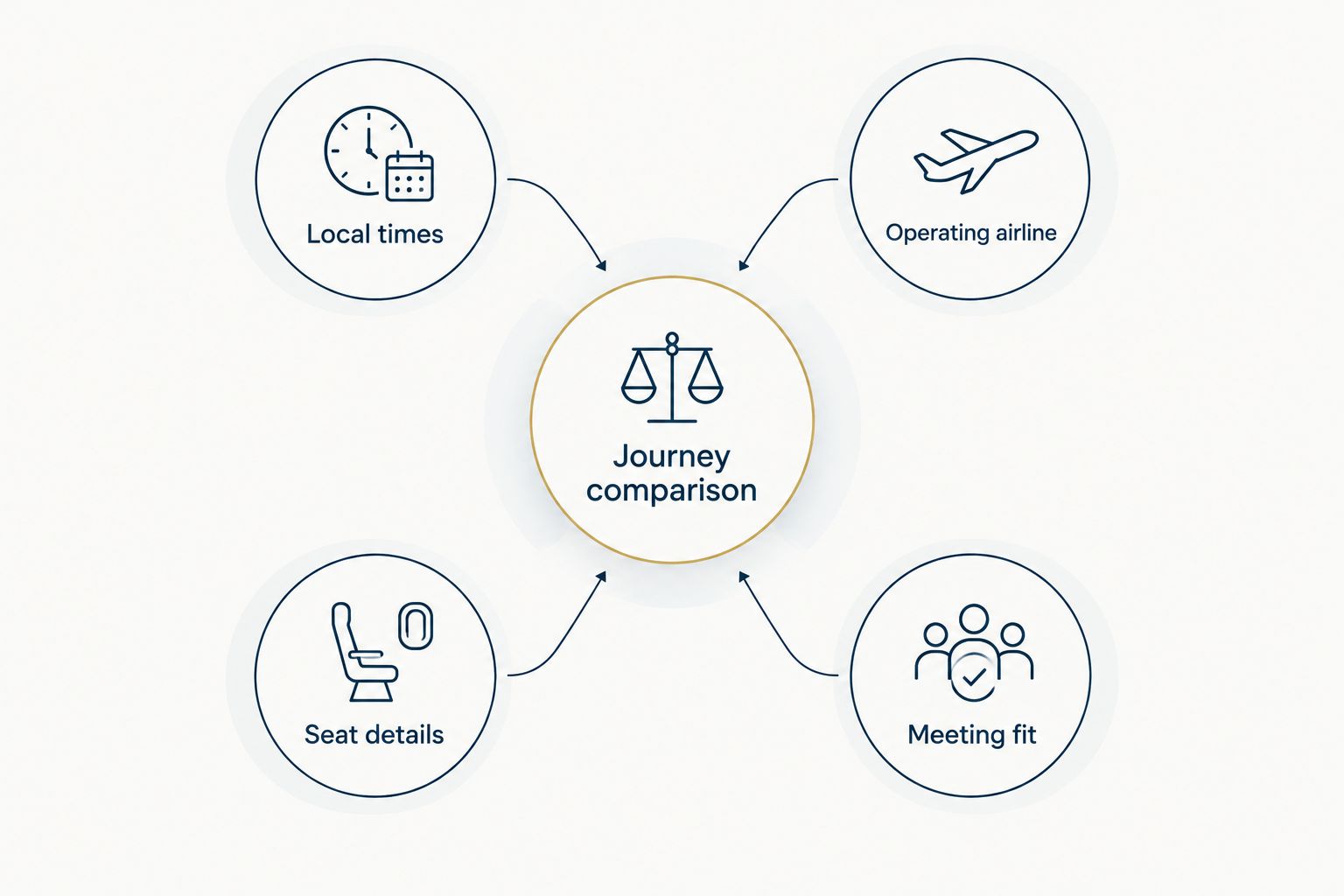
Build a shortlist of 3 itinerary options where your schedule allows: a preferred route, a different departure time, and a different routing. These are comparison categories, not a requirement to find three suitable flights when the brief only supports one.
Business class is not a uniform onboard product. Check the operating airline, the cabin on each flight segment, and the seat details shown for the proposed service. Do not assume that a business class label means a lie-flat seat throughout a connected journey.
For a 2026 sales trip, compare the time between arrival and the first work commitment alongside the onboard details. Include airport transfers, check-in arrangements at the destination, and the opportunity to prepare. A convenient flight time on paper still needs to work as a complete day.
Use a consistent comparison sheet rather than a collection of screenshots. That keeps the discussion focused on what the itinerary does for the assignment.
- Record departure and arrival times in local time.
- Identify the operating airline for every flight segment.
- Check the cabin and seat details for each segment.
- Compare connection arrangements and airport changes.
- Explain how each itinerary fits the first appointment.
Check fare conditions and coordinate the travelers
Read the written conditions before approving the booking. Business class describes a cabin; it does not, by itself, establish whether a ticket is refundable or how changes are handled. Ask what happens if the meeting moves, one traveler withdraws, or the return date changes.
For several travelers, begin with a shared roster. Collect passenger details through your approved company process, then confirm that each booking uses the correct information. Keep sensitive identification details out of broadly shared planning documents.
Globalbusinessflights offers flexible fare options and multi-passenger booking assistance. Ask the consultant to explain the conditions of the specific proposed fare; the existence of flexible options does not make every ticket equally flexible.
Also distinguish traveling together from booking under the same conditions. If a representative needs a different return date, record that difference explicitly instead of assuming the team’s itinerary covers it.
- Ask for the change and cancellation conditions in writing.
- Confirm how a changed itinerary would be handled.
- Check each traveler’s passenger details before ticketing.
- Record individual return dates and route exceptions.
- Name the person authorized to approve changes.
Review the e-tickets and close the planning loop
After ticketing, check the issued documents against the approved itinerary. Review names, dates, routes, and cabins rather than assuming the final documents match the earlier proposal. Ask for clarification as soon as you find a discrepancy.
Send 1 written trip recap to the travelers and the internal travel owner. Include the approved itinerary, meeting requirements, and the booking support contact supplied during the process. Do not add service hours or response commitments unless those have been confirmed.
For your 2026 travel records, capture practical feedback after the trip. Ask whether the arrival schedule supported the work and whether the booking conditions matched the team’s needs. This is more useful for the next approval than a general statement that business class was comfortable.
Keep the feedback focused on travel decisions, not claims that a cabin caused a sale. Your records should support better planning without assigning commercial results to an unproven cause.
- Match issued tickets to the approved itinerary.
- Confirm every traveler has their travel documents.
- Share the supplied booking support details.
- Record schedule changes and how they were handled.
- Note what to repeat or change for the next trip.
Compare your booking options
Choose the booking method around the work your team wants to retain internally. Airline-direct booking offers a direct airline relationship; consultant-led booking adds personal assistance. Neither removes the need to check the ticket conditions and approve the journey.
| Option | Best for | Main advantage | Key limitation |
|---|---|---|---|
| Airline-direct booking | Sales teams comfortable managing their own booking process | Direct communication with the airline about its proposed itinerary | Your team handles comparisons across airlines and coordinates internal decisions |
| Globalbusinessflights consultant-led booking | Sales teams wanting personal help with premium fares and multi-passenger arrangements | Dedicated consultant support from quote to e-ticket | Requires a quote-and-review conversation rather than self-service checkout |
| Internal travel coordination | Companies wanting one employee to manage requirements and approvals | Keeps the trip brief and company decisions in one place | Does not replace a booking provider; someone still needs to arrange the tickets |
Internal coordination can sit alongside either booking route. For a small sales team, a shared brief and a named approver provide a clear starting point without creating a complicated process.
Explore your fare options
Share your sales team's route, dates, and passenger requirements with a dedicated travel consultant.
Common mistakes sales teams make
Approving the cabin without reviewing the arrival plan
A premium cabin cannot fix an itinerary that conflicts with the first appointment. Approve the arrival plan alongside the cabin. Check the ground journey and preparation requirements before treating the flight as suitable.
Assuming business class means flexible conditions
Cabin and fare conditions answer different questions. Read the specific rules before booking, particularly when client meetings are subject to change. Ask for clarification rather than treating the word flexible as a complete explanation.
Giving every representative the same itinerary
Shared travel simplifies coordination, but travelers do not always have identical responsibilities or return requirements. Record exceptions early. Do not make a presenter’s preparation needs or an account owner’s additional visit disappear inside a group request.
Letting several people send booking instructions
Conflicting messages make it harder to establish what the company has approved. Route decisions through one internal contact and keep the current itinerary clearly identified. Travelers can contribute preferences without each issuing separate instructions.
Measuring success only by the cabin experience
A comfortable flight is only part of the assignment. Review whether the schedule, conditions, and booking process supported the trip. Use that feedback to refine your 2026 policy without claiming that premium travel guarantees better sales results.
FAQ
What's the best way to book business class flights for sales teams?
Use a written meeting brief, clear approval rules, and an itinerary comparison before booking. Choose airline-direct booking if your team wants to manage the process, or consultant-led booking if you want personal assistance with premium fares and passenger coordination.
Should every sales representative fly business class?
Base business class approval on the assignment rather than giving every representative the same entitlement. Consider the journey, arrival schedule, and work responsibilities, then apply your written company policy consistently.
Does business class always include a lie-flat seat?
Business class does not always include a lie-flat seat. Check the proposed flight's seat details and confirm the cabin on every segment rather than relying on the itinerary's overall cabin label.
Are business class tickets always refundable?
Business class tickets are not automatically refundable. The specific fare conditions determine cancellation and change terms, so review them before approving ticketing.
Can a sales team book together with different return dates?
Treat different return dates as explicit passenger requirements in your booking request. Ask the booking provider to confirm the proposed arrangements and conditions for each traveler before tickets are issued.
Is a travel consultant better than booking directly with an airline?
A travel consultant fits teams that want personal booking assistance; airline-direct booking fits teams prepared to handle their own comparisons and coordination. The right choice depends on who will manage the work, not on an assumption that either route always produces a better fare.
What should we send when requesting a business class quote?
Send the route, travel dates, passenger count, meeting schedule, and any acceptable alternatives. Include individual return requirements and ask for written fare conditions so your approver can assess the complete proposal.
One last thing
Put the first meeting time above the preferred flight time in every travel request. That small change makes the purpose of the journey visible before anyone starts comparing seats or schedules. For your next sales trip, begin with when the team needs to be ready to work, then build the travel around it.