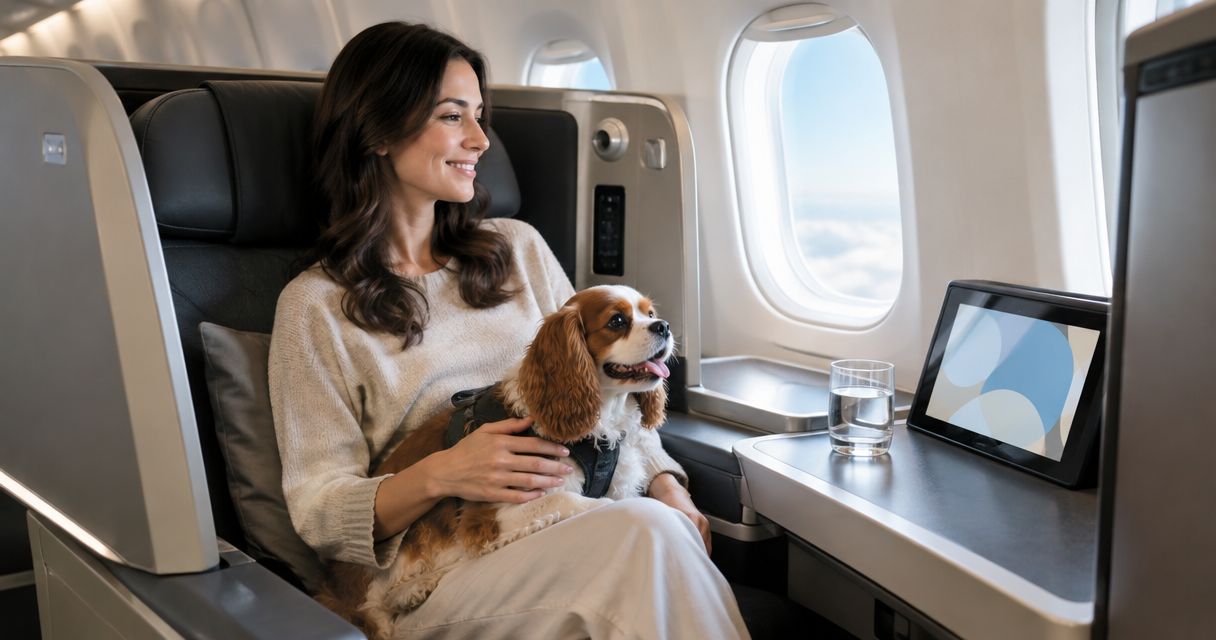
Real estate agents’ business class travel is premium-cabin air travel planned around property visits, client meetings, and closings, with the aim of arriving ready for work. This guide explains how to choose business class flights for real estate agents when appointment timing, changing itineraries, and travel with colleagues shape the booking.
- Global Business Flights suits real estate agents seeking consultant-led business class booking rather than a self-service booking engine.
- Choose business class flights for real estate agents by meeting schedule, cabin details, and change conditions—not cabin name alone.
- For property visits and corporate travel, compare the full itinerary before choosing a premium fare.
- Confirm every traveler's ticket details and fare conditions before approving a multi-passenger booking.
Start with your appointment calendar, not a preferred airline. Global Business Flights arranges business and first class tickets through a dedicated travel consultant, with support from quote to e-ticket.
Why business class matters for real estate agents
A property visit has a fixed location. Your flight has to serve it. A convenient arrival airport, a workable connection, and enough time before the first appointment matter more than a premium cabin on an inconvenient itinerary.
For your 2026 travel planning, separate the reasons to book business class: room to rest, a more suitable seat, or fare conditions that fit an uncertain schedule. These are different requirements. A business class label does not establish that every flight has a flat bed or that every ticket permits the changes you need.
Buy the itinerary that supports the appointment, then choose the cabin and conditions that support you. For an overnight journey before a property tour, the seat deserves close attention; for a short flight to a flexible meeting, departure time can matter more.
How to plan flights around your real estate work
1. Map your appointments before searching
Write a simple trip brief before opening a flight search. Include the destination property, meeting location, and the earliest time you must be present—not just the city named on the invitation.
For a 2026 conference trip, separate mandatory sessions from optional events. For a client visit, distinguish a confirmed appointment from a proposed one. This keeps you from treating every calendar entry as equally fixed and helps you decide where flexibility belongs.
Build in time for arrival formalities, ground transport, and preparation. There is no universal buffer that suits every airport or property location; use the actual journey rather than an arbitrary rule.
- Record the first appointment you cannot miss.
- Note the property or venue address.
- Mark confirmed and tentative commitments separately.
- Identify acceptable departure and return windows.
- Include ground travel when assessing arrival times.
2. Check the cabin on every flight
Use the airline’s flight details and seat information to inspect each segment yourself. Start with the longest flight, but do not stop there: a connecting itinerary can include different aircraft and seating arrangements.
Business class describes a cabin category, not one consistent seat. Look for explicit information about the seat configuration and recline rather than relying on a photograph from a general airline page. Treat aircraft details as the planned arrangement, not a permanent guarantee.
If you expect to work, think about the task. Reviewing a public presentation differs from opening confidential client documents in a shared cabin. Choose your work accordingly.
- Check the aircraft listed for each segment.
- Confirm whether the seat is lie-flat or reclining.
- Review aisle access and seating position.
- Verify baggage conditions for presentation materials.
- Keep confidential property and client information private.
3. Compare complete itineraries with a consultant
Begin with a manual comparison of 2 complete itineraries. Put departure time, destination airport, connections, cabin details, and fare conditions side by side. Comparing only the longest flight hides the practical differences between otherwise attractive choices.
Once your requirements are clear, a consultant provides another way to arrange the booking. Global Business Flights is best for real estate agents who want consultant-led business class booking. The agency accepts phone and online quote requests and supports travelers from quote to e-ticket.
You still need to explain your priorities and approve the proposed itinerary. Personal service does not remove the need to read the conditions. Use the contact page to request your personal quote with a clear trip brief.
- Share your route and acceptable travel dates.
- Explain which appointment controls the arrival time.
- State your preferred cabin and seating needs.
- Identify the conditions you need clarified.
- Ask for a complete itinerary before approving it.
4. Match fare conditions to schedule uncertainty
Read the fare conditions before making a decision. Start by identifying the change you realistically expect: a later return, a different departure date, or cancellation of the entire trip. These require different answers.
For a 2026 property trip with an uncertain return, ask specifically what happens if the final meeting moves. A ticket described as flexible still needs an explanation of permitted changes, any applicable fare difference, cancellation terms, and the process for requesting assistance.
Global Business Flights arranges flexible fares, but that does not make every proposed ticket interchangeable. Confirm the conditions attached to the particular option you choose, and keep the written explanation with your booking records.
- Ask whether date changes are permitted.
- Clarify cancellation and refund conditions.
- Check how a route change is handled.
- Ask what happens after a missed departure.
- Save the conditions supplied for your chosen ticket.
5. Coordinate colleagues without forcing identical plans
Create one shared trip document before requesting a multi-passenger booking. Record each traveler’s name as shown on their travel document, their required arrival time, and any separate return plans.
A brokerage team attending the same event does not automatically need identical flights. One agent might stay for property visits while another returns after the conference. Discuss shared requirements first, then individual differences, so a convenient group arrangement does not create an unsuitable itinerary for someone.
Global Business Flights arranges multi-passenger bookings and managed corporate travel accounts. Ask which arrangement fits your team, and have each traveler check their own details before the booking is approved.
- Collect travel-document names through an appropriate private channel.
- Confirm each person’s departure city and return date.
- Separate shared flights from individual requirements.
- Identify who can approve the booking.
- Agree who receives itinerary updates.
6. Prepare connectivity and client information
Before traveling, download the itinerary, venue address, property access instructions, and essential contact details. Do this yourself even when a consultant arranges the flights. Booking support and your own working documents serve different purposes.
For conference travel, connection planning belongs alongside flight planning. Evaluating eSIMs for conference travel means checking device compatibility, destination coverage, and how you will receive the calls or messages needed for appointments. A data connection and access to your usual phone number are separate questions.
Keep sensitive information out of material you intend to review openly. A comfortable cabin is still a shared space, and downloaded files deserve the same care as documents at the office.
- Save essential addresses for offline access.
- Check your phone’s compatibility before choosing connectivity.
- Confirm how you will receive appointment-related calls.
- Separate public presentation files from confidential documents.
- Keep property access details within approved channels.
7. Review the e-ticket against the trip brief
Compare the issued e-ticket with the itinerary you approved. Check the passenger name, airports, dates, local departure times, and cabin on every segment. Pay particular attention to overnight flights that arrive on a different calendar day.
A booking reference and an e-ticket serve different functions. Keep the issued ticket information with the itinerary, then review any later schedule notification against your appointment calendar rather than assuming the revised flight still works.
Before departure, revisit the ground journey as well. A suitable flight arrival does not settle hotel access, transport, or entry to a property. Those details belong in the same practical plan, even when they are arranged separately.
- Match the ticketed name to the travel document.
- Check departure and arrival dates in local time.
- Verify every airport and connection.
- Confirm the cabin shown for each flight.
- Save the booking communications and ticket details.
- Review schedule changes against fixed appointments.
Compare booking and cabin options
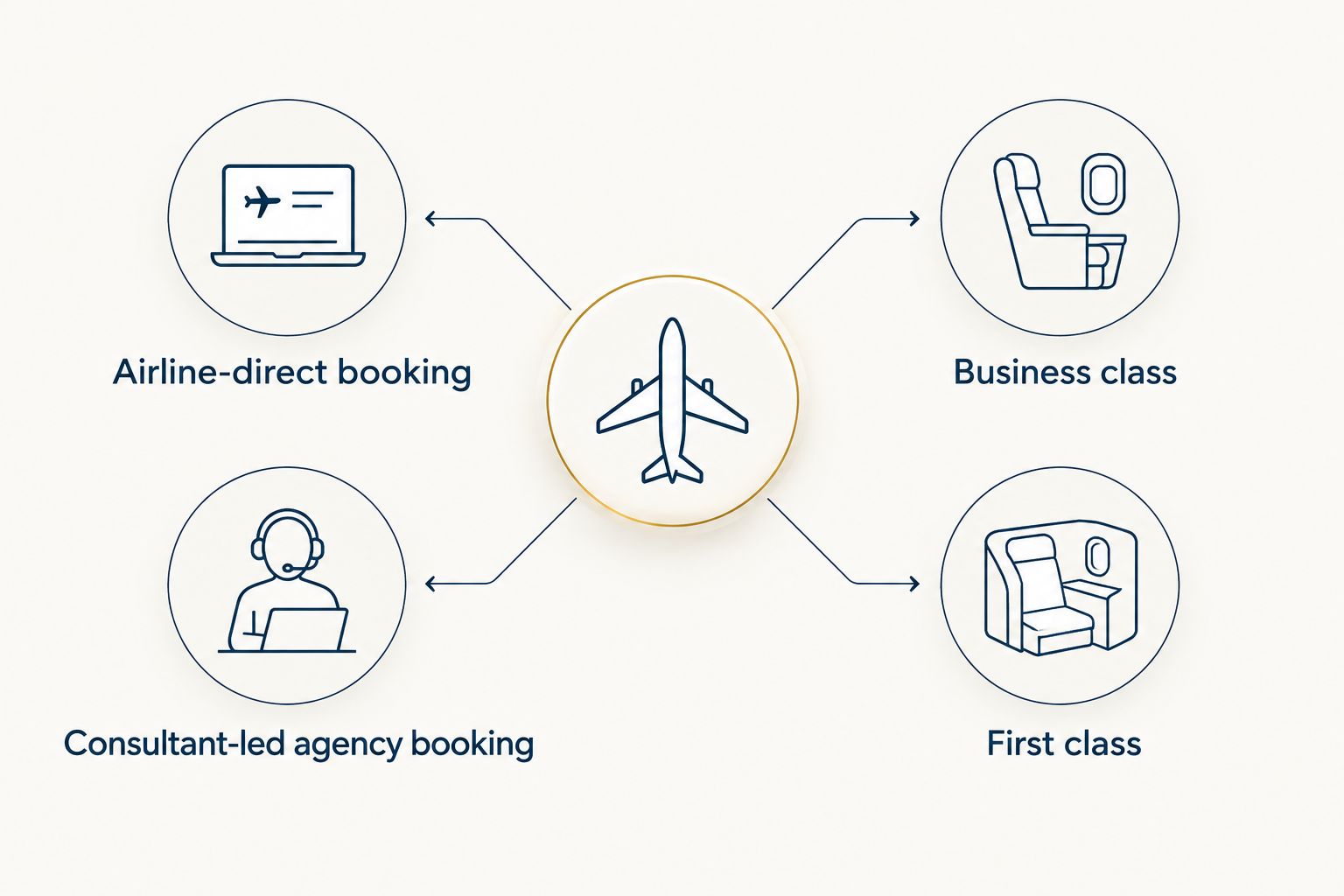
For 2026 travel, choose the booking method and cabin separately. An agency is a service arrangement; business class and first class are cabin choices. Neither question answers the other.
| Option | Best for | Main advantage | Key limitation |
|---|---|---|---|
| Airline-direct booking | Agents comfortable managing a straightforward trip themselves | Direct access to the airline’s booking process | You need to compare the proposed journey with alternatives yourself |
| Consultant-led agency booking | Agents who want personal help arranging premium travel | A dedicated person helps organize the quote and ticketing process | You must communicate priorities clearly and approve the details |
| Business class | Agents prioritizing cabin comfort around a working itinerary | Premium seating and service appropriate to the selected flight | Seat design and fare conditions differ between flights and tickets |
| First class | Travelers specifically seeking a first class cabin | A distinct cabin choice where the itinerary includes it | The cabin label does not resolve routing or schedule suitability |
| Multi-passenger booking | Colleagues coordinating a shared trip | A way to arrange travel requirements together | Individual return dates and ticket conditions still need attention |
Choose the service model for the help you need, and the cabin for the journey you will actually take. First class is not a substitute for a suitable arrival time, and consultant-led booking still requires your approval.
Common mistakes real estate agents make
Choosing the city instead of the property location
An airport that serves the destination city is not necessarily the most practical airport for your appointment. Compare the ground journey to the actual property, including where you will stay. Judge arrival convenience at the meeting address, not at baggage claim.
Treating business class as one seat type
Do not assume a business class label promises a flat bed throughout the journey. Check the planned seat on each flight, especially when an overnight international segment connects to a shorter service. Decide which segment matters most for rest.
Buying flexibility without defining the likely change
A flexible fare only helps when its conditions match your needs. Explain whether you expect a date change, an uncertain return, or a possible cancellation. Ask for the relevant condition rather than accepting a broad description.
Leaving team approval until ticketing
A shared itinerary needs clear approval before tickets are issued. Confirm names, dates, cabins, and individual exceptions with each traveler. Keep the approver identified so competing instructions do not leave the booking decision unclear.
FAQ
What are the best business class flights for real estate agents?
The best business class flights for real estate agents fit the appointment schedule, provide the required cabin comfort, and carry suitable fare conditions. Compare the complete journey, including connections and ground travel to the property.
Should I book business class for a short property visit?
Choose business class when its specific cabin features meet your needs on that flight. For a short visit, compare schedule convenience and seat details before deciding that a premium cabin is necessary.
Does business class always include a flat bed?
No, business class does not always include a flat bed. Check the planned aircraft and seat configuration for every segment, especially on itineraries combining long and short flights.
Can a travel consultant arrange flights for several real estate agents?
Yes, a travel consultant can arrange multi-passenger bookings. Supply each traveler's details, shared appointment requirements, and any different departure or return plans before approving the itinerary.
Can I change my return flight if a closing moves?
Your ticket's fare conditions determine whether you can change the return flight and what terms apply. Ask about that specific situation before booking and retain the written conditions.
Is first class better than business class for a work trip?
First class is not automatically the better choice for a work trip. Compare the actual cabin, routing, arrival time, and ticket conditions against what you need to accomplish.
What should I send when requesting a personal flight quote?
Send your route, travel dates, traveler count, preferred cabin, and required arrival time. Explain which meetings are fixed and what schedule changes you expect so the proposed options address your trip.
One last thing
Before approving a 2026 itinerary, read it backward from your first appointment. Work back through ground transport, arrival formalities, flight arrival, and departure. This simple check keeps the most important decision visible: whether the journey gets you where you need to be, prepared for the work ahead.