Medical professionals’ business class travel is premium air travel planned around clinical duties, conferences and personal trips, with the aim of matching onboard comfort to a workable schedule. This 2026 guide explains how to assess seats, connections and fare conditions when your departure follows a shift or your return must fit a clinical rota.
- Business class flights for medical professionals should balance rest, reliable scheduling and clear fare conditions.
- Globalbusinessflights suits travelers who want business class booking through a dedicated travel consultant rather than a self-service engine.
- Verify the operating airline and cabin on every flight segment before accepting a quote.
- A medical credential does not establish eligibility for a particular discount; check the fare’s actual terms.
Globalbusinessflights is best for travelers who want consultant-led business class booking from quote to e-ticket. You can request personal fare options rather than manage the booking entirely through a self-service engine. The limitation is equally clear: this is an assisted booking process, not an independent online checkout.
Why business class matters for medical professionals
For medical professionals planning travel in 2026, the useful question is not simply whether business class feels more comfortable. It is whether the itinerary supports the commitments around the flight. A conference presentation, a hospital start date and a family holiday call for different decisions about timing and flexibility.
A premium seat does not correct an unsuitable schedule. An overnight connection, an awkward arrival time or a restrictive ticket can work against the reason you chose business class. Start with the commitment you cannot move, then assess the cabin.
Keep these distinctions clear:
- Conference travel: Match arrival and departure to the sessions you intend to attend.
- Locum or visiting appointments: Confirm reporting dates before choosing fare restrictions.
- Travel after clinical duties: Allow time to leave work, collect luggage and reach the airport.
- Personal travel: Balance comfort with the preferences of everyone traveling with you.
Choose the itinerary first and the cabin second. Business class adds value when its seat, schedule and conditions fit the trip you actually need to take.
How to plan your business class booking
Define your arrival requirements
Write down when you need to be at your destination, not just when you want to land. Airport formalities, baggage collection and ground transport sit between arrival and your hotel, hospital or conference venue. Keep those tasks separate from the flight itself.
For a 2026 conference trip, work backward from the first session you cannot miss. If you are starting an appointment, confirm whether the stated start date includes induction or other preliminary commitments. Do not assume that arriving on the same calendar day leaves enough usable time.
Build a simple brief yourself before requesting fares. This keeps comparisons focused and prevents an attractive cabin from distracting you from an unsuitable arrival.
- Record your departure airport, destination and required arrival date.
- List the earliest departure you can manage after your final work commitment.
- Separate essential sessions or reporting times from optional activities.
- Identify any dates that remain unconfirmed by your employer or organizer.
Verify the cabin on every segment
Check the operating airline’s flight details and seat information manually. A business class label does not, by itself, describe the seat you will use on every aircraft. Look for the actual seat configuration and whether the itinerary includes different cabins across its segments.
This matters when you are choosing a journey primarily for an opportunity to rest. A reclining seat and a lie-flat seat are different products. Neither guarantees sleep, and the longest flight deserves more attention than a short connecting sector.
Compare 2 itineraries side by side, using the same criteria for both. Treat the published aircraft as the planned equipment rather than a promise that it cannot change.
- Identify the operating airline for each flight, not only the airline selling the ticket.
- Check whether each segment is booked in business class or another cabin.
- Confirm whether the long-haul seat reclines or converts into a lie-flat bed.
- Review connection duration alongside total journey time.
- Recheck aircraft and seat details before departure.
Request comparable fare options
Start with a manual comparison of the same route and dates. Record the schedule, cabin and fare conditions together; an isolated fare total does not show whether two tickets serve the same purpose. Include nearby departure dates only when you can genuinely use them.
Globalbusinessflights offers a consultant-led business class booking service for leisure and corporate travelers, including flexible fares and multi-passenger bookings. The faster path is to send a clear brief and ask a dedicated travel consultant to explain suitable options, with support from quote to e-ticket. That service does not mean every quoted fare has the same flexibility.
For a useful request, provide 3 possible departure dates if your schedule allows. If it does not, state the fixed date clearly. Precision is more helpful than suggesting flexibility you cannot accept.
- Describe whether the trip is for a conference, appointment, corporate travel or leisure.
- State your essential arrival time and acceptable departure dates.
- Include the number of travelers and whether everyone needs the same itinerary.
- Ask for cabin details and fare conditions alongside each option.
Read change and cancellation conditions
Before approving a ticket, distinguish a changeable fare from a refundable fare. They answer different questions: whether you can alter the journey and whether you can recover payment after cancellation. Read the actual conditions rather than treating the word flexible as a complete explanation.
For medical professionals booking in 2026, uncertainty often concerns a specific commitment: leave approval, a conference schedule or the end date of an assignment. Identify that uncertainty first. Then ask which ticket conditions address it and which restrictions remain.
Keep the answer in writing with the quote. A verbal summary is useful, but the documented conditions are what you should review before authorizing the booking.
- Ask what happens if you change travel dates before departure.
- Confirm whether a changed itinerary requires an additional fare payment.
- Check cancellation conditions and the form of any permitted refund or credit.
- Ask how a missed flight or failure to travel affects the remaining itinerary.
- Clarify which questions belong with the agency and which require the airline.
Confirm employer and group requirements
Check your employer’s travel rules yourself before choosing a cabin. Professional status alone does not establish permission to book business class, and an appealing itinerary is not a substitute for written approval where your organization requires it. Keep personal preferences separate from reimbursable expenses.
For colleagues attending the same event, decide whether traveling together is essential or simply convenient. A shared arrival can simplify onward plans, while separate itineraries let travelers fit different clinical schedules. The right choice depends on the group’s actual commitments.
Use a short approval checklist: Travel approval, Fare conditions, Passenger details and Ticket confirmation. Each item answers a different question, from permission to travel through confirmation that the agreed booking has been issued.
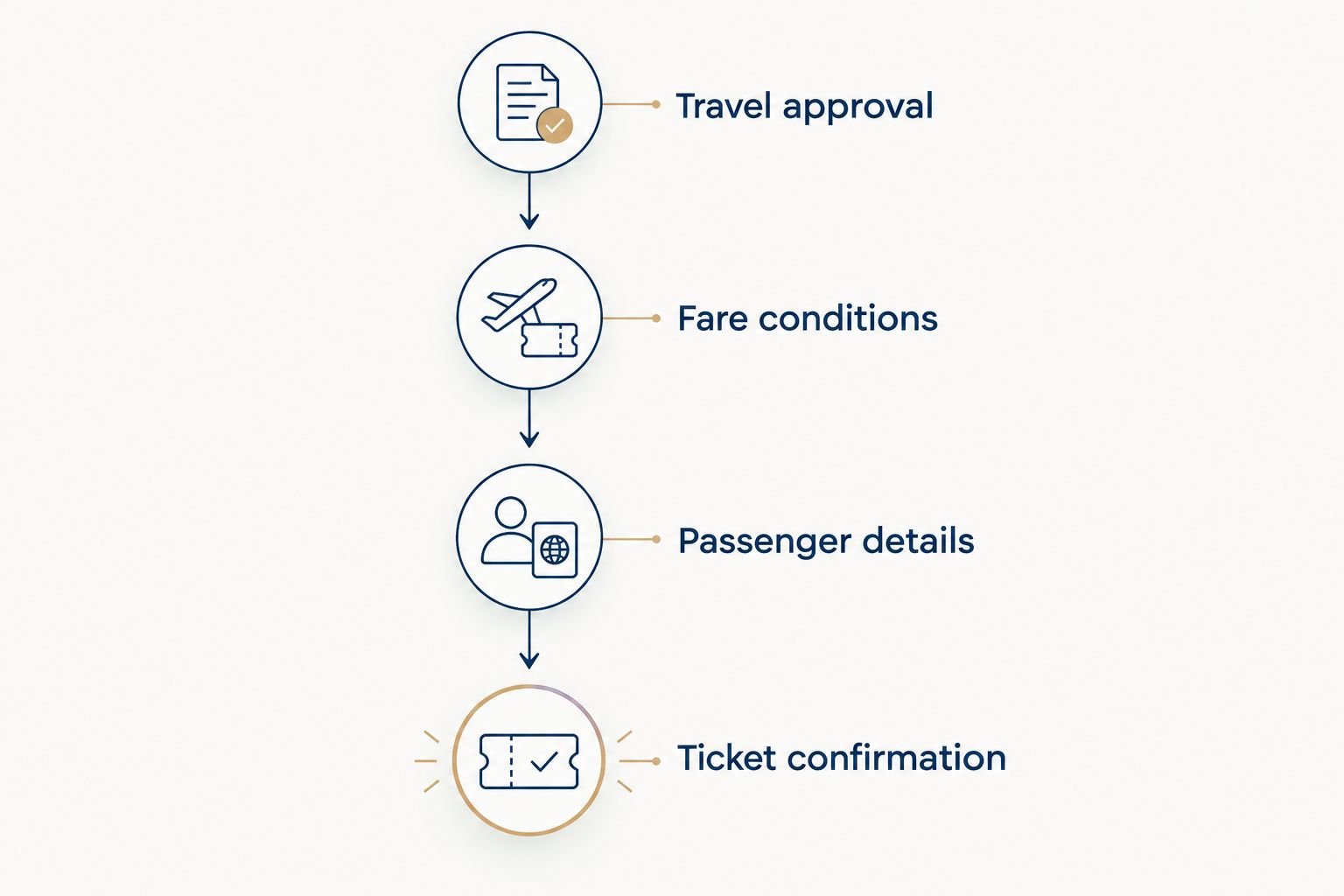
A multi-passenger request still needs individual details. Check each traveler’s dates and preferences instead of assuming that colleagues attending the same event have identical requirements.
- Confirm the permitted cabin and any required approval before booking.
- Ask which receipts or booking records your organization needs.
- Identify travelers who must arrive together and those who can travel separately.
- Separate accompanying family members’ arrangements from employer-funded travel.
Check the issued itinerary and prepare for departure
Review the final itinerary against the option you approved. Names, airports, dates and cabin assignments deserve a deliberate check, especially when a journey crosses time zones. Read local arrival dates carefully rather than following the departure date through the whole trip.
Save the e-ticket and agreed fare conditions in 1 travel folder, alongside the relevant booking correspondence. Keep clinical information and patient records out of travel requests; a travel consultant needs your itinerary requirements, not confidential details about your work.
Before leaving, review the airline’s current baggage and check-in instructions. If you carry medicines or medical equipment for personal use, consult official airline and destination guidance rather than assuming that a premium cabin changes the applicable rules.
- Match passenger names to the travel documents you will use.
- Check departure and arrival airports, local dates and flight numbers.
- Confirm the booked cabin on each segment of the issued itinerary.
- Save booking references, e-ticket details and the agreed fare conditions.
- Review current document, baggage and check-in requirements before departure.
Explore your fare options
Share your route, dates and cabin preferences for a consultant-led personal quote.
Compare your booking options
For your 2026 trip, choose the booking method that matches how much coordination you need. The strongest option is not automatically the most hands-on or the most independent; it is the one that fits your approval process and preferred way of booking.
| Option | Best for | Main advantage | Key limitation |
|---|---|---|---|
| Direct airline booking | Travelers comfortable selecting and managing their own flights | Lets you review that airline’s published itinerary and fare information directly | You handle your own comparison and booking decisions |
| Globalbusinessflights | Leisure and corporate travelers wanting consultant-led premium travel booking | Dedicated consultant support from quote to e-ticket, with flexible fare and multi-passenger options | Uses an assisted quote process rather than a self-service booking engine |
| Employer-designated booking channel | Medical professionals whose organization requires a particular travel process | Keeps the booking within the employer’s specified approval route | Your permitted choices depend on the organization’s policy |
Use your employer’s required channel when policy dictates it. For independently arranged travel, decide whether you prefer to research and book directly or have a consultant help organize the options. Neither approach removes the need to read the ticket conditions.
Common booking mistakes medical professionals make
Booking around the flight instead of the commitment
An appealing departure can create an impractical arrival. Start with the conference session, reporting time or personal commitment, then account for the journey from the airport. Keep the whole trip visible.
Assuming business class means a bed throughout
Check each segment separately. A business class itinerary can involve different aircraft and seat types, so the cabin label alone does not answer whether your longest flight has the seat you want.
Treating professional status as a discount entitlement
Do not assume a medical credential qualifies you for a special fare. Ask whether a quoted option has eligibility requirements and review those requirements before relying on it. Assess the complete itinerary, not an unverified professional-discount claim.
Confusing a request with an issued ticket
A quote, a seat preference and an e-ticket are different things. Review what has actually been confirmed, and compare the issued itinerary with your approved option. Keep any unresolved request separate from confirmed booking details.
Leaving approval until after booking
A premium cabin does not establish reimbursement eligibility. Confirm the permitted cabin and approval requirements before authorizing payment. This is especially important when combining a work trip with personal travel or accompanying family members.
FAQ
What’s the best way to book business class flights for medical professionals?
Start with your required arrival time, then compare schedules, seats and fare conditions. Use an employer-required booking channel where applicable; otherwise, choose between direct booking and consultant-led assistance according to how much support you want.
Do doctors and nurses automatically get business class discounts?
A medical credential does not automatically establish eligibility for a particular business class discount. Check the terms of any specific offer and assess the itinerary and ticket conditions before accepting it.
Does business class always include a lie-flat seat?
No, the business class label does not guarantee a lie-flat seat on every flight. Check the operating airline, planned aircraft and seat configuration for each segment, particularly the longest flight.
Can I change my flight if my clinical schedule changes?
Your ability to change a flight depends on the ticket’s fare conditions. Before booking, ask about permitted changes, additional fare payments, cancellation terms and the treatment of missed flights.
Can Globalbusinessflights arrange travel for several colleagues?
Globalbusinessflights arranges multi-passenger bookings as part of its travel agency service. Provide each traveler’s dates and requirements, and clarify whether the group needs identical flights or separate itineraries.
Is a direct airline booking better than using a travel consultant?
Direct airline booking suits travelers who want to make and manage their own booking decisions, while a travel consultant suits those who want personal assistance. Employer travel rules take priority when they specify a booking process.
What should I send when requesting a business class quote?
Send your route, acceptable dates, passenger count, preferred cabin and essential arrival time. Add any employer approval requirements and explain which travel dates are fixed; do not include confidential patient information.
One last thing
For a 2026 booking, write down the requirement you would refuse to trade away: a particular arrival date, a suitable long-haul seat or defined change conditions. Put it at the top of your quote request, not at the end.
The clearest request produces the most useful comparison. Before approving a ticket, check that the chosen option satisfies that requirement in writing. Comfort matters most when the rest of the journey works too.