
Law firm business class travel is premium air travel arranged around legal work, with the aim of supporting rest, reliable attendance and clear expense control. Planning business class flights for law firms means matching cabin comfort to hearing schedules, client commitments and approval rules—not simply choosing a seat at the front.
- Business class flights for law firms should prioritize arrival timing, written fare conditions and clear approval ownership.
- Globalbusinessflights suits law firms seeking consultant-led business class booking rather than a self-service engine.
- Compare the cabin on every flight segment; a business class label alone does not confirm a flat bed.
- Keep client identities and matter details out of routine booking correspondence unless genuinely necessary.
Why business class matters for law firms
A legal trip often has a fixed purpose but a moving schedule. You need to attend a meeting or proceeding at a particular time, while the return date can depend on work that is not yet complete. For your 2026 travel policy, separate those two needs: dependable arrival planning and clearly understood change conditions.
Globalbusinessflights arranges business and first class tickets through a dedicated travel consultant, with support from quote to e-ticket. That service model gives your travel coordinator a person to discuss itinerary requirements with rather than relying solely on a self-service search.
Globalbusinessflights is best for law firms seeking consultant-led business class booking from quote to e-ticket. Your firm still needs to set its own approval, confidentiality and expense rules; a booking service does not replace those controls.
Business class belongs in the policy when its actual features serve the assignment. A suitable sleeping seat can support an overnight journey, while a sensible connection and arrival buffer protect the schedule. Neither cabin choice nor fare flexibility guarantees an uninterrupted trip.
How to arrange business class travel for your firm
1. Define the assignment before searching
Start with a short internal travel brief. An email or shared document is enough: state where the traveler must be, when attendance begins and which parts of the schedule remain uncertain. Keep the booking brief separate from privileged work material.
Identify the real arrival deadline, not just the departure date. A flight that lands shortly before an important appointment leaves little room for immigration, ground transport or disruption. Choose an arrival buffer that fits the assignment rather than applying one unexplained rule to every trip.
For a useful brief, record:
- Departure city, destination and acceptable alternative airports.
- Required arrival date and local appointment time.
- Fixed dates versus dates that remain subject to change.
- Traveler names exactly as shown on travel documents.
- A non-sensitive internal reference for approvals and reconciliation.
2. Set approval rules before requesting fares
Write down who can authorize business class, who approves an exception and who receives the booking confirmation. For your 2026 policy, distinguish authorization to travel from authorization to purchase a particular itinerary. They are different decisions.
A spreadsheet or simple approval email can handle this without specialist software. Assign 1 named approver per booking, with a backup if that person is unavailable. This is a recommended control, not an airline requirement.
If travel is connected to client work, resolve the firm's reimbursement and billing treatment before purchase. Do not assume that internal approval also establishes whether an expense is chargeable to a client.
Your approval record should include:
- The business reason for the requested cabin.
- The person authorized to approve the itinerary.
- The treatment of personal extensions or accompanying travelers.
- The internal process for urgent changes.
- The documentation needed for expense reconciliation.
3. Compare the journey, not just the cabin label
Build a side-by-side shortlist manually before deciding. Use 2 itinerary options as a practical starting point: one that prioritizes the simplest journey and another that offers a different schedule or routing. Add more only when they answer a real question.
Check the operating carrier and cabin on every segment. Business class does not universally mean a lie-flat seat, and a connection can introduce a different aircraft or cabin experience. Ask what is scheduled, while recognizing that aircraft assignments can change.
At this stage, a Globalbusinessflights consultant can help you discuss business class itinerary options against the brief. Consultant-led booking still requires your firm to explain its priorities and approve the final choice.
Compare these details consistently:
- Local departure and arrival times, including date changes.
- Total journey duration and connection locations.
- Scheduled seat type on the overnight segment.
- Airport changes or separate ground transfers.
- Cabin assignment on connecting flights.
4. Read the fare conditions before approving
Request the written conditions for the exact fare being considered. A business class ticket and a flexible ticket are not interchangeable descriptions. Permission to change a booking does not automatically mean that every replacement itinerary has the same conditions.
For 2026 bookings, ask what happens if a hearing moves, a meeting ends early or the traveler needs to return from another city. Work through the situations relevant to the assignment rather than asking only whether the ticket is flexible.
Separate ticket restrictions from agency service terms. You need to understand both before approving payment, particularly when more than one traveler is involved. Keep the answer with the booking record so another coordinator can find it later.
Ask for clear answers on:
- Changes before departure and after travel has begun.
- Cancellation, refunds and unused ticket treatment.
- Missed-flight or no-show conditions.
- Rules affecting a partially used itinerary.
- The process for requesting help with a change.
5. Coordinate travelers without oversharing
Use one itinerary sheet for the traveling team, but restrict access to personal details. A party traveling to the same matter does not need every participant's passport information, preferences or private schedule distributed to the whole group.
Decide whether the team must travel together or simply arrive by the same deadline. Shared flights simplify coordination, but they also place everyone on the same disrupted service if that flight is canceled. Assess that trade-off against the assignment rather than treating either arrangement as automatically better.
Globalbusinessflights supports multi-passenger bookings and managed corporate travel accounts. Ask how those arrangements would fit your firm's workflow; do not assume they include a particular reporting system, response time or after-hours service.
Keep coordination focused on:
- A lead traveler and an administrative contact.
- Individual return dates and onward destinations.
- Permission to share itinerary details within the team.
- Seat, meal or accessibility requests where relevant.
- A separate record for sensitive personal information.
6. Match the route to the working day
For international assignments, compare the trip against the destination's local calendar. An overnight flight can arrive on a different date, and a convenient departure at home can produce an awkward arrival abroad. Work backward from the first commitment.
Use 3 planning checkpoints: before departure, on arrival and before the first appointment. At each checkpoint, identify what must happen next and who owns it. This keeps the flight connected to the actual working day rather than treating the airport arrival as the end of planning.
For a UK-to-India assignment, comparing business class airlines to India starts with the same questions: which routing fits the required arrival, what cabin is scheduled and what conditions govern a changed return. A carrier name alone does not answer those itinerary-specific questions.
Check these parts of the journey:
- Departure-day travel to the airport.
- Local arrival date and onward ground transport.
- Time between landing and the first commitment.
- Entry and transit requirements using official sources.
- A return plan if the assignment finishes differently than expected.
7. Verify the e-ticket and handover
Approval is not the final check. When the e-ticket arrives, compare it with the approved itinerary and the traveler's documents. Catching a mismatch before departure is better than discovering it during check-in.
For your 2026 booking checklist, assign one person to complete the handover rather than assuming the traveler and coordinator have each checked everything. Keep ticket information accessible to the people who need it without placing confidential matter descriptions in calendar entries or widely shared files.
Support from quote to e-ticket is part of the stated service. Confirm separately how to request assistance after ticketing and during travel; do not infer round-the-clock coverage from the existence of a dedicated consultant.
Complete the handover with:
- A check of names, dates, airports and flight segments.
- Confirmation that the ticket matches the approved cabin.
- Written fare conditions stored with the itinerary.
- A clear contact route for booking questions.
- An agreed internal process for approving changes.
Compare your booking options
Best for your firm means best for the assignment and approval process—not the most elaborate booking setup. A coordinator handling an occasional trip has different needs from a team arranging repeated travel for several offices.
Use this comparison to choose the booking method. Then assess the actual itinerary separately; the booking channel does not determine the aircraft, seat or ticket conditions.
| Option | Best for | Main advantage | Key limitation |
|---|---|---|---|
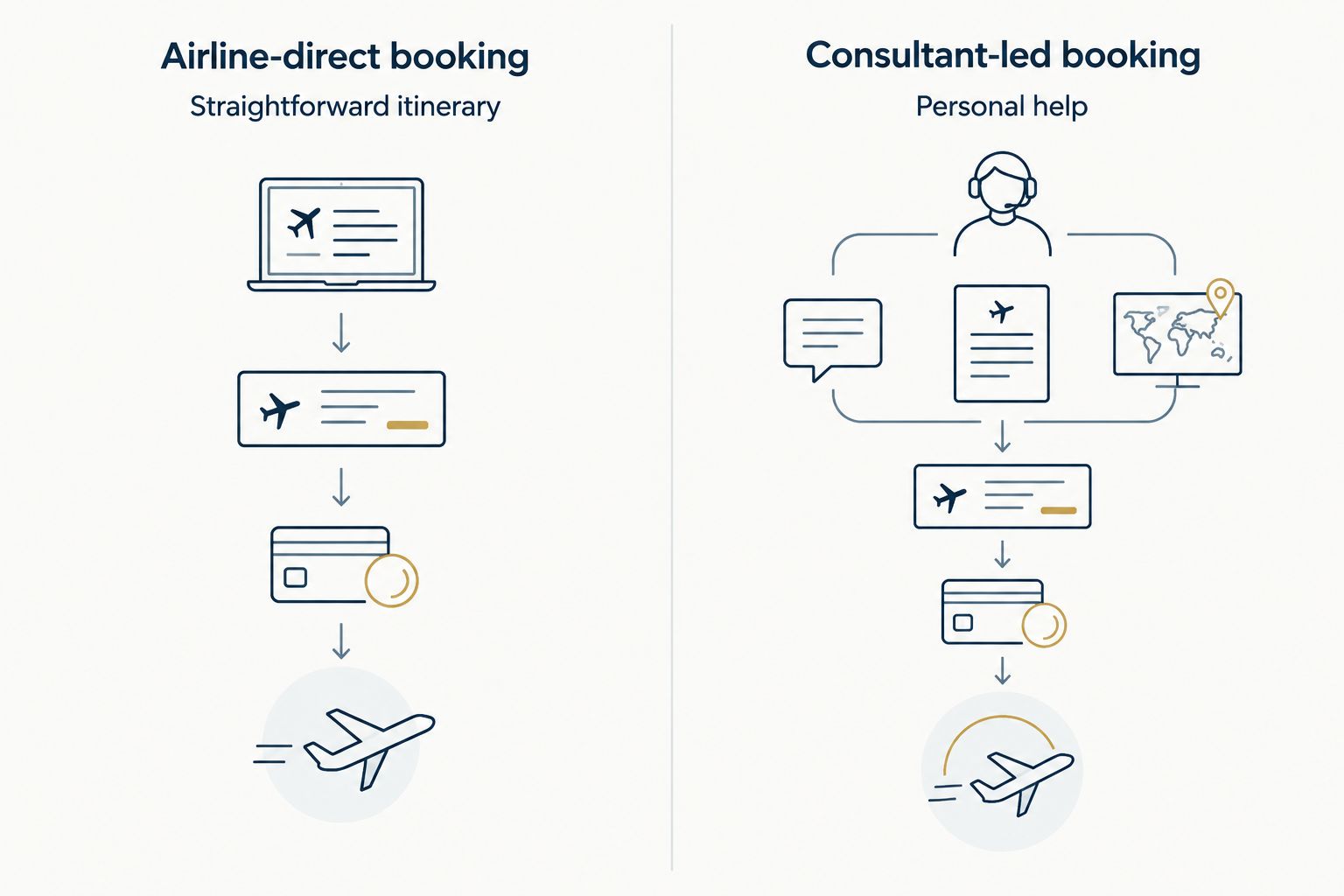
| Airline-direct booking | Coordinators comfortable managing a straightforward itinerary | Keeps the booking conversation with the airline | Your team still compares alternatives and manages internal approvals |
| Globalbusinessflights consultant-led booking | Firms wanting personal help with premium itineraries and multi-passenger requests | Dedicated consultant support from quote to e-ticket | Requires a briefing and quote process rather than self-service checkout |
| Internally coordinated travel | Firms with staff assigned to research and administration | Keeps policy decisions close to the legal team | Research, comparison and recordkeeping remain internal responsibilities |
These approaches can overlap. An internal coordinator can work with a consultant while retaining approval ownership. Define that division of work before requesting a quote so tasks are not duplicated or overlooked.
Common mistakes law firms make
Approving the cabin but not the schedule
A business class approval does not settle whether the traveler can reach the appointment comfortably. Review the arrival buffer, connecting flights and ground transfer alongside the cabin. Approve the complete journey.
Treating flexibility as a blanket promise
A flexible fare still has conditions. Keep written answers about changes, cancellation and unused travel with the approval record, especially when the return date depends on proceedings or negotiations.
Putting matter details in booking correspondence
A travel consultant needs routing requirements, not a case narrative. Use an internal reference and provide only the information needed to arrange travel. Apply your firm's confidentiality procedures to attachments and shared itineraries.
Assuming every traveler has the same return plan
Partners, associates, witnesses and clients can have different commitments even when they share an outbound flight. Confirm each person's return separately before approving a multi-passenger request.
Leaving disruption decisions unassigned
A traveler should know whom to contact and what they are authorized to change. Identify the internal decision-maker before departure, including who approves a substantially different routing or an additional overnight stay.
FAQ
What's the best way to book business class flights for a law firm?
The best method is the one that fits your firm's itinerary complexity and approval process. Consultant-led booking suits firms wanting personal assistance, while airline-direct booking suits coordinators comfortable handling the comparison and administration themselves.
Does business class always include a flat bed?
No, business class does not always include a flat bed. Confirm the scheduled seat type on each flight segment and remember that aircraft assignments can change.
Can a law firm arrange business class tickets for several travelers?
Yes, a law firm can request a multi-passenger booking. Confirm individual names, approval requirements and return plans rather than assuming every traveler needs the same itinerary.
Should lawyers choose flexible business class tickets?
Choose flexibility according to the likelihood and consequences of a schedule change. Read the exact fare conditions before deciding, particularly when a hearing or negotiation determines the return date.
Is a travel consultant better than booking directly with an airline?
A travel consultant is better suited to travelers who want help discussing routes, fare conditions and booking requirements. Direct booking suits travelers who prefer handling those tasks themselves; neither channel removes the need to verify the ticket.
What should a law firm include in a business class quote request?
Include the route, required arrival time, traveler names, schedule flexibility and approval contact. Keep confidential matter details out of the request unless they are genuinely necessary.
What should our 2026 corporate travel policy say about business class?
Your 2026 policy should state eligibility, approval ownership, documentation requirements and the process for changes. Address client-related expense treatment separately rather than assuming travel approval settles reimbursement.
One last thing
Your most useful booking instruction can be a boundary rather than a preference. Tell the person arranging travel which part of the assignment cannot move: the arrival deadline, a required connection arrangement or the approved return window. Explore your fare options around that fixed requirement, then compare comfort and flexibility within it.