Best overall for a U.S.-centered shortlist: United Airlines. Best for teams comparing long-haul and domestic cabins separately: Delta Air Lines. Best for London-focused travel: British Airways. The best business class airlines for small companies in 2026 depend on your departure airport, meeting location and the cabin offered on each flight—not an airline-wide ranking alone.
- Best business class airlines for small companies 2026: shortlist United, Delta, American, British Airways and Qatar Airways by itinerary.
- United Airlines is the default shortlist choice for U.S.-centered companies comparing domestic and international travel.
- Check the operating airline, aircraft and fare conditions before approving any business class booking.
- Global Business Flights suits business class travelers who want a dedicated consultant rather than self-service booking.
Why this matters
A small company needs a flight that fits the working day, not simply a recognizable premium cabin. An inconvenient connection or unsuitable return schedule can undermine an otherwise comfortable journey. Start with the meeting, then work backward to the flight.
Global Business Flights arranges business and first class tickets through a dedicated travel consultant, with support from quote to e-ticket. That service suits companies that want help comparing itineraries and fare conditions rather than managing every booking decision through a self-service engine.
For your 2026 travel policy, separate the airline decision from the ticket decision. The airline determines the network and cabin product; the specific fare determines the conditions attached to your booking. You need both to fit.
What makes the best business class airline?
Use these criteria before choosing a carrier. They keep the comparison tied to your business rather than to cabin photographs.
- Route fit: Favor departures and arrivals that suit your employees' actual starting points and meeting locations. Compare nonstop service with connecting alternatives.
- Flight-specific comfort: Check the cabin on every segment. An airline's long-haul business class product does not describe every aircraft it operates.
- Schedule usefulness: Review arrival time, the return departure and the connection sequence. A comfortable seat cannot fix an unsuitable schedule.
- Fare flexibility: Read change, cancellation, refund and no-show conditions for the quoted ticket. A business class label does not establish those rights.
- Booking coordination: Decide who approves the itinerary, confirms passenger details and receives the ticket. Multi-passenger travel needs an agreed process.
- Program relevance: Treat corporate and loyalty programs as separate checks. Confirm current eligibility and terms rather than assuming a business ticket qualifies your company.
Choose the itinerary first, the fare conditions second and the loyalty preference third. That order gives a small team a practical way to resolve competing preferences without turning each booking into an open-ended debate.
Business class airlines at a glance
This 2026 shortlist assigns each airline a different role. “Best for” identifies where to begin your comparison, not a promise that the carrier wins on every route.
| Airline | Best for | Standout consideration | Key limitation |
|---|---|---|---|
| United Airlines | U.S.-centered travel across domestic and international trips | United Polaris is its long-haul business class product | Do not assume every business class segment is Polaris |
| Delta Air Lines | Teams separating long-haul comfort from domestic cabin needs | Delta One and First Class are distinct products | The premium cabin name and seat need checking by flight |
| American Airlines | Trips combining U.S. domestic travel with international business class | Domestic First and international business class require separate review | A premium label does not mean the same seat throughout |
| British Airways | Companies with London-focused travel | Club World serves long-haul business travel; Club Europe serves European routes | European and long-haul business cabins are different products |
| Qatar Airways | International itineraries where a Doha connection fits | Doha provides a connecting point for international journeys | A connection through Doha is not appropriate for every destination |
1. United Airlines: best for U.S.-centered company travel
United Airlines is the default starting point on this shortlist for a U.S.-centered company comparing both domestic and international travel. Its network makes it a relevant candidate, while United Polaris gives you a named long-haul business class product to investigate.
The booking still needs a segment-by-segment check. A domestic connection sold alongside a Polaris flight is not automatically the same cabin experience, and an attractive outbound flight does not settle the return journey.
United Airlines pros:
- Relevant to both domestic and international itinerary searches.
- Polaris provides a distinct long-haul business class product to compare.
- A useful starting point when your company wants to assess one carrier across different trip types.
United Airlines cons:
- Not every premium segment is Polaris.
- A connecting itinerary still needs assessment against a suitable nonstop alternative.
- Fare conditions must be checked separately from the cabin name.
Best for: A U.S.-centered company building an initial carrier shortlist, especially when its employees take different kinds of trips.
Verdict: Buy when United Airlines offers the right schedule and confirmed cabin; hold when the recommendation rests only on the Polaris name.
2. Delta Air Lines: best for cabin-specific travel policies
Delta Air Lines belongs on a shortlist that distinguishes long-haul rest from domestic premium travel. Delta One and First Class are different products, so the distinction gives your company a useful prompt: specify the required cabin rather than approving “business class” as a catch-all.
For 2026 bookings, ask which cabin is sold on the exact departure. Review the aircraft and seating information before approval, and check again if the airline changes the itinerary or equipment.
Delta Air Lines pros:
- Delta One offers a clearly named product for relevant long-haul comparisons.
- Distinct cabin names help make travel-policy requests more precise.
- Suitable for comparing domestic and international requirements separately.
Delta Air Lines cons:
- First Class and Delta One should not be treated as interchangeable.
- The cabin offered depends on the particular flight.
- A preferred airline does not remove the need to compare schedules.
Best for: Teams that want their booking requests to distinguish an overnight rest requirement from a shorter premium flight.
Verdict: Buy when Delta Air Lines meets the stated cabin requirement; hold when the request names only the airline, not the flight experience.
3. American Airlines: best for mixed domestic and international trips
American Airlines is a relevant candidate when a business journey combines U.S. domestic travel with an international business class flight. The important task is to assess the complete trip, rather than letting the longest segment stand in for everything else.
Ask for each flight's operating carrier and cabin to appear in the itinerary review. If a partner operates a segment, evaluate that flight on its own details instead of assuming the American Airlines booking reference describes the onboard product.
American Airlines pros:
- Relevant to itineraries combining U.S. and international travel.
- Domestic and international cabin options can be reviewed within the same trip plan.
- A useful comparison candidate when employees begin in different U.S. cities.
American Airlines cons:
- Domestic First does not establish the experience on an international segment, or vice versa.
- Partner-operated flights require their own cabin checks.
- A shared destination does not guarantee equally convenient journeys for every employee.
Best for: Companies coordinating domestic positioning flights alongside international business travel.
Verdict: Buy when American Airlines fits the complete journey; hold when only the international segment has been reviewed.
4. British Airways: best for London-focused business travel
British Airways deserves an early comparison when London is central to your company's travel. Start with the airport and the meeting location, then assess the flight schedule and onward journey.
Keep Club World and Club Europe separate in your review. Club World is the airline's long-haul business class product; Club Europe serves European routes. The shared business class category does not make those cabins equivalent, particularly when your itinerary combines both.
British Airways pros:
- A natural carrier to assess for London-focused itineraries.
- Club World provides a defined long-haul product to investigate.
- Club Europe gives a separate reference point for European connecting flights.
British Airways cons:
- European business class is not the same product as long-haul business class.
- An onward connection adds another flight to assess.
- Arrival at the right airport still leaves the ground journey to your meeting.
Best for: Companies whose recurring meetings or client visits make London the main destination.
Verdict: Buy when British Airways fits the London itinerary; skip a London connection when a more suitable direct journey meets your needs.
5. Qatar Airways: best for journeys suited to a Doha connection
Qatar Airways belongs on the shortlist when connecting through Doha makes sense for your destination. Assess the route before the cabin: a premium experience is only useful when the full journey serves the trip.
If you are considering Qsuite, confirm whether the specific flight is scheduled with that product. Do not treat the Qatar Airways name as confirmation of Qsuite on every segment, and keep equipment changes in mind when reviewing seat expectations.
Qatar Airways pros:
- Offers an international connecting option through Doha.
- Qsuite is a specific business class product you can ask about by flight.
- Provides an alternative to itineraries connecting elsewhere.
Qatar Airways cons:
- A Doha connection does not suit every origin and destination.
- Qsuite should not be assumed across the itinerary.
- Additional flight segments require additional schedule and cabin checks.
Best for: International travelers whose destination and schedule fit a connection through Doha.
Verdict: Buy when Qatar Airways provides a suitable complete itinerary; skip when the connection works against the purpose of the trip.
How this shortlist is ranked
The ranking prioritizes route fit, flight-specific comfort, schedule usefulness, fare conditions and booking coordination. It is an itinerary-led shortlist, not a cabin test or a measured service leaderboard.
United Airlines takes the default position for the U.S.-centered brief. The remaining carriers have distinct comparison roles. Your actual departure airport and destination can change the order immediately; a suitable nonstop deserves review before an attractive connecting cabin.
Turn the shortlist into a booking decision
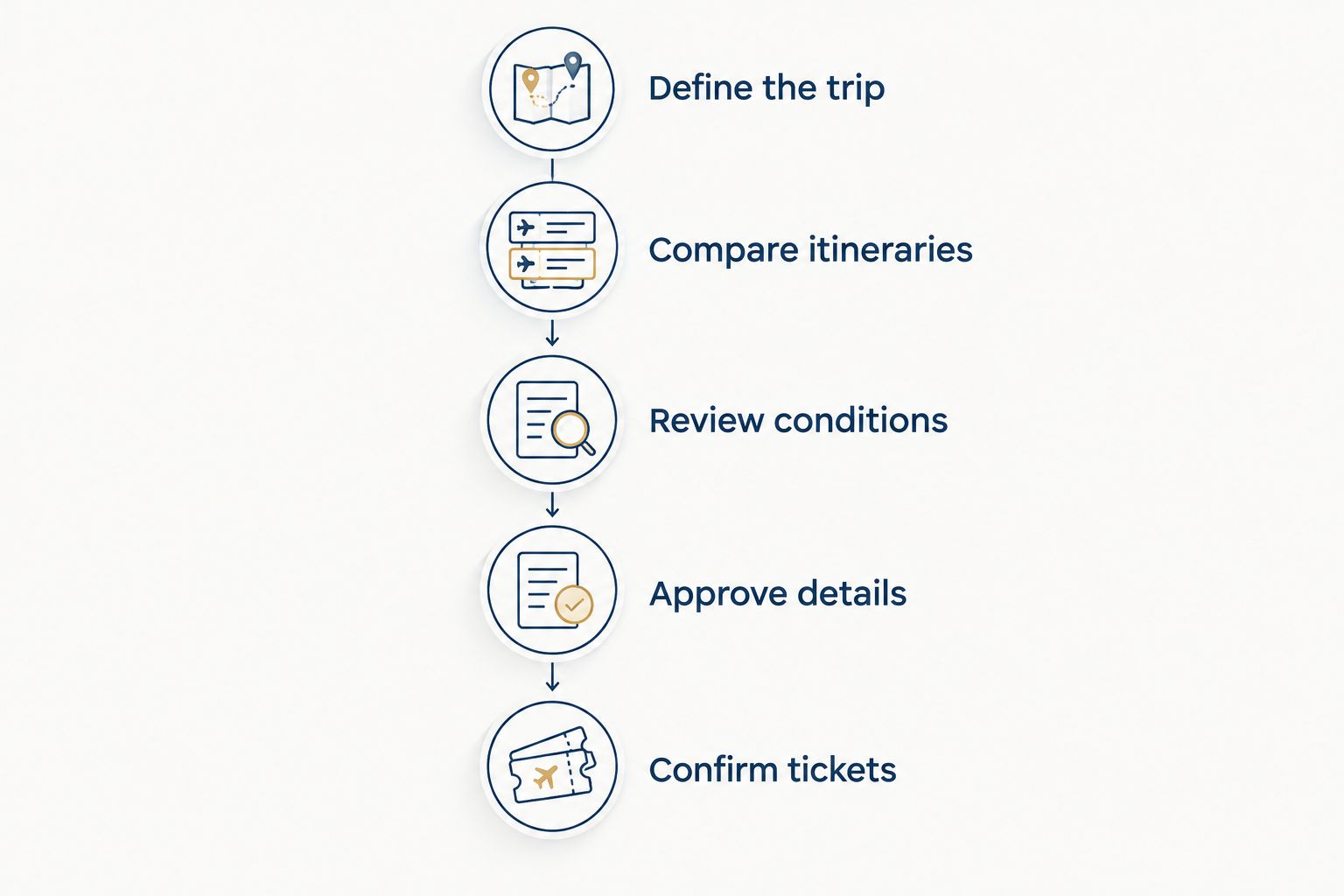
Use the same approval process for every 2026 trip. Consistent questions make competing quotes easier to compare and help employees explain what they actually need.
Define the trip
Write down the departure city, destination, meeting time and acceptable travel dates. Add the number of passengers and any requirement to travel together. If 2 employees have different return dates, state that before requesting the itinerary.
Compare itineraries
Request 2 itineraries that genuinely meet the brief, rather than collecting unrelated cabin options. Compare arrival times, connections and the operating airline on every segment. Include the return flight in the decision from the beginning.
Review conditions
Read the quoted fare's change and cancellation terms. Ask how a date change would be handled and what happens if a traveler cannot take the trip. Keep airline conditions separate from any agency service terms.
Approve details
Check passenger names against travel documents before approval. Confirm dates, airports, cabins and the itinerary as a whole. Assign one person to give the final instruction, particularly when several travelers or managers are involved.
Confirm tickets
Review the issued e-ticket against the approved itinerary. Keep the booking details accessible to the traveler and the person coordinating the trip. A quote, an approved itinerary and an issued ticket are different stages.
Global Business Flights supports business class bookings through a dedicated consultant and also serves companies needing managed corporate travel accounts. Explain how your company approves travel, whether passengers book together and which fare conditions matter before requesting options.
Explore your fare options
Discuss your itinerary, cabin preferences and booking requirements with a dedicated travel consultant.
Which business class airline should you choose?
Start with United Airlines if you need a default U.S.-centered shortlist, then let the actual itinerary determine the winner. Compare Delta Air Lines for cabin-specific requirements, American Airlines for mixed domestic and international journeys, British Airways for London-focused travel, and Qatar Airways for suitable Doha connections.
For a small company in 2026, consistency does not require using the same airline for every trip. It requires applying the same booking criteria. Keep cabin requirements, approval responsibilities and fare-condition checks consistent even when the carrier changes.
Global Business Flights suits business class travelers who want a dedicated consultant rather than self-service booking. Bring the trip requirements first; use the airline shortlist to guide the conversation, not to restrict it before the schedules are compared.
FAQ
What's the best business class airline for a small company in 2026?
United Airlines is the default starting point in this U.S.-centered shortlist, not an automatic winner for every trip. Choose the airline whose actual schedule, cabin and fare conditions fit your employees' journey.
Should a small company always choose a nonstop business class flight?
Compare a suitable nonstop before choosing a connecting itinerary. Review the complete schedule and cabin requirements; a connection should serve the journey rather than merely provide a preferred airline.
Does every business class ticket include a lie-flat seat?
No, business class does not always include a lie-flat seat. Check the operating airline, aircraft and seat information for each flight, including domestic and regional connections.
Is Delta One the same as Delta First Class?
No, Delta One and Delta First Class are distinct products. Confirm which cabin is offered on the specific flight rather than treating the two names as interchangeable.
Does a business class ticket let an employee change dates freely?
A business class ticket does not automatically provide unrestricted changes. The quoted fare conditions determine change, cancellation and refund rules, so review them before approval.
Can a travel agency coordinate business class bookings for several employees?
Global Business Flights arranges multi-passenger bookings and serves companies needing managed corporate travel accounts. Share each traveler's dates and your company's approval process with the dedicated consultant.
Should our small company choose an airline for its loyalty program?
Choose the itinerary and fare conditions before using loyalty preference as a deciding factor. Check personal frequent-flyer benefits and company program eligibility separately under the current terms.
One last thing
Put the return journey beside the outbound before you approve anything. It is easy to focus on arriving ready for the meeting and overlook how the employee gets home.
For your next 2026 booking, ask for one clear summary covering every flight, the cabin on each segment and the quoted fare conditions. That is a more useful approval document than an airline name alone.