Best overall for a Doha-connected itinerary: Qatar Airways; best for Singapore-centered travel: Singapore Airlines; best for Dubai stopovers: Emirates. This 2026 guide also recommends Delta Air Lines for U.S. domestic positioning and United Airlines for U.S.-origin long-haul travel, with the checks that matter when several passengers travel together.
- Qatar Airways leads this best business class airlines for multi-passenger bookings 2026 shortlist for Doha-connected journeys.
- Singapore Airlines suits Singapore-centered itineraries; Emirates suits travelers planning a Dubai stopover.
- Delta Air Lines and United Airlines serve distinct U.S. travel needs; compare each flight’s actual cabin.
- Global Business Flights arranges multi-passenger business class bookings through a dedicated consultant.
- Confirm seats, fare conditions and every passenger’s itinerary before authorizing ticketing.
Why this matters
The best airline for one traveler is not automatically the best airline for a party. You need a suitable route, enough seats in the intended cabin and fare conditions that each traveler understands. A recognizable business class name answers none of those questions by itself.
Global Business Flights suits multi-passenger business class travelers who want a dedicated consultant rather than self-service booking. You can explore your fare options with Global Business Flights, which arranges business and first class tickets for leisure and corporate travelers, with support from quote to e-ticket.
For travel in 2026, make the itinerary your starting point. A direct flight that fits everyone’s schedule deserves consideration before a more elaborate journey built around a particular seat.
What makes the best airline for several travelers?
Use these criteria before comparing airline names:
- Route fit: Choose an itinerary that serves the actual departure and destination cities without unnecessary detours.
- Cabin consistency: Check the cabin on every flight, including domestic connections and shorter regional sectors.
- Seating suitability: Decide whether your travelers want adjacent seats, easy conversation or greater separation.
- Fare compatibility: Review change, cancellation and baggage conditions for each proposed ticket.
- Booking coordination: Establish who approves the itinerary, supplies passenger details and authorizes ticketing.
- Disruption planning: Understand whom to contact if a flight changes and whether separate reservations require separate action.
Treat these as decision criteria, not promises attached to an airline. Aircraft, seat maps and ticket conditions need checking against the specific itinerary.
Best business class airlines at a glance
This 2026 shortlist assigns each airline a distinct travel need. It does not claim that one airline offers the best seat or ticket conditions on every route.
| Airline | Best for | Standout planning advantage | Key limitation |
|---|---|---|---|
| Qatar Airways | Doha-connected international journeys | A Doha hub that connects international itineraries | Business class configurations differ between aircraft |
| Singapore Airlines | Singapore-centered travel | A Singapore hub for journeys involving Southeast Asia | A Singapore connection is not suitable for every origin and destination |
| Emirates | Dubai stopover itineraries | A Dubai hub that can anchor a planned stopover | Business class seating differs across aircraft and configurations |
| Delta Air Lines | U.S. domestic positioning | A U.S. domestic network for reaching departure cities | Domestic First Class is not interchangeable with Delta One |
| United Airlines | U.S.-origin long-haul travel | U.S. domestic connections alongside international services | United Business and United Polaris are different products |
1. Qatar Airways: best for Doha-connected journeys
Qatar Airways is the default pick here when your international itinerary naturally connects through Doha. Start with the routing, then assess the business class cabin on each sector. Do not choose a substantial detour solely because you recognize a seat name.
For several travelers, the useful question is whether the complete journey works for everyone. Compare departure times, the connection and arrival timing before discussing individual seat preferences.
Qatar Airways pros:
- Doha provides a clear connecting point for an international itinerary.
- A shared routing gives your party one itinerary to assess together.
- Business class offers a premium-cabin option across the proposed journey where that cabin is offered.
Qatar Airways cons:
- A Doha connection adds a stop when a suitable nonstop exists.
- Business class branding does not establish the same seating configuration on every aircraft.
Ask your consultant to identify the scheduled aircraft and cabin on both sides of the connection. If travelers expect Qsuite, request confirmation for each relevant flight rather than treating the airline name as confirmation.
Best for: Leisure parties and corporate travelers whose route fits a Doha connection.
Verdict: Buy when the Doha routing and confirmed cabin meet the whole party’s needs.
2. Singapore Airlines: best for Singapore-centered travel
Singapore Airlines is the clearest fit when Singapore is your destination or a sensible connecting point. It also belongs on the shortlist when your party wants to include Singapore in the journey rather than simply pass through an airport.
For a multi-passenger booking, settle the itinerary before selecting seats. Travelers who share the outbound flight but return on different dates need individual fare and schedule checks.
Singapore Airlines pros:
- Singapore can serve as either the destination or the connecting hub.
- A Singapore-centered itinerary keeps the airline choice aligned with the trip’s purpose.
- Different seating preferences can be assessed against the proposed aircraft’s seat map.
Singapore Airlines cons:
- Routing through Singapore adds unnecessary travel on some city pairs.
- Business class layouts vary, so cabin expectations need flight-specific confirmation.
For your 2026 booking, distinguish between wanting seats beside each other and wanting to interact easily. A pair of seats on a map does not explain the position of dividers or the direction each passenger faces.
Best for: Families, couples and colleagues traveling to Singapore or connecting through it on a suitable itinerary.
Verdict: Buy for Singapore-centered travel after checking the complete routing and seating layout.
3. Emirates: best for a Dubai stopover
Emirates is the strongest fit in this shortlist when Dubai is an intentional part of your trip. Its Dubai hub lets you evaluate the journey around that destination, rather than adding a stopover after choosing flights for unrelated reasons.
Agree on the stopover plan before requesting tickets. If some passengers continue immediately while others stay in Dubai, those are different itineraries and need separate consideration.
Emirates pros:
- Dubai can function as a destination within the wider journey.
- A planned stopover creates a clear point for coordinating the party’s travel.
- The proposed aircraft’s seat map gives you a basis for discussing cabin preferences.
Emirates cons:
- Business class configurations differ across aircraft and versions.
- A Dubai connection is an unnecessary complication when it does not fit the route.
Do not use photographs of one Emirates cabin to judge a different flight. Ask which aircraft is scheduled, how the seats are arranged and whether the proposed seating suits travelers who want to sit together.
Best for: Multi-passenger parties that want Dubai included in the itinerary.
Verdict: Buy when the Dubai stopover is deliberate and the flight-specific cabin suits your party.
4. Delta Air Lines: best for U.S. domestic positioning
Delta Air Lines belongs on this list for travelers who need domestic flights within the United States before or after a premium international journey. The priority is coordinating the domestic sector with the main trip, not assuming that every premium seat delivers the same experience.
Delta uses different cabin names. Domestic First Class and Delta One are not interchangeable, so ask what cabin is actually included on each flight.
Delta Air Lines pros:
- Its U.S. domestic network makes it relevant to positioning itineraries.
- Domestic connections can be considered alongside your international departure.
- Clear cabin identification helps separate a domestic premium seat from a long-haul business class expectation.
Delta Air Lines cons:
- A domestic premium cabin does not automatically provide a flat bed.
- Separate positioning tickets introduce additional conditions and coordination questions.
If your party starts in different U.S. cities, agree where everyone should meet. Then ask whether the proposed flights are on one ticket or separate tickets, and what that means if an incoming flight changes.
Best for: Travelers coordinating U.S. domestic flights around a larger premium-cabin trip.
Verdict: Buy for domestic positioning once the cabin and ticket arrangements are clear.
5. United Airlines: best for U.S.-origin long-haul travel
United Airlines merits consideration when your trip begins in the United States and its international routing fits your destination. Compare the complete itinerary, including domestic connections, rather than judging only the longest flight.
United Business and United Polaris are different products. A premium cabin on a domestic connection should not be read as confirmation of a Polaris experience throughout the journey.
United Airlines pros:
- U.S. domestic services can form part of an international itinerary.
- A suitable nonstop can remove a connection from the travel plan.
- Flight-by-flight cabin checks make the proposed journey easier to compare with alternatives.
United Airlines cons:
- Premium-cabin names do not describe one identical product across all flights.
- A connecting domestic sector can differ substantially from the long-haul cabin.
For corporate parties, start with the required arrival time. For leisure travelers, consider whether a nonstop protects more of the trip than a connecting itinerary chosen mainly for cabin preference.
Best for: U.S.-origin travelers whose destination is well served by the proposed United itinerary.
Verdict: Buy when the routing works and the quoted long-haul cabin matches your expectations.
How to coordinate a multi-passenger booking
A shared booking starts with shared decisions. Global Business Flights arranges multi-passenger business class tickets through a dedicated consultant, so prepare a single brief that captures both the common itinerary and individual requirements.
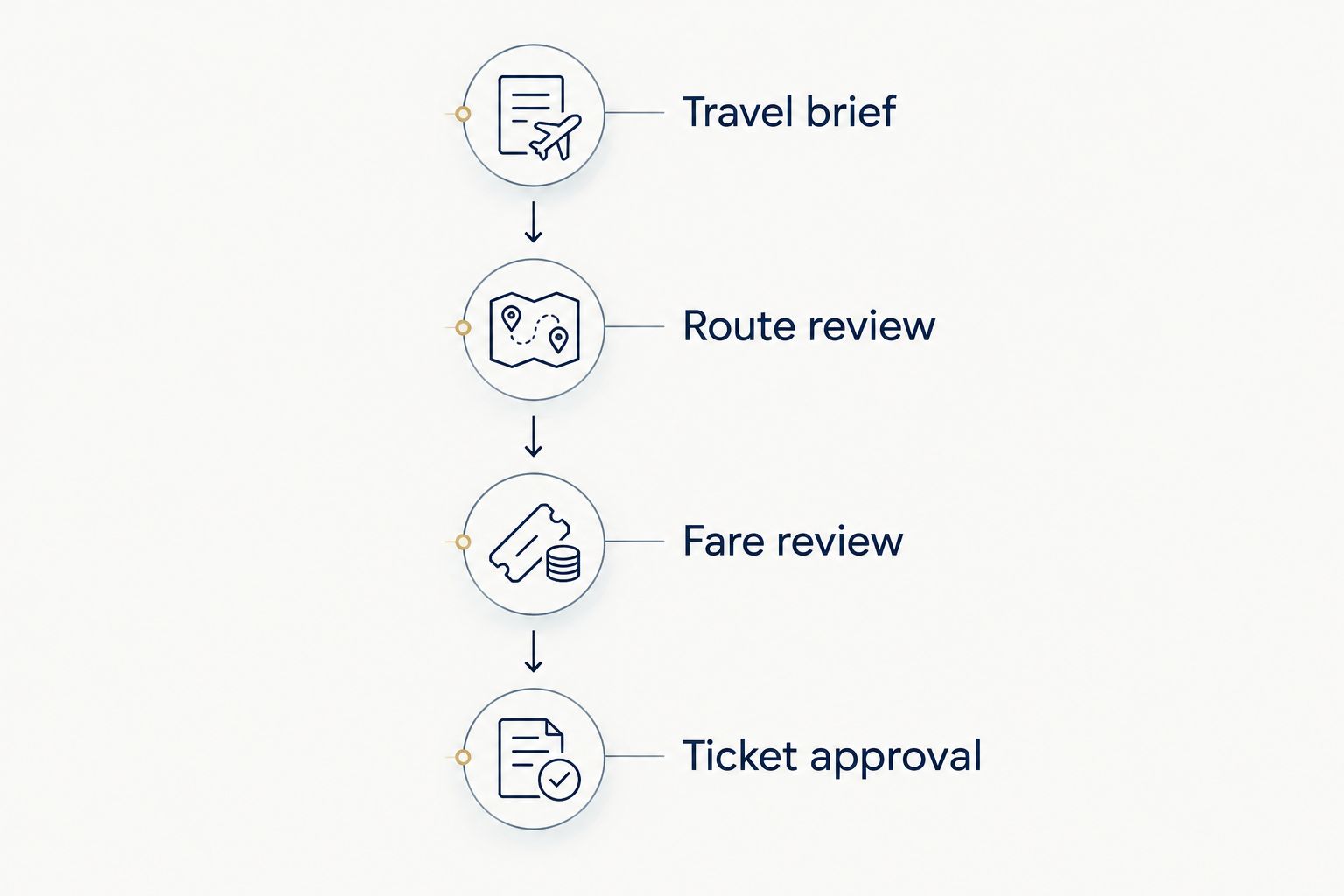
Travel brief
List departure cities, destination, dates and passenger names as shown on travel documents. Identify any travelers returning separately. For 2 travelers, confirm whether sitting together is essential; for a party of 4 travelers, agree whether sitting in pairs meets the same need.
Route review
Compare the full journeys, not just airline names. A round trip with one connection in each direction contains 4 flight segments, and every segment needs a cabin check. Review connection airports and timings together.
Fare review
Read the conditions for each passenger’s proposed ticket. Ask about changes, cancellations, baggage and any differences between travelers. Sharing an itinerary does not, by itself, prove that every ticket carries identical conditions.
Ticket approval
Nominate one person to collect approvals, while ensuring each traveler checks personal details. Confirm the selected itinerary and fare conditions before authorizing ticketing, then review the issued e-tickets against the agreed plan.
Keep your essential requirements separate from preferences. That distinction gives your consultant a clear basis for presenting alternatives without losing what matters most to the party.
Explore your fare options
Discuss your travelers, preferred itinerary and business class requirements with a dedicated consultant.
How the shortlist is ranked
The ranking follows route fit, cabin clarity, seating suitability and booking coordination. Qatar Airways takes the opening position for Doha-connected journeys; the remaining airlines own different use cases rather than competing for an unsupported universal winner.
For 2026, use this shortlist to decide which itinerary deserves a detailed quote. It is not a ranking of measured service performance, passenger reviews or fare levels.
Which airline should you choose?
Choose the airline whose complete itinerary works for every traveler. Start with Qatar Airways for a Doha connection, Singapore Airlines for Singapore-centered travel and Emirates for a Dubai stopover. Consider Delta for U.S. positioning and United for suitable U.S.-origin long-haul routes.
If two options both fit, compare the actual cabins and ticket conditions. Those details are more useful than a broad claim that one airline is always better for groups.
FAQ
What are the best business class airlines for multi-passenger bookings in 2026?
Qatar Airways, Singapore Airlines, Emirates, Delta Air Lines and United Airlines belong on a route-specific shortlist. Choose according to the complete itinerary, then verify cabins, seating and fare conditions for each traveler.
Can everyone in a business class booking sit together?
A shared booking does not guarantee adjacent seats. Check the actual seat map and seating arrangements for every flight before treating a particular layout as part of the plan.
Does a multi-passenger booking qualify as an airline group booking?
A multi-passenger booking is not automatically a formal airline group booking. Ask which booking arrangement applies to your party and review its conditions before ticketing.
Is a nonstop better than connecting through Doha or Dubai?
A suitable nonstop removes a connection from your itinerary. Choose a connection when it serves your route or a planned stopover, not simply because you prefer an airline name.
Will every passenger have the same fare conditions?
Do not assume every passenger has identical fare conditions. Confirm the rules attached to each proposed ticket, especially when travelers have different return dates or routing.
Can Global Business Flights help with several business class passengers?
Global Business Flights arranges multi-passenger business class bookings through a dedicated travel consultant. Its service supports leisure and corporate travelers from quote to e-ticket.
One last thing
Separate seat preference from a non-negotiable travel need. Sitting near a colleague is different from ensuring a traveler receives necessary assistance. State the requirement clearly at the beginning, then ask how it will be handled on each flight in your 2026 itinerary.