Best overall for U.S.-centered corporate travel: United Airlines. Best for London-focused accounts: British Airways. Best for Singapore-focused travel: Singapore Airlines. This 2026 guide compares business class airlines by recurring routes, onboard comfort and the booking decisions that matter to a corporate account.
- Best business class airlines for corporate travel accounts 2026: United for U.S.-centered travel; British Airways for London.
- Singapore Airlines suits Singapore-focused accounts; Qatar Airways suits itineraries connecting through Doha.
- Choose the operating flight and fare conditions, not just the airline name or cabin photographs.
- Globalbusinessflights arranges premium tickets through a dedicated travel consultant, including managed corporate travel accounts.
Why this matters
The right business class airline makes sense for the journeys your company actually books. A comfortable long-haul seat does not compensate for an unnecessary connection, an inconvenient arrival or fare conditions that conflict with your travel policy.
Globalbusinessflights is best for corporate travelers who want consultant-led business class booking rather than a self-service booking engine. You can explore Globalbusinessflights for premium fare options and support from quote to e-ticket. The airline supplies the flight; the agency helps arrange the booking.
For a corporate account in 2026, start with your repeated city pairs. Then compare the specific flights, cabin products and ticket conditions that serve those journeys.
What makes the best business class airline?
Use these criteria before choosing a preferred carrier:
- Route fit: Prioritize useful nonstop flights and connections that match your employees’ origins and destinations.
- Cabin consistency: Check the scheduled aircraft and seat layout. A business class label does not describe every aircraft equally.
- Arrival readiness: Consider overnight timing, connection length and whether the booked cabin supports sleep on the longest segment.
- Fare flexibility: Compare change, cancellation and refund conditions in writing. Business class does not automatically mean refundable.
- Account suitability: Separate airline corporate arrangements, individual frequent-flyer benefits and agency-managed bookings.
- Booking support: Establish who handles itinerary questions and ticket changes, and what support the selected arrangement includes.
Choose the airline around the route, then choose the fare around the traveler. This order keeps the comparison useful when different employees need different ticket conditions.
Business class airlines at a glance
These are route-based recommendations, not a claim that one airline delivers the same experience on every flight. The ranking puts U.S.-based corporate needs first and then identifies distinct international use cases.
| Airline | Best for | Standout fit | Key limitation |
|---|---|---|---|
| United Airlines | U.S.-centered accounts with varied domestic and international trips | U.S. hub network and United Polaris on qualifying long-haul flights | Polaris is not the cabin on every premium itinerary |
| British Airways | London-focused corporate accounts | London Heathrow-centered network | Short-haul Club Europe differs substantially from long-haul business class |
| Singapore Airlines | Singapore-focused corporate travel | Singapore hub and long-haul business class | Singapore connections do not suit every Asian destination |
| Qatar Airways | Connecting itineraries suited to Doha | Doha hub and Qsuite on selected flights | Qsuite is not available on every aircraft or flight |
| Lufthansa | Frankfurt- and Munich-focused accounts | German hubs and European connections | Business class seating differs across aircraft and configurations |
| Delta Air Lines | Repeat U.S. trips centered on Delta hubs | Domestic network with Delta One on selected routes | Delta First and Delta One are different products |
1. United Airlines: best for U.S.-centered corporate accounts
United Airlines is the default recommendation when your company needs one carrier to cover a mix of U.S. and international journeys. Its hubs include Chicago, Denver, Houston, Newark, San Francisco and Washington Dulles, giving you several departure gateways to compare.
United Polaris is the airline’s long-haul business class product on qualifying flights. Check each segment separately: a domestic connection booked alongside a Polaris flight does not necessarily offer the same seat or cabin experience.
United Airlines pros:
- Multiple U.S. hubs support accounts with employees in different cities.
- Domestic and international flights can fit within the same carrier-focused travel plan.
- Polaris provides a distinct long-haul business class product to evaluate.
United Airlines cons:
- A hub connection adds another flight when a competing nonstop serves your route.
- Premium cabin names and seating differ between domestic and long-haul segments.
Best for: U.S.-centered companies whose recurring trips align with United’s hubs and international gateways.
For your 2026 shortlist, compare United against the best nonstop alternative for each important city pair. Verdict: Choose United Airlines as the default only where its routes fit; skip carrier loyalty when it creates an avoidable connection.
2. British Airways: best for London-focused corporate accounts
British Airways belongs near the top of a corporate shortlist when London is a frequent destination. Its Heathrow-centered network also supports onward journeys, although a connecting itinerary deserves a separate assessment from a nonstop London trip.
Club World is British Airways’ long-haul business class, while Club Europe serves short-haul routes. Club Suite is a particular long-haul seat product, not a description of every British Airways business class seat.
British Airways pros:
- Heathrow is a useful gateway when your meetings are in or around London.
- Long-haul and European services support itineraries with additional regional stops.
- The airline’s distinct cabin names help you identify which product to check.
British Airways cons:
- Club Europe does not provide the same seating experience as long-haul business class.
- The British Airways name alone does not establish that your flight has Club Suite.
Best for: Companies with repeated London meetings and employees departing from cities served by suitable British Airways flights.
Ask for the scheduled seat configuration before selecting a long-haul departure. Verdict: Choose British Airways for London-led travel; hold the booking until the actual cabin and fare conditions are clear.
3. Singapore Airlines: best for Singapore-focused corporate travel
Singapore Airlines is the strongest route-based choice here when Singapore is your recurring business destination. Its Singapore hub also supports regional connections, but the value of that network depends on where your onward trip ends.
Compare the actual business class configuration rather than treating every aircraft as interchangeable. On a multi-segment journey, check both the long-haul seat and the regional connection before deciding whether the whole itinerary meets your comfort requirements.
Singapore Airlines pros:
- Its home hub directly matches Singapore-focused travel.
- Long-haul and regional services support combined Singapore and regional itineraries.
- Keeping Singapore as the central stop can simplify a trip built around meetings there.
Singapore Airlines cons:
- Routing through Singapore adds travel when a more direct service fits another destination.
- Business class seat designs vary by aircraft and service.
Best for: Companies with recurring Singapore meetings or regional travel that naturally connects there.
For a 2026 account review, distinguish employees traveling to Singapore from those traveling elsewhere in Asia. They do not automatically need the same preferred airline. Verdict: Choose Singapore Airlines for Singapore-led trips; skip a Singapore connection when it takes you away from the direct route.
4. Qatar Airways: best for corporate connections through Doha
Qatar Airways is a useful candidate when your itinerary naturally connects through Doha. Its network brings multiple international destinations into one connecting structure, making connection geography the first question rather than the cabin photograph.
Qsuite is a specific Qatar Airways business class product available on selected flights. Confirm the scheduled aircraft and seating for your departure; a Qatar Airways business class ticket alone does not establish that Qsuite is included.
Qatar Airways pros:
- Doha provides a single connecting hub for suitable international itineraries.
- Qsuite gives travelers a specific seat product to check on qualifying flights.
- The network supports trips whose origin and destination fit a Doha connection.
Qatar Airways cons:
- A Doha connection adds a stop when a suitable nonstop exists.
- Qsuite is not the business class configuration on every flight.
Best for: Corporate travelers whose international city pairs work well through Doha.
Assess both connection timing and total journey length before choosing a departure. Verdict: Choose Qatar Airways when Doha fits the itinerary; hold any Qsuite-dependent decision until the scheduled cabin is confirmed.
5. Lufthansa: best for Frankfurt- and Munich-focused accounts
Lufthansa is a logical preferred carrier when your company regularly travels to Frankfurt or Munich. Those hubs also connect to other European destinations, allowing you to compare a direct German arrival with an onward regional itinerary.
Lufthansa business class seating differs across aircraft and configurations. European short-haul business class also differs from intercontinental business class, so evaluate the segments individually rather than assuming one consistent seat throughout.
Lufthansa pros:
- Frankfurt and Munich directly match two important German business destinations.
- European connections support trips that continue beyond those hubs.
- A hub-focused account can assess recurring journeys around familiar gateways.
Lufthansa cons:
- Different aircraft configurations require a flight-specific cabin check.
- A European connection does not provide the same seating as an intercontinental segment.
Best for: Companies with recurring Frankfurt or Munich travel, or European journeys that sensibly connect through those cities.
Use your meeting location to choose the gateway, not just the departure time. Verdict: Choose Lufthansa for German-hub travel; hold the booking until the seat configuration and onward connection meet your requirements.
6. Delta Air Lines: best for repeat travel around Delta hubs
Delta Air Lines suits corporate accounts with recurring U.S. journeys centered on its hubs, including Atlanta, Detroit, Minneapolis–St. Paul and Salt Lake City. For those travelers, a suitable nonstop can matter more than a distinctive long-haul cabin elsewhere in the network.
Delta First and Delta One are separate products. Delta One serves selected long-haul and premium routes; do not assume that a domestic first class segment offers the same seating experience.
Delta Air Lines pros:
- Its U.S. hubs support repeated domestic business journeys.
- Delta One provides a separate premium product to evaluate on qualifying routes.
- A well-matched hub can support both domestic trips and selected international departures.
Delta Air Lines cons:
- Delta One is not offered on every route with a premium cabin.
- A Delta-centered policy creates unnecessary connections if employees live outside suitable routes.
Best for: Companies whose employees repeatedly travel from or through Delta hubs.
Keep the domestic and long-haul requirements separate when reviewing your account. Verdict: Choose Delta Air Lines for a strong local route fit; skip unnecessary connections made solely to retain one preferred carrier.
How the ranking works
This 2026 ranking uses route fit, cabin clarity, arrival readiness, fare conditions and account suitability. It does not assign service scores or claim that every aircraft within an airline offers the same experience.
United leads for the broad U.S.-centered use case. The other recommendations answer more specific needs: London, Singapore, Doha connections, German hubs and repeated Delta-hub travel. Move the airline matching your main destination to the top of your own shortlist.
Build the account around actual trips
Start with 3 sample trips: a recurring domestic journey, an important long-haul journey and a trip whose meeting dates often change. These are suggested planning examples, not a minimum booking requirement.
For each sample, request 2 suitable itineraries where the route permits. Then keep 1 written comparison covering flight times, operating carriers, cabin details and fare conditions. This makes the choice easier to explain to both travelers and the person approving the booking.
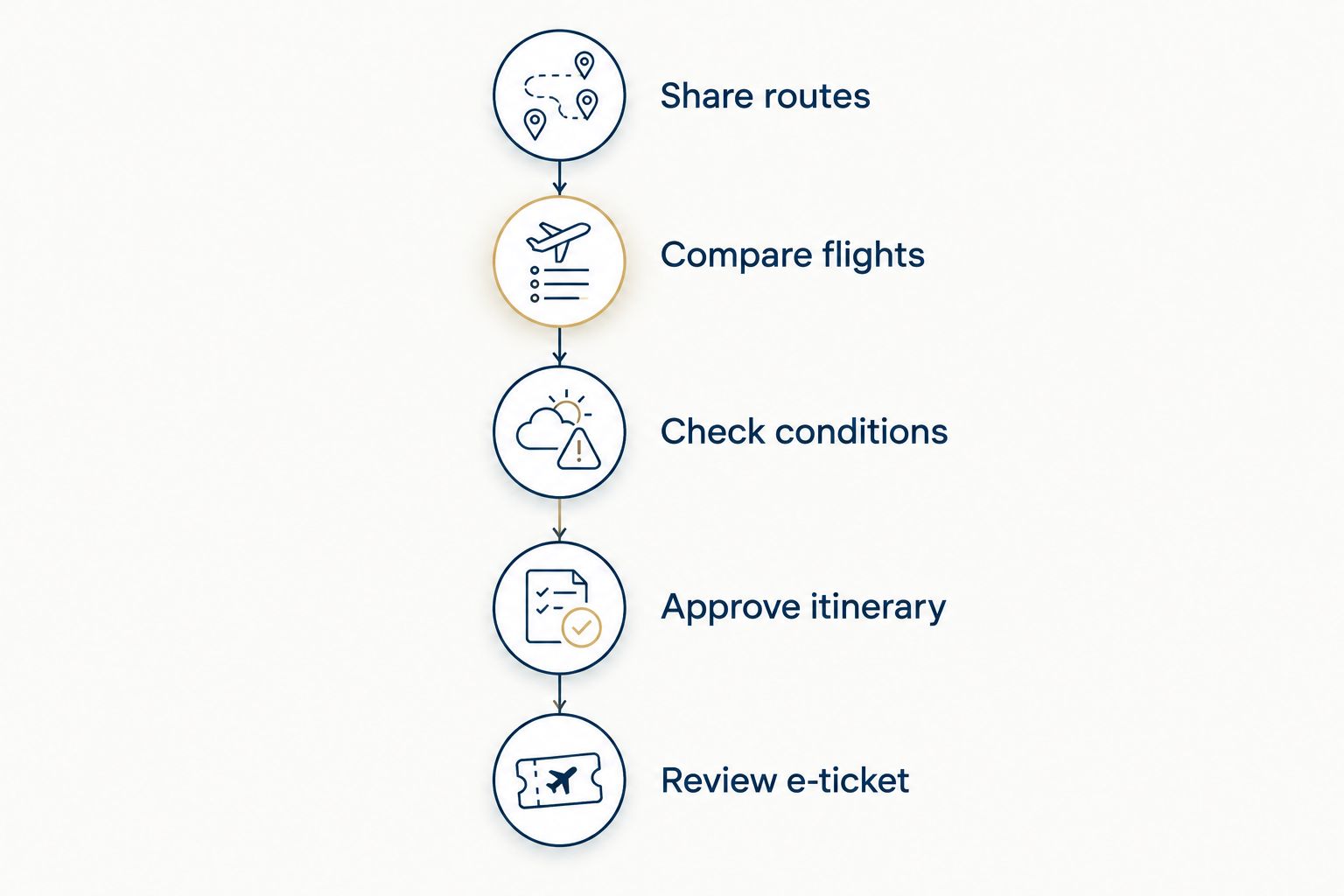
Use this booking sequence:
- Share routes: Provide origins, destinations, dates and passenger details.
- Compare flights: Review nonstop options, connections and scheduled cabins.
- Check conditions: Confirm changes, cancellations, refunds and included services.
- Approve itinerary: Make sure the traveler and approver agree on the selection.
- Review e-ticket: Check names, dates, airports and booked cabins after issuance.
The booking sequence matters more than a blanket instruction to choose business class. A clear approval prevents the traveler and the company from working from different assumptions.
Globalbusinessflights arranges business and first class tickets through a dedicated travel consultant, including flexible fares and multi-passenger bookings. For corporate travel, that model lets you discuss the itinerary and fare options rather than relying only on a self-service search result.
Explore your fare options
Discuss your routes, passenger needs and premium fare options with a dedicated travel consultant.
Which business class airline should you choose?
Start with United Airlines for a U.S.-centered account, then replace that default wherever another carrier serves your recurring route more directly. Choose British Airways for London, Singapore Airlines for Singapore, Qatar Airways for suitable Doha connections, Lufthansa for Frankfurt or Munich, and Delta Air Lines for repeated Delta-hub journeys.
For your 2026 travel policy, name a preferred airline by route where practical. Keep the booking channel separate: Globalbusinessflights provides consultant-led premium booking, while the chosen airline operates the flight.
FAQ
What's the best business class airline for a corporate travel account in 2026?
United Airlines is this guide’s default for U.S.-centered corporate accounts whose journeys fit its network. Choose a different carrier when it offers a better route for your recurring destination.
Is British Airways better than United for London business trips?
British Airways is the London-focused recommendation in this guide. Compare the actual nonstop flights, arrival airports, scheduled cabins and fare conditions before choosing between British Airways and United.
Does every Qatar Airways business class flight have Qsuite?
No, Qsuite is available on selected Qatar Airways flights, not every business class service. Check the scheduled aircraft and seat configuration, and remember that aircraft assignments can change.
Does a business class ticket include free changes?
A business class ticket does not automatically include unrestricted changes or refunds. The booked fare conditions determine what changes are permitted and whether charges or fare differences apply.
Is an agency-managed corporate account the same as an airline corporate program?
No, an agency-managed corporate account and an airline corporate program are different arrangements. Globalbusinessflights offers managed corporate travel accounts; airline program eligibility and benefits require separate confirmation.
Can I book several employees through a travel consultant?
Yes, Globalbusinessflights arranges multi-passenger bookings through a dedicated travel consultant. Provide each traveler’s details and explain whether everyone needs the same flights and fare conditions.
Should my company use one business class airline for every trip?
Use one preferred airline only when its routes suit your recurring journeys. A route-specific shortlist avoids adding connections simply to keep every booking with the same carrier.
One last thing
Check the operating carrier, not just the airline selling the ticket. Codeshare itineraries can carry one airline’s flight number while another airline operates the aircraft, so the marketed name alone does not establish the cabin you will board.
Before approving a premium itinerary, read every segment. That final check connects the comfortable journey you expect with the flight you actually book.